Contents
- Getting started
- Controls
- The map and sailing
- Ships at sea
- Ports
- Governors’ families
- The Information screen
- Sea battles
- Sword fights
- Land battles and towns
- Prizes, prisoners and fame
- The living world
- Treasure and your family
- Prison
- Retirement and the Hall of Fame
- Famous expeditions
- Achievements and the weekly challenge
- The worlds
- Rivers and canoes
- Languages
- Options
- Saves
- Tips for a first career
- Glossary
Getting started
Letters of Marque is a game of sail and sword. You are a young captain with one ship, a small crew and a little gold from your backers. You carry a letter of marque, your nation’s license to take the ships of its enemies. From there your career is your own: trade, hunt pirates, take prizes, storm towns, serve a governor for rank and land, court someone of his house, search for your lost family, and retire before your health gives out. The game remembers your best careers in the Hall of Fame.
Installing and updates
Letters of Marque is a Windows game, coming soon to itch.io. When it is out, download the installer from its itch.io page and run it. If Windows SmartScreen warns about an unknown app, choose More info, then Run anyway.
- The game plays offline. There is no account and nothing to sign in to.
- About 15 seconds after the window opens, and every six hours after that, the game asks the XN3 Technologies update server in Frankfurt, Germany, whether a newer version is out. If one is, a small window asks whether to Download now or Later. Once it has downloaded, choose Restart now or When I close the game. The update installs by itself and keeps your saves and settings. The first start after an update shows what is new.
- F11 switches full screen on and off. The game remembers the window’s size and place.
The first start: your language
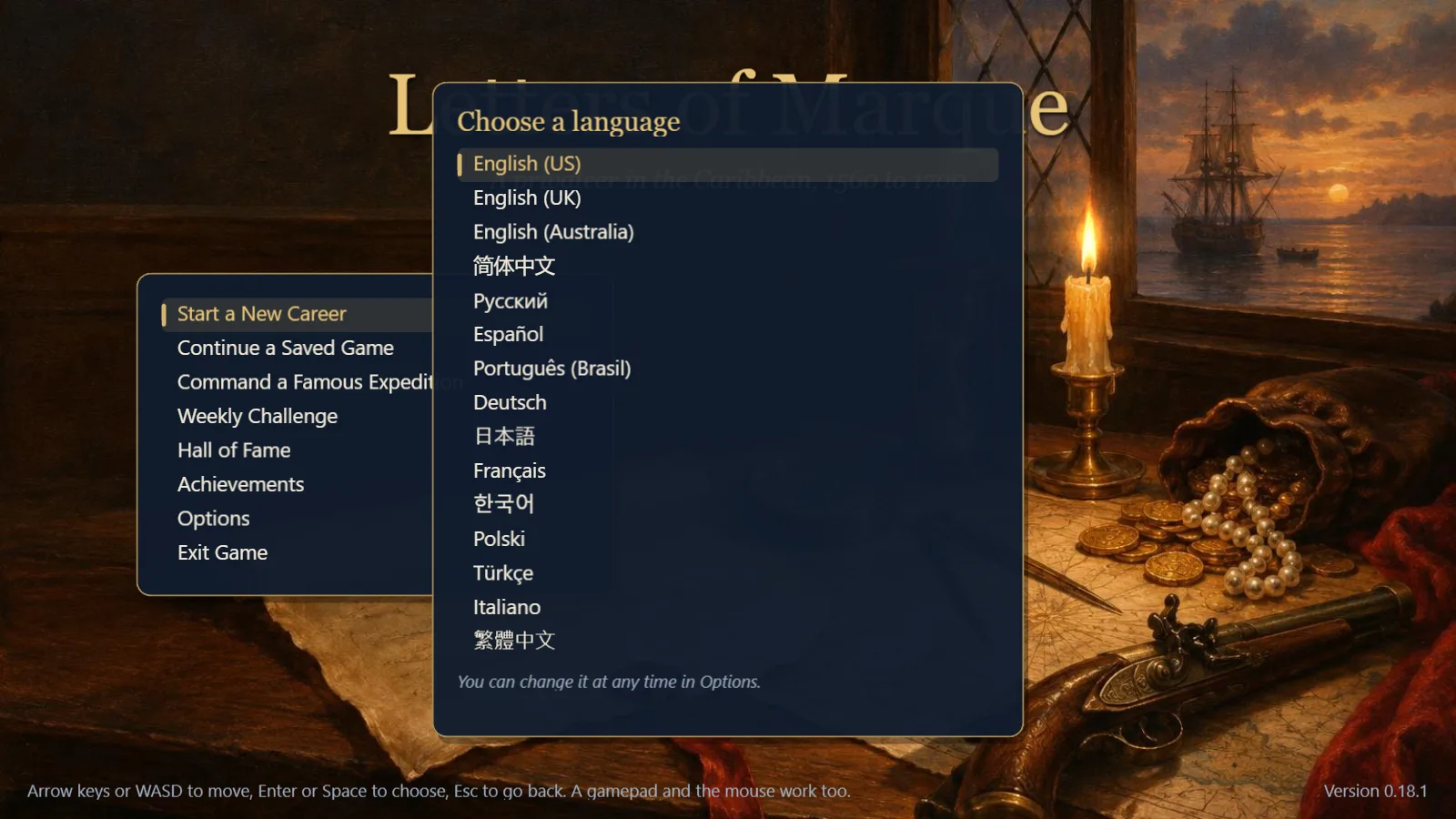
The very first time the game starts, it asks for your language. Each language is shown in its own name, and the one your computer uses is already highlighted, so Enter or Esc keeps it. You can change it at any time in Options.
The main menu
- Start a New Career begins a new captain’s life.
- Continue a Saved Game opens the autosave, the five save slots, or a save file you exported.
- Command a Famous Expedition plays a short scenario from history (see Famous expeditions).
- Weekly Challenge is the same start for every captain this week (see Achievements and the weekly challenge).
- Hall of Fame lists your retired captains, best first.
- Achievements shows the goals you have earned in all your careers.
- Options holds the language, the classic rules, sound, text size, the screen settings, keys and sword practice.
- Exit Game closes the game.
The version number is at the bottom right of the main menu, and on the Information screen. Please give it if you write to us.
A new career
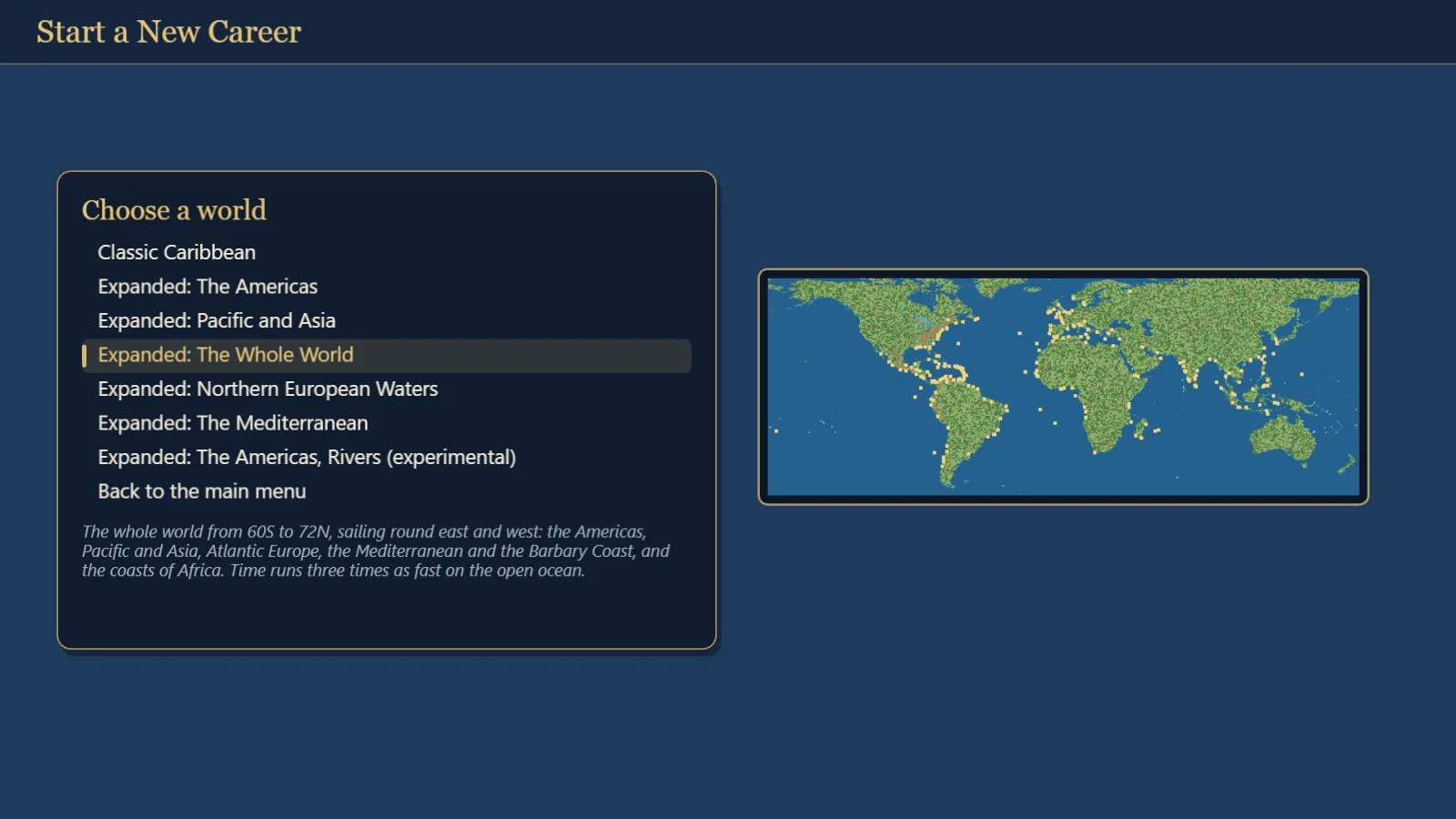
A new career takes a few short steps. Back, Esc or B on a controller goes back one step.
- The world. The Classic Caribbean is first and is the place to start. Six wider worlds follow (see The worlds).
- The period. The game asks whether you wish to choose a special historical period. No starts in the world’s usual year (1660 in the Caribbean). Yes lists the eras, each with its own towns, owners, wars and ships.
- Your nationality. In the Caribbean: English Buccaneer, French Buccaneer, Dutch Adventurer or Spanish Renegade. The Dutch have no role in 1560. Your nation decides where you begin, your ship, crew and gold, who welcomes you, and whose ships are lawful prizes.
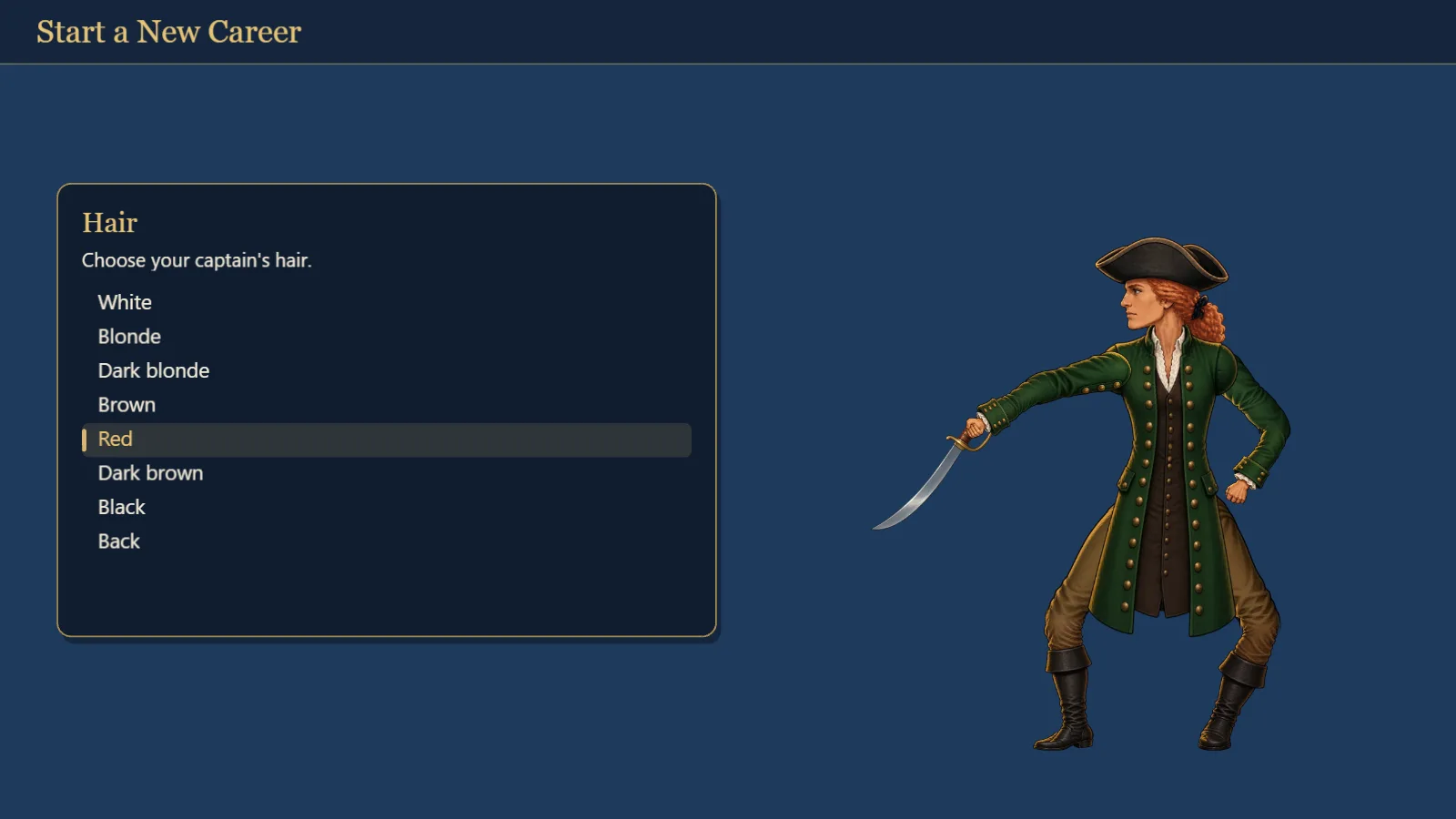
- Your captain. In the Classic Caribbean your captain is a man: choose one of five complexions (Light, Tanned, Golden, Medium, Dark) and one of seven hair colors, and you see him this way in every sword fight. In the wider worlds the Your Captain window designs your captain in one place (see below).
- Your name. Type a name, then choose Done, or let the game pick one. Names have at most nine letters unless you turn that rule off in Options.
- Whom to meet, and romance (wider worlds only). In each governor’s house you may meet a lady or gentleman of his household, or his sister or brother. Choose ladies, gentlemen or either, and whether romance is possible or you stay friends only. In the Classic Caribbean you meet governors’ daughters.
- The difficulty. Apprentice, Journeyman, Adventurer or Swashbuckler. Each row shows your share of the plunder at that level (see the table below).
- A special skill. One of five, for the whole career (see the table below).
- The opening question (only if you turned it on in Options). Your backers ask when the Treasure Fleet or the Silver Train reaches a town. The answer is in the Almanac. A right answer starts you with a happy crew and more gold.
Your Captain (wider worlds)
The window shows your captain’s portrait beside a list of rows. Each row shows a picture and its number, such as 3 of 12:
- Captain: the male or the female symbol.
- Skin tone and hair color: nine swatches each, grey and auburn among the hair colors.
- Head and hair style: twelve of each. Under headwear the hair is drawn as it sits under a hat.
- Beard (men only): eight mustaches and beards of the period, or None.
- Headwear: twelve period hats, caps and scarves, or None.
- Outfit: eleven dresses: the captains of the seven peoples of the wider worlds, and the European officer, merchant, soldier and pirate. It starts as the dress of your own people. Your portrait wears its coat, and your figure wears it in every sword fight, with your head, hair, beard and headwear drawn to match.
Some things were not worn together, such as a long beard with a full periwig, or loose hair under a coif. Such a choice is crossed out with the reason, and a clashing choice sets the other row to None with a note. Random picks a whole look; change any row after it. Done goes on. Keys: ↑ and ↓ choose a row, ← and → change it, R random, Enter done, Esc back. On a gamepad: X random, A done, B back, LB and RB the captain.
Your portrait then appears on the Personal page of the Information screen, before governors, in taverns, with your family, at retirement and in the Hall of Fame. A career saved before the window existed gets a look from its earlier choices.
Last comes Your career begins: the year, who you are, where you start, and your ship, men, food and gold. Choose Set sail, or Take a fencing lesson first for two minutes with a fencing master.
Difficulty
The level is the quality of your officers. Good officers help you a great deal but take most of the officers’ part of the plunder. At Swashbuckler your officers are no help at all, and their shares are yours.
| Apprentice | Journeyman | Adventurer | Swashbuckler | |
|---|---|---|---|---|
| Your share of the plunder | 5% | 10% | 15% | 20% |
| Officers warn of low food, morale and health | Yes | Yes | No | No |
| Sailing master estimates longitude | Yes | No | No | No |
| The enemy’s coming blow is named for you | Yes | Yes | No | No |
| Time to strike after a parry (riposte) | 1.14 seconds | 0.97 seconds | 0.83 seconds | 0.68 seconds |
| Time alone to beat the other leader when your men break or fall | 17 seconds | 12 seconds | 8 seconds | 6 seconds |
| Clean hits that beat him in a lone stand (wider worlds) | 6 | 5 | 6 | 7 |
| Sailing master asks before you attack a friend | Yes | Yes | Yes | No |
| Warning before a flight that costs fame | Yes | Yes | No | No |
| Limited shot in land battles | No | No | Yes | Yes |
| Sea battles begin at sunrise | Yes | Yes | No: at any hour up to mid-afternoon | No: at any hour up to mid-afternoon |
The easier levels also give you quicker reloading and truer broadsides, quicker gunners and handier ships in battle, slower and clumsier enemy swordsmen, lighter losses ashore, lighter wounds, and a crew whose spirits fall more slowly. You can change the level at the start of each new voyage, after you divide the plunder.
Special skills
| Skill | What it does |
|---|---|
| Fencing | Enemy actions seem slower in a sword fight: you see each blow coming a little longer. |
| Navigation | Your ships sail faster and closer to the wind, and gain more from storm winds. |
| Gunnery | Your broadsides are more likely to hit, your gunners reload faster, and your musketeers aim truer ashore. |
| Wit and Charm | Governors and people of high station deal with you more kindly, and your crew stays in better spirits. |
| Medicine | Your health lasts longer and wounds hurt less, so your career lasts longer. |
Your first voyage in brief
- In port, visit the governor for the news, then the tavern for more men.
- Choose Make ready to sail (R): repairs, waiting recruits and food in one step.
- Leave Town. Click a port on the map to set a course, or steer with the arrow keys.
- When the lookout cries Sail ho!, look her over. Merchants are rich and weak. Leave stronger ships alone at first.
- Close for battle, board her, and win the sword fight on her deck.
- Sell her cargo in a friendly port, then Divide up the Plunder before the crew grows angry.
With the first-voyage guide on (Options), your mate suggests the next step at the bottom of the screen, in port and at sea. Click his note away when you have read it. The guide turns itself off once one of your careers reaches the Hall of Fame.
Controls
Every screen works with the keyboard, the mouse or a gamepad. The game reads where a key sits on the keyboard, not the letter printed on it, so the letter keys work on every layout. On a French keyboard, for example, Z Q S D move.
Menus
- Arrow keys or W A S D move. Enter or Space chooses. Esc or Backspace goes back.
- With the mouse, point at a row and click it. The line under a menu explains the row you point at.
- Menus with tabs (the expeditions, the Information screen) change tab with left and right.
On the map
| Key | At sea | Ashore |
|---|---|---|
| ← → or A D | Turn the bow | Walk west or east |
| ↑ or W | Set sail from anchor; under way in the expanded worlds, make more sail | Walk north |
| ↓ or S | Under way in the expanded worlds, shorten sail a step: two thirds, one third, then heave to (no headway; time passes and ships may still find you) | Walk south |
| Tab, P or Esc | The pause menu | |
| M | The Information screen, at its map | |
| F | Time speed: 1x, 2x or 4x (faster time works only in open water) | |
| Z | Map zoom: 70%, 100% or 140% | |
| O | Open-ocean sailing, in the worlds that let you choose it | |
| N | At Apprentice and Journeyman, the sailing master names the nearest port (see The nearest port) | |
| B | In the wider worlds, the sailing mode: Brazen, Normal or Evasive (see Sailing modes) | |
| V | In the wider worlds, rations: full, short or half (see Rations) | |
| Enter | Resume a paused course | |
With the mouse, click a port to set a course for it, click a ship you have identified to close with her, or click anywhere else to steer there. Click the flagship panel at the top right to open the Fleet menu. In the canoes, up and down row up and down the river and Enter stops (see Rivers and canoes).
A gamepad
| Button | Does |
|---|---|
| Left stick or d-pad | Steer, walk, move through menus, row |
| A | Choose, fire, stop the canoes |
| B | Back |
| Start | The pause menu |
| Y | Time speed |
| X | Change the aim in a sea battle |
| Back (View) | On the map in the wider worlds, the rations |
In a sea battle
- ← → steer.
- Q (or ↑ ↓) changes between full sail and battle sails.
- Space fires the broadside on the side facing the enemy. Hold it to fire the moment the guns are loaded.
- X changes the aim. Z zooms closer, wider or back to the usual view; in a fight at sea the view widens on its own to keep both ships in sight. Esc pauses.
- With the mouse: click the water to steer for that spot, right-click (or the Fire! button) to fire, and use the Sails and Aim buttons.
In a sword fight
Choose the classic or the modern keys in Options. The classic keys are the default.
| Action | Classic keys | Modern keys |
|---|---|---|
| Attack | ← (toward the enemy) | Space or ← |
| Slash | Hold Space from before you push ← until the blade lands | Hold Shift as you attack, until the blade lands |
| Height | Hold ↑ for high, ↓ for low, neither for the middle | |
| Parry | Push no left or right: you parry at the height you hold | Whenever you are not attacking, you parry at the height you hold |
| Back away | →, away from the enemy, parrying as you go | |
| Pause | Esc, P, Tab or Start; press again to go on | |
| Gamepad | The stick or pad as the arrow keys, A as Space | The stick or pad picks the height, left attacks and right backs away; A attacks and B held slashes |
The mouse works too. Hold a square of the pad at the top right: the left column attacks, the middle parries and the right backs away, each at its height. Hold the right mouse button on the left column until the blade lands for a slash.
If you let go of the slash too soon, your slash becomes a standard attack at the same height.
In a land battle
- Space picks the next group, then all groups after the last. 1 to 3 pick a group, and 4 picks all.
- The arrow keys march the picked men in eight directions.
- With the mouse, click a group or its card to pick it (the All groups card picks every group), then click the field and the men march there, keeping their places.
- Esc pauses.
Trading and the Information screen
- At the merchant, up and down (or the mouse wheel, or a click on a row) choose a good. ← buys one and → sells one; hold to keep going. Shift buys or sells ten, Ctrl all you can. The arrows on each row do the same with a click. X sells all goods. Esc when you are done. On a gamepad: the d-pad or the stick, a shoulder button for ten, a trigger for all, Y to sell all goods and B when you are done.
- On the Information screen, left and right change the page, up and down or the mouse wheel scroll, and Esc closes it.
Your own keys
Options, Keys lists every action with its keys. Choose an action and press a key: it becomes the first key for that action and is taken from any other. Reset all keys puts them back.
The map and sailing
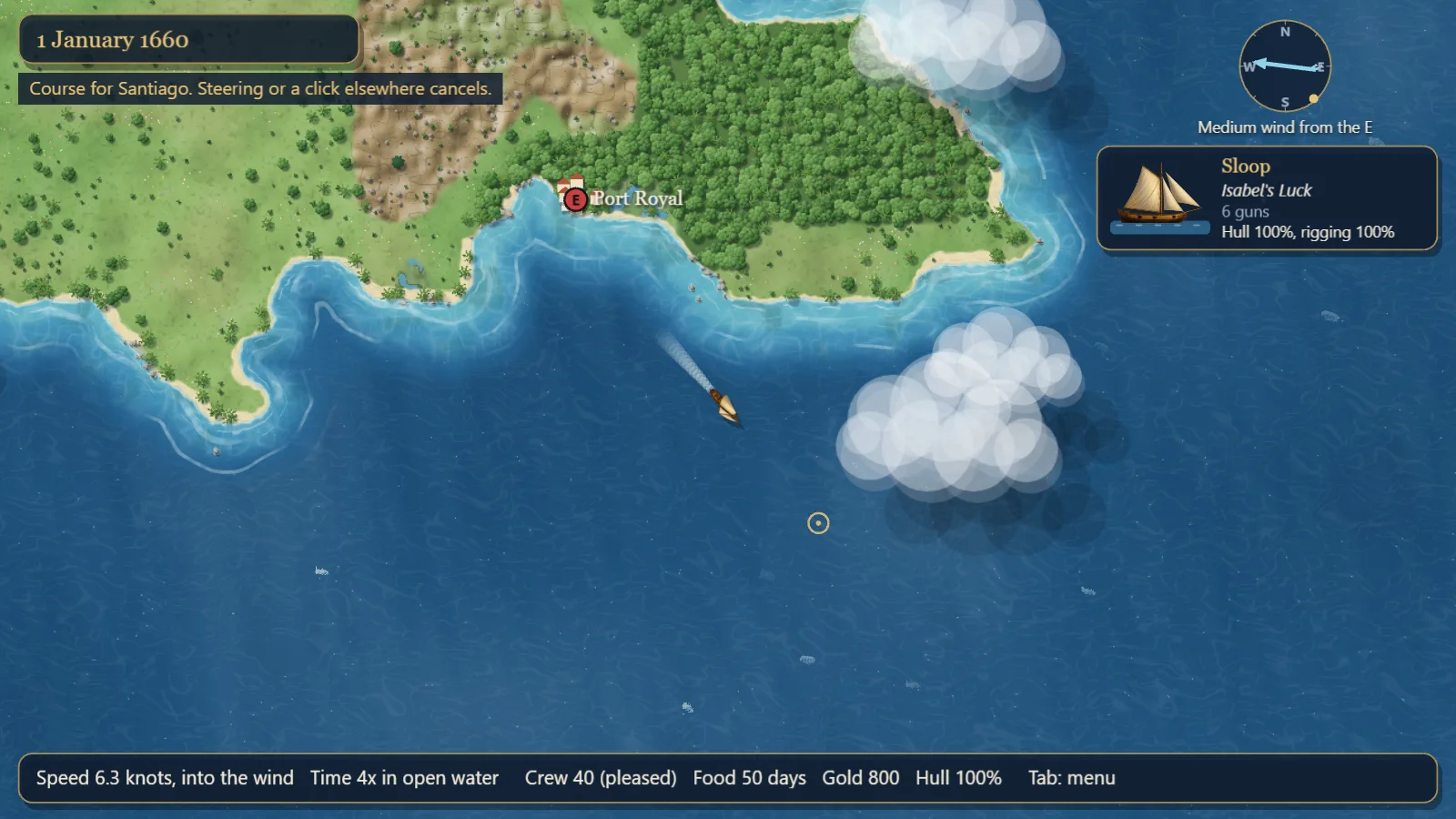
The screen
- Top left: the date, and under it the course you are on.
- Top right: the wind dial. The arrow shows where the wind blows, and the words say its strength (light, medium or strong) and where it comes from. Under it, the flagship panel: her type, name, guns, hull and rigging, and her picture as damaged as she is. Click it to open the Fleet menu.
- Bottom: the status bar: the sail you have set (in the expanded worlds), your speed and point of sail, the time speed, the crew and its mood, days of food, the gold in the voyage treasury, and the hull.
- Towns show their nation’s initial and their name. Ships you meet appear as they come into sight.
Sailing with the wind
Your ship sails where her bow points, as fast as the wind lets her. In the Caribbean the trade winds blow mostly from the east, shifting in direction and strength. The status bar names your point of sail:
- Running before the wind: the wind dead astern. Fast, but not the fastest.
- Broad reach: the wind over the quarter, from behind and to one side. Usually the fastest.
- Beam reach: the wind across the side.
- Close-hauled: as close to the wind as the ship can point. Slow.
- Into the wind: closer than she can point. Barely moving, except for the ships that row.
Square-rigged ships (galleons, frigates, merchantmen, fluyts) point no closer than about 67 degrees off the wind. Fore-and-aft rigs (the barque, sloop and pinnace) point to about 45 degrees and can row slowly into the wind. Small ships do best in a light wind, big ships in a strong one, and big ships lose the most speed sailing toward the wind. A damaged hull or rigging slows a ship, and a fleet sails at the pace of its slowest ship. At Apprentice and Journeyman the map eases part of the upwind slowdown.
Courses
Click a port on the map and your ship sets a course for it. On a course she finds her own way, beating to windward on the better tack when the port lies upwind, and long courses follow the season’s winds. Encounters and landfalls pause the course; Enter resumes it. Steering, or a click anywhere else, cancels it.
Time and zoom
A day passes in about twenty seconds. F runs time two or four times as fast, but only in open water. Z zooms the map.
Storm fronts
The clouds on the map are storm fronts. Under one the wind blows much stronger, and the status bar says your speed is in storm wind. Clouds drift with the wind, so a captain can chase one for speed. The Navigation skill gets even more out of them.
Shoals and reefs
The fluyt, the sloop and the pinnace have a shallow draft and cross shoals safely. A deeper ship that strikes a reef is damaged, and may break up. If your flagship is wrecked, you lose health and spend months with the people of the coast before you reach a town.
Narrow waters and pilots
A ship that meets the shore at a shallow angle slides along it instead of stopping, so you can follow the bank of a channel or a river mouth. Steer nearly straight at the land to make landfall. A town is passed by the same way only when you brush it along the shore; steer for it and you come to it.
In the wider worlds, a pilot helps you into a port a dozen miles off or less. Sailing by hand, he comes aboard when you run head on into the shore near a port you are heading for, instead of the landfall; sail past a port and none comes. On a course, the port you are bound for sends him as you come near. He takes your ship in along the channel at her best pace, or towed by his boats when the wind is foul. Touch the helm and he leaves at once; that port sends no pilot again until you are clear of its waters, and neither does the port you just left. When you must turn right round in tight water, shorten sail or heave to first, so she turns where she lies. No pilot comes out from an anchorage, a native village or a small settlement of fewer than 1,500 people: there you take her in yourself. A few of those small places are hard to reach. At those your sailing master takes the helm instead and guides her in carefully, a little slower than a pilot would. He leaves at a touch of the helm, as the pilot does, and gives no advice; you only see a notice that he has the helm.
Landfall and going ashore
Ashore, Wait here in the pause menu camps where you stand until something happens, a month at most: the men eat, and the wait ends if food runs short. Walking back from a town to ships anchored near it, you are asked once about the ships; stay ashore and you can walk on into the town. Near the ships, walk down to the water to be asked again, or choose Return to the ships in the pause menu. Sail onto a coast and your ships anchor in the shallows. The landfall dialog offers to Forage for food and water for a few days on a wild coast, to Go ashore, or to stay aboard. Ashore, walk with the arrow keys or click where to go. Walk into a town, or back to your ships to Return to the ships. On a few coasts wild cattle roam, and each day ashore there adds to your food.
Some islands and stretches of coast have no people at all. At such an anchorage you can Take on food and water, or Careen a ship: choose the ship, then her hull, her sails and rigging, or both. The men first gather timber and stores on the island for some days, then haul her down on the beach, scrape and patch her. The dialog shows how far the timber here will take her and how many days it costs before any day passes, and the men eat their food all the while. They stop when the food runs out, so take on food and water first for a long job. A store too small to mend her even a little is not offered. In the wider worlds a painting of the island heads its menu.
The wider worlds have anchorages where the voyagers of the age took on water and food or careened their ships: Port St. Julian, Port Desire, Port Famine and Good Success Bay on the way round South America, the Falkland Islands, Santa Catarina, Fernando de Noronha, Trindade and Tristan da Cunha in the South Atlantic, Grand Cayman for its turtles, Coiba, San Lucas Bay, Cedros Island and Drakes Bay on the Pacific coast, Shark Bay and King Sound in New Holland, Pulo Condore, the Seychelles, Rodrigues, the Keeling Islands, St. Paul Island and Antongil Bay on Madagascar in the Indian Ocean, and Table Bay, Mossel Bay and Port Natal on the coast of Africa. Each stands from the era in which the accounts first put ships there: the Falklands from the 1680s, when John Strong landed, and Table Bay under Table Mountain until the Dutch found Cape Town there in 1652. Every anchorage has its own foods, named when the men come back aboard: goats and crayfish at Juan Fernández, turtles at the Caymans and Ascension, giant tortoises at the Galápagos and Rodrigues, penguins and seals in Patagonia. The men take only what the land and the sea give, for no one lives there to trade with. A place of plenty fills the hold a little faster than a dry rock.
Each island has its own store. Wooded ones such as Juan Fernandez, Gorgona, Cocos Island, Mauritius and Bourbon have plenty; dry ones such as Isla de la Plata, the Galapagos, Ascension and Lampedusa have little. What the men take grows back slowly, over about six months. A big ship needs far more work than a small one: a wooded island can make even a badly damaged sloop or pinnace whole, but brings a frigate, galleon or ship of the line only part of the way. For a full repair of a big ship, go to a shipyard.
The nearest port
At Apprentice and Journeyman a small Nearest port button sits at the bottom right of the sailing map, and N does the same (it is in Options, Keys, and in the pause menu). Your sailing master answers in the mate’s bar: the nearest port by sea that would receive you (never one across an isthmus or round a cape when a nearer one lies on your own coast), which way it lies, how many sea miles along a course, and about how many days at the fleet’s speed in today’s wind. Where the course first runs well off that way, out of a gulf or round a headland, he says which way to steer first. A port at war with you or closed to you does not count; if one is nearer, he names it and why, then the nearest that would take you in.
Food
Every man eats food each day: a hundred men eat about a ton a day. The status bar shows the days left. At Apprentice and Journeyman the quartermaster warns you when the food will run out within a week. When it runs out, men desert every day until you find more. Buy food from a merchant, forage on a wild coast, or take on food at an anchorage.
The crew’s mood
Your crew is happy, pleased, unhappy or angry. Gold in the voyage treasury lifts their spirits. What counts is the gold for each man, so the same treasure pleases a lean crew more than a large one. Captured ships and goods count for little until you sell them. The longer a voyage lasts, the more their spirits slide.
- Unhappy or angry men desert at every port you reach.
- At Apprentice and Journeyman your officers warn you when the men are angry.
- A crew angry too long mutinies. A third of the men take up arms, and you must fight for your ship (see Sword fights). Lose, and the mutineers sail away with the fleet and the treasury, while you and a few loyal men go on in a small ship.
- In the expanded worlds at Swashbuckler, the crew may vote to depose you. They keep count over the voyage, since the last division of the plunder: battles lost and fights fled, ships lost, men lost in battle or to hunger, and a share that would still be small after three months at sea. Each battle you win counts back a little. When the count runs high and the men are unhappy or worse, they gather and name their grievances. The first time in a voyage you may fight their leader for the command. Win, and they give you four weeks to turn the voyage around. If they still hold as much against you after that, they rise without a duel. Lose the fight, or give up the command, and it happens at once: they put you in chains, sail to the nearest port that will receive them and divide the plunder there. You get only half your captain’s share and lose fame, and then you choose a new voyage or retirement, as after any division. Fights ashore count as fights at sea. A Famous Expedition's crew never votes.
- The cure is to divide the plunder in a friendly port.
Open-ocean sailing
In the wider worlds, far from land, time runs faster: twice as fast in the Americas, Northern European Waters and the Mediterranean, and three times as fast in Pacific and Asia and the Whole World. Your ships cover the same distance each day; you only wait less. In Pacific and Asia and the Whole World it happens by itself at Apprentice and Journeyman. At the harder two levels, press O far out at sea to set it. It lapses when land is near.
Sailing modes
In the wider worlds you choose how you sail, from the pause menu or with B, and the status line shows it. Brazen: you meet about a quarter more sails. Normal: you sail to get where you are going. Evasive: you meet fewer sails, a little over half as many, but more of those you meet are warships, pirates and pirate hunters; you slip past most of the merchants. Your choice is kept with your career. The Classic Caribbean has no sailing modes.
Rations
In the wider worlds you choose what the men eat away from port: full, short or half rations. Press V, click the rations button above the status line, use the pause menu, or press Back on a gamepad; the status line shows the ration. On short rations the men eat three quarters of a full day’s food, so it lasts a third longer; on half rations they eat half, so it lasts twice as long. Each day on short or half rations lowers the crew’s morale, more on half: half rations for about six weeks cost a whole step of their mood, short rations for about three months. Back on full rations the men win that morale back little by little: a month on half rations is made good in some five weeks, a month on short rations in about two weeks; a new voyage starts their morale afresh. Every count of the days your food lasts (the status line, the mate’s and quartermaster’s warnings, the Information screen) counts with the ration. Rations go back to full when you enter a port, and when the men go ashore at an anchorage or to forage, where they eat in full. At Apprentice and Journeyman the mate’s word on short food also says short rations would stretch it. The Classic Caribbean has no rations.
Places of the buccaneers
The wider worlds also hold the places where the buccaneers and pirates of Dampier’s and Exquemelin’s accounts, and of other writers of the age, watered, careened and waited for prey: among them the Samballas, Boca del Toro, Roatán, San Andrés, Salt Tortuga, Los Roques, Las Aves east of Bonaire, the Isle of Pines, the Pearl Islands, Amapala and Bahía Culebra on the Pacific coast, and São Vicente, Bioko and Perim farther east. A few were small towns with people living there, such as Île à Vache, Taboga, Puná, Aruba, Bonaire, Mayo and Sal in the Cape Verde Islands, and Johanna in the Comoros. Three islets of a single square, Lobos de la Mar, Gallo and Santa Clara, stand off the Pacific coast of South America. Each place stands from the era in which the accounts first put ships there, and each has its own painting.
Three wrecks lie part sunk in the shallows: Count d’Estrées’s fleet on the reef of Las Aves (in a career begun in the 1680 era or later), the prize of the buccaneer Portugues on the Jardines rocks off the Isle of Pines (from the 1660 era), and Kidd’s Quedagh Merchant off Catalina Island (from the 1700 era). When your fleet comes within reach of one, your boats search her. She may hold nothing, some food, a cargo, or gold as well. The log and a notice on the map say what was found. The Classic Caribbean has no wrecks.
Discoveries
In the wider worlds the seas hold discoveries, as the voyagers of the age wrote them down: winds and currents, plants, animals, foods and landmarks, from the trade winds and the monsoons to the giant tortoises of the Galápagos and the Peak of Tenerife. Each world has those of its own waters, the Whole World all 100. Winds and currents are found by sailing through them (a few only in their season), landmarks by sighting them from the sea, and plants, animals and foods mostly by going ashore near them: landing, walking or rowing there, entering a town nearby, or taking on food and water or careening at an anchorage. Each is found once a career and written in your journal. A short notice at the top of the map names it, at Apprentice and Journeyman the sailing master tells its story, and the Ship’s Log keeps it. Each brings a little fame: 1, 2 or 3 points, more for rarer finds. The Journal page of the Information screen lists what you have found by kind, with how many of each are still to find (not named). At retirement each discovery adds 0.5, 1 or 1.5 points by its rarity, and a journal with at least one of every kind adds 5 more. The Classic Caribbean has none.
Castaways
In the wider worlds a few of the smallest islands, far from any town, hold a marooned sailor, as Juan Fernández once held Alexander Selkirk. When your fleet passes within a few miles of one, the lookout sees his smoke and you choose: Send a boat for him, or Sail on. Either way, each island is met only once a career. A rescued castaway may sign on with your crew; he may be raving mad, so you put him in chains (he takes a berth and eats until he is set ashore at the next port you enter); he may carry a fever that kills a few of your men; or he may bring something with him: stores he saved from a wreck (food and a cargo, as your holds have room), a small cache of gold for the voyage treasury, or a wreck’s guns, which go into any empty gun ports. If every berth in your ships is taken, a man who would sign on, or a mad one, sails with you only as a passenger to the next port. The Ship’s Log records what came of it. The Classic Caribbean has no castaways.
Ship’s worm
In the wider worlds, ships left at anchor near a river while the men are away, waiting at its mouth while they go up it in the canoes or lying off the shore while they walk, may be attacked by shipworm. On any day there is a small chance, greater at the harder levels, that the worm bores into the planking of one or more of your ships, a few percent of the hull each. In one stay it takes at most 6 percent of a ship’s hull at Apprentice, 9 at Journeyman, 12 at Adventurer and 15 at Swashbuckler, and it never brings a hull below 20 percent. The Ship’s Log notes it, and when the men come back aboard the carpenters tell you which ships were weakened and by how much. Worm water reaches a short way out from a river and its mouth, so ships waiting anywhere the men can take to the canoes lie in it. At Apprentice and Journeyman the mate warns you while the ships lie in worm water. Repair the hulls in a port or by careening. The Classic Caribbean has no shipworm.
The pause menu
Tab opens it: Resume, Check Information, the expedition’s goals, Nearest port (Apprentice and Journeyman), a wait (Wait here ashore, or for the convoy at an expedition’s goal), Search here (ashore, with a map piece), Close with a ship in sight, Fleet, Save Game, open-ocean sailing, the sailing mode and the rations (wider worlds), music, time speed, zoom, and Quit to the main menu.
The Fleet menu chooses your flagship, scuttles one of your other ships (her crew joins the rest), throws cargo overboard, and deals with the prisoners you hold. At sea a scuttled ship takes her hold with her: if your other ships cannot hold all the cargo and food you carry, the game says how many tons of what would go over the side (the cheapest goods first, food last) and asks before it happens. The same warning comes when a ship is kept in place of a scuttled one, and when your crew would have to abandon ships for want of men. Every scuttle, sale, prize swap and abandoned ship asks Yes or No first, starting on No.
Ships at sea
Merchants sail their trade routes, navies patrol, privateers hunt in wartime, and pirates and pirate hunters roam. Each is a real ship on the map, and the lookout reports her when she comes into sight.
Sighting, step by step
- Sail ho! A sail on the horizon. Investigate, or Sail away.
- A sail. Through the glass you make out her type, and see her in the spyglass. Investigate further, or sail away.
- Her colors. Now you read her flag: her nation and what she is (a merchant about her trade, a naval patrol, a privateer, a pirate under the black flag, a pirate hunter, or a ship of the Treasure Fleet). A famous captain is named. Her captain’s portrait stands beside the report: a famous captain’s own likeness, or the face of an ordinary captain of his people, his trade and his time, which he keeps every time you meet him. The lookout tells you roughly her guns and men, whether she runs out her guns, keeps her distance or dips her colors, and how she sizes up: stronger or weaker than you, faster or slower.
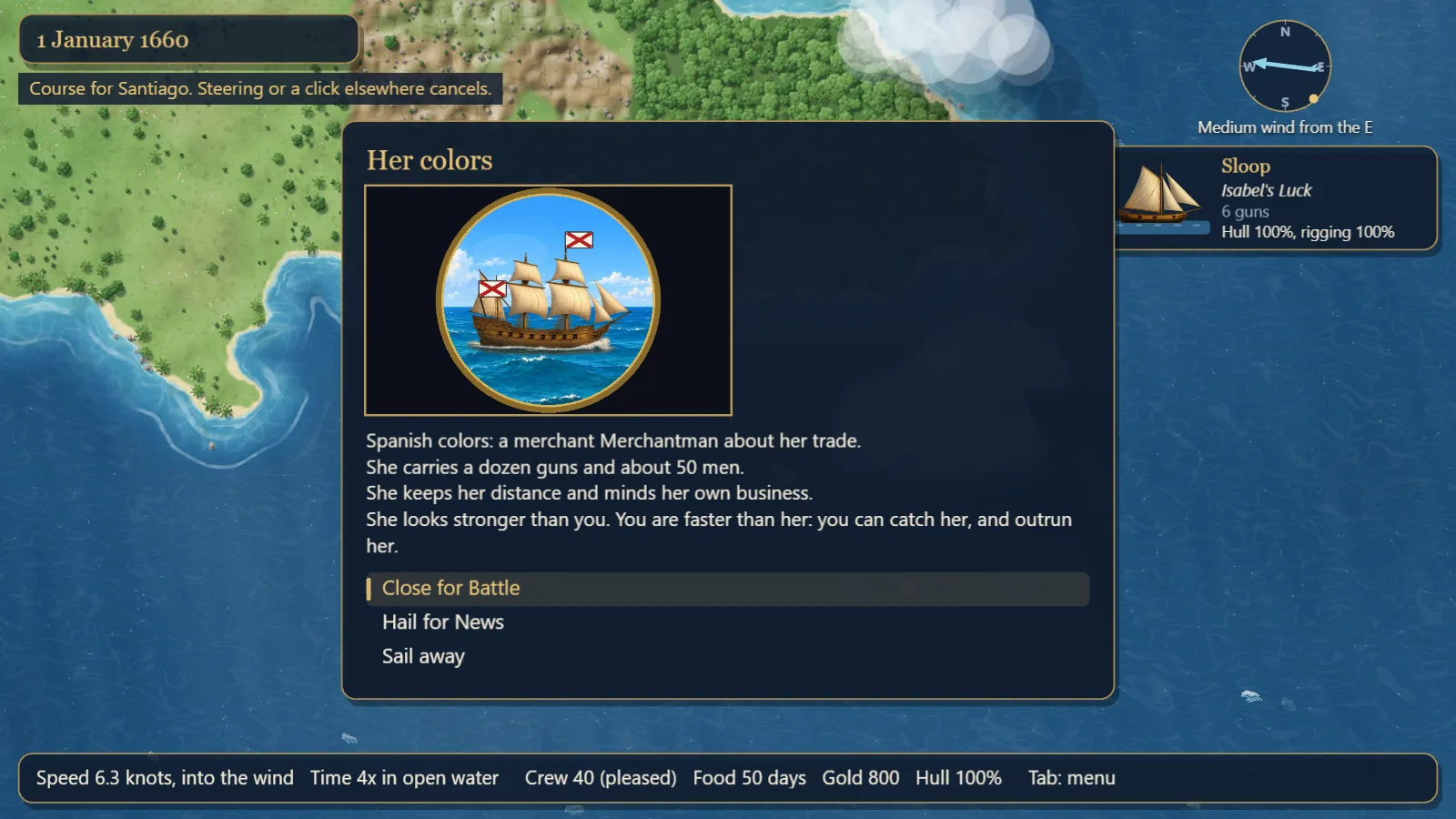
Then choose Close for Battle, Hail for News (wars, treaties, convoys and the strength of towns), or Sail away. A friendly ship may hail you with the news herself. An enemy refuses to speak, or answers with a warning shot.
Sailing away
Only a hostile ship gives chase, and sailing away usually works. But she may close anyway, more often when she is faster than you and when your name is known to her, and the Navigation skill helps you slip away. If she closes, she turns toward you at the next step, and at the last there is no escape. Running from a ship that has challenged you costs fame, more if she is the weaker ship; at Apprentice and Journeyman the game asks first, and you may Stand and face her.
A ship you have identified and left can be met again: click her on the map, or choose Close with her in the pause menu.
Where ships are met
In the wider worlds, where you sail matters. Out on the high seas, a hundred miles and more from any land, sails are few. Along a coast near towns they come at the usual rate, and in a port’s own waters a little more often. Off a wild coast, far from any town or village (an empty island anchorage does not count), they grow fewer the farther you are from people, until they are as few as on the high seas. Near a port most of the ships you meet fly its own flag or the flags of its friends, its patrols are out, and few of its enemies’ ships come by. Now and then a ship near a port is a raider of its trade: the local pirate of those waters, another pirate, or a privateer of a nation at war with the port. The lookout tells you when she is one. Take her captain and the port’s governor rewards you (see Captured captains). The Classic Caribbean keeps the old rule: sails are met at the same rate everywhere.
Pirate hunters on your trail
A nation sends pirate hunters after you once you have taken several of its ships or attacked its towns, or once you are known and it dislikes you. In the wider worlds they follow your trail: they are met most often in the waters where you struck at that nation, and the more famous you are, the more of them come. Sail far from those waters and after a few weeks they lose your trail; your mate tells you when they do. Away from every trail, only a famous captain whom a nation dislikes meets its hunters, and seldom. The lookout tells you when a hunter is following your trail, and the talk in a tavern may warn you of it.
In the Classic Caribbean pirate hunters are very rare until you are notorious and a nation is hostile to you; then that nation hunts you in earnest. A cruel or villainous captain meets more of them, and the ones sent after her fence better and are better known, so taking one brings more fame, though not a higher ransom.
Attacking a ship of your own nation forfeits your letter of marque and costs fame. The game warns you on the choice. See Prizes, prisoners and fame.
Attacking a friend
When you choose to attack a ship, a town or the Silver Train of a nation that stands well with you, or whose letter of marque you hold, your sailing master asks whether you are sure, and says why and what it would cost (at Apprentice, Journeyman and Adventurer; at Swashbuckler he says nothing). Go ahead and you lose fame, your name darkens, and your good standing with that nation is gone at once; sinking or taking the ship, the train or the town sets that nation against you. Where both the letter and the friendship are lost, you pay only the larger of the two costs. In the Classic Caribbean he asks too, but only the letter of marque rule costs anything. With several ships, Back on the flagship choice before a battle takes you back to the menu before it, so you can still change your mind.
Ports
Coming into a town
Sail onto a town and the game tells you whose it is. A friendly or neutral town lets you Enter the harbor. Where a fort guards the harbor of a hostile nation, its guns fire on you: you may Run past the guns, a short sail under fire into the harbor. Other choices:
- Sneak into Town: slip in by night with a few men. You can see the governor and listen in the tavern, but you cannot trade, sign on men or divide the plunder, as the loot stays aboard. A famous captain may be recognized. Then you must fight your way out, or surrender.
- Attack Town: see Land battles and towns.
- In some towns only certain nations may trade, and guard boats turn you away.
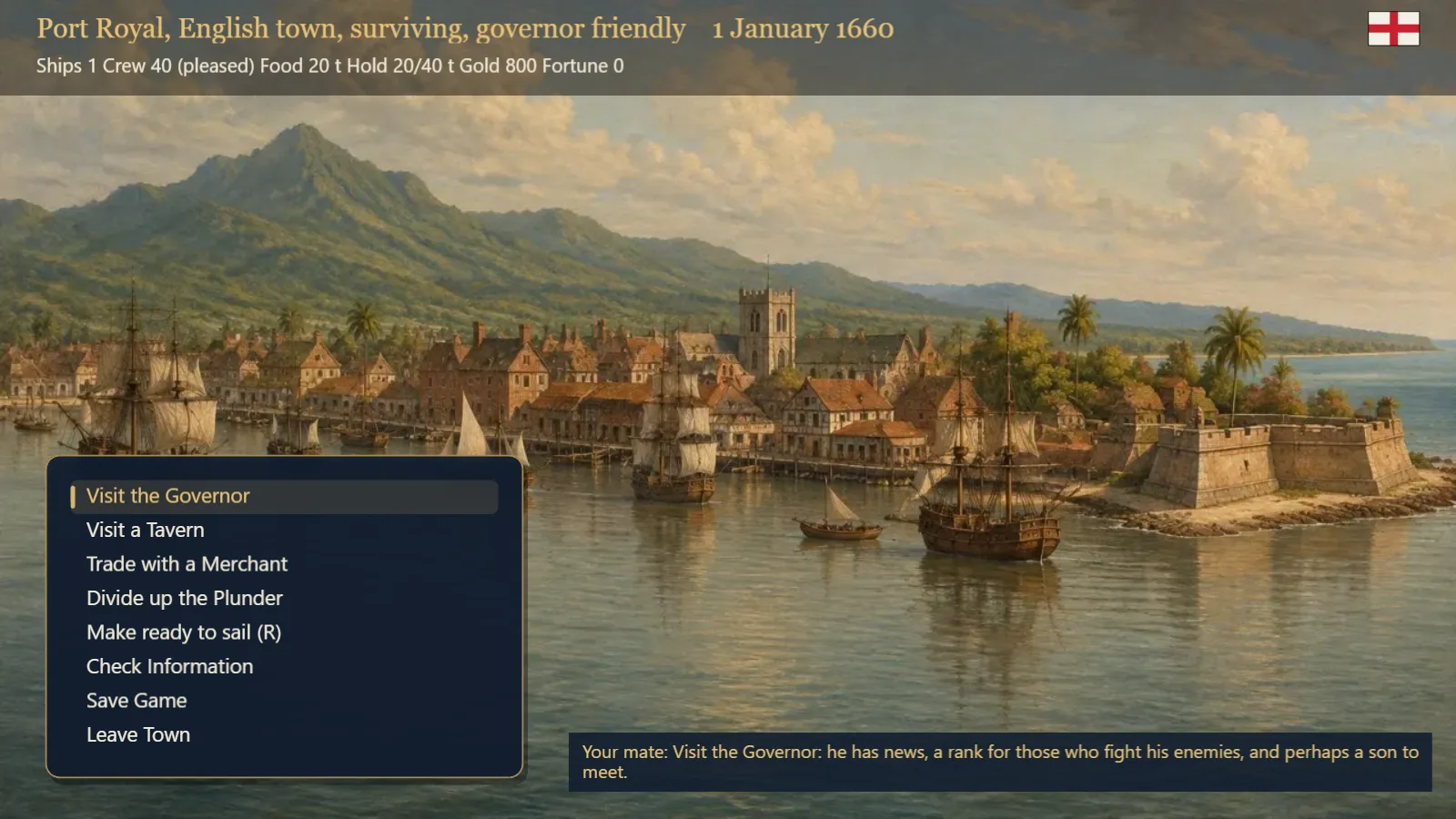
The town screen
The header names the town, its nation, how prosperous it is (struggling, surviving, prosperous or wealthy), how its governor feels about you, and the date. Under it are your ships, crew and mood, food, hold, the gold in the voyage treasury and your own fortune. The menu:
- Visit the Governor
- Visit a Tavern (a coffee house, tea house or inn in some lands)
- Trade with a Merchant
- Divide up the Plunder
- Make ready to sail (R)
- Check Information
- Save Game
- Leave Town
Entering a town makes an automatic save. Malaria sometimes rages in a town; you may catch the fever there and lose men to it.
The governor
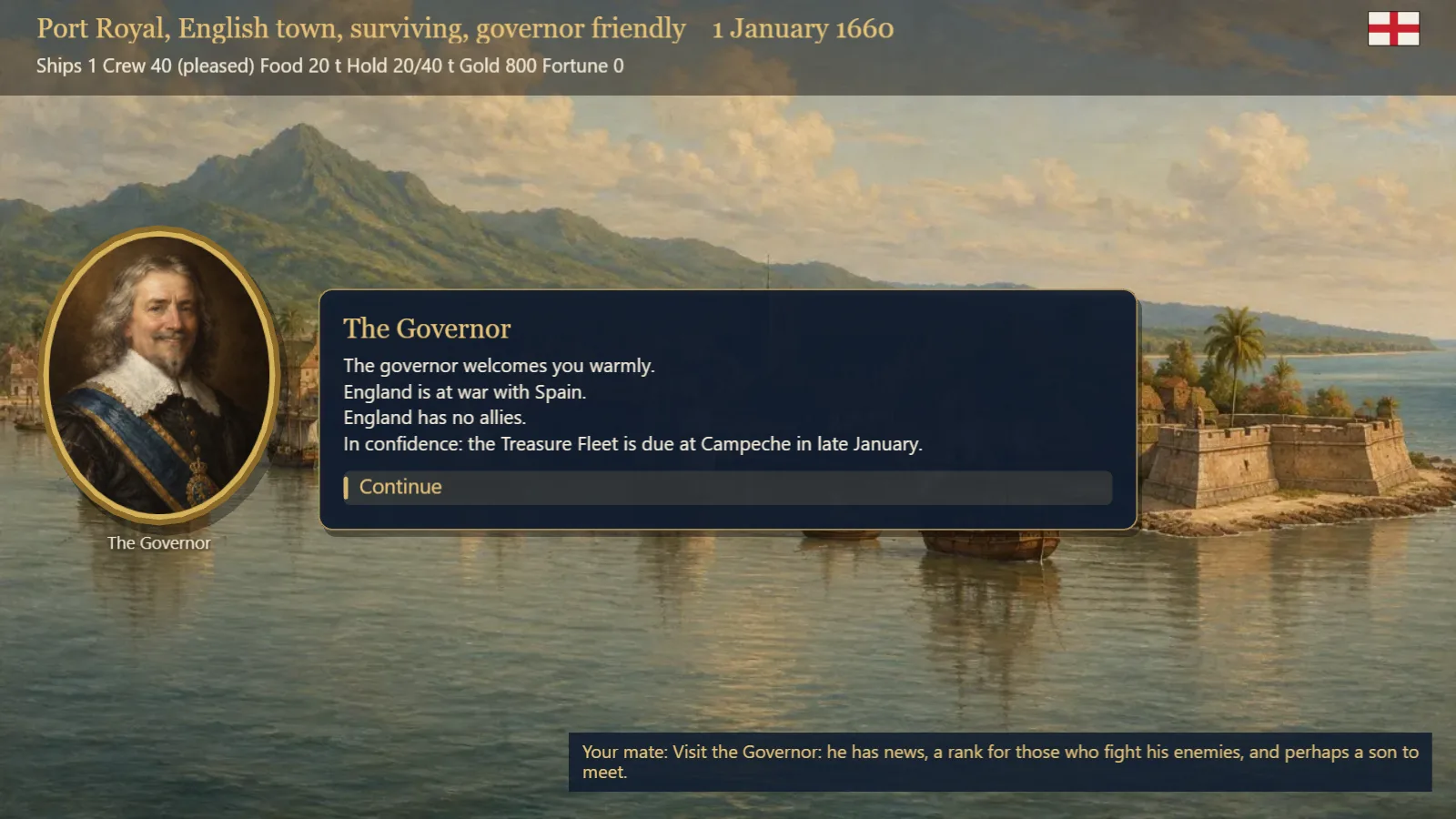
Every town of more than 600 people has a governor. He sees you whenever you have done something since your last audience with him that could earn a promotion or a reward: taken or sunk a ship of his nation’s enemies or a pirate’s, taken or sacked an enemy town, taken a pirate or a pirate hunter, or brought him prisoners. With nothing new to tell, he will not see you again until a month has passed. A governor:
- Tells you the news: whom his nation is at war with and allied to, and sometimes, in confidence, when a treasure convoy is due.
- Feels a certain way about you. His attitude starts from his nation’s relations with yours and remembers what you do: friendly, pleased, neutral, ill-disposed, wary or hostile. Attacks on his nation’s ships make him ill-disposed, then wary, then hostile. Taking pirates near his port pleases him. A hostile governor refuses to see you.
- Promotes you. Blows against his nation’s enemies in wartime earn you service with his nation: ships taken or sunk, more for big ships and treasure ships, pirates taken, towns sacked, governors installed. When your service is enough, he raises you one rank a visit: Ensign, Captain, Major, Colonel, Admiral, then the titles Baron, Count, Marquis and Duke. Ranks bring land, more for service beyond what the last rank asked, and each rank warms his nation toward you. Each nation ranks you on its own. A promotion shows its decree, painted in the style of the nation that grants it: a sealed scroll for a rank, a patent with the insignia of nobility for a title. When land comes with it, a painting of your new estate follows, in the look of the town it lies near (the people who built it, its climate and its land). Any key, a click or any button of a gamepad moves on. Installing a governor in a town you took shows the same, for the land he grants you there.
- Pays bounties on pirates and takes prisoners you hand over (see Prizes, prisoners and fame).
- Pardons you when his nation offers amnesty to pirates. Sometimes the pardon is free, sometimes it has a steep price, and evil deeds raise it. An honorable captain may sometimes be pardoned even without an amnesty.
- Has a family, and in the wider worlds a household (see Governors’ families).
The tavern
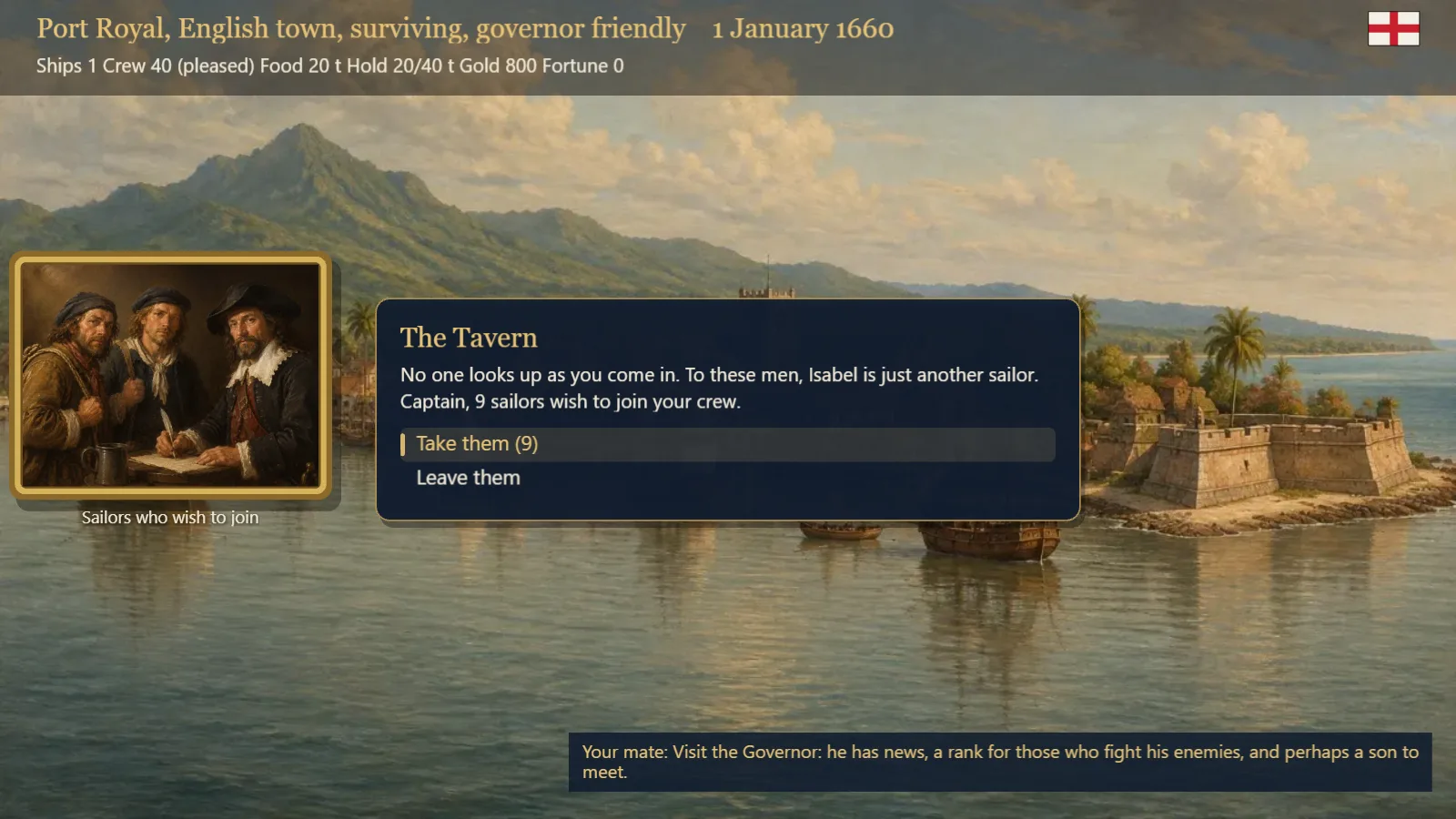
- Recruits. Men come to sign on with a captain of deeds: more for a famous captain, a big town and a good voyage. The ones who came this time do not come again on the next visit; a town’s pool fills again in about three months. Your ships must have room for them. In lawful towns your evil deeds put men off and your good ones draw them; in pirate havens it is the other way round. A captain in poor health finds fewer men.
- The talk. Sailors trade the latest news: wars, where a good sells high, where a famous pirate was last seen and the bounty on him.
- A traveler’s report on another town, for a little gold: its owner, people, soldiers, forts and wealth. It appears on the Cities page with its date.
- An old sailor may offer you a piece of a treasure map (see Treasure and your family).
- How the room greets you shows your fame, from snickers to a hush.
The merchant
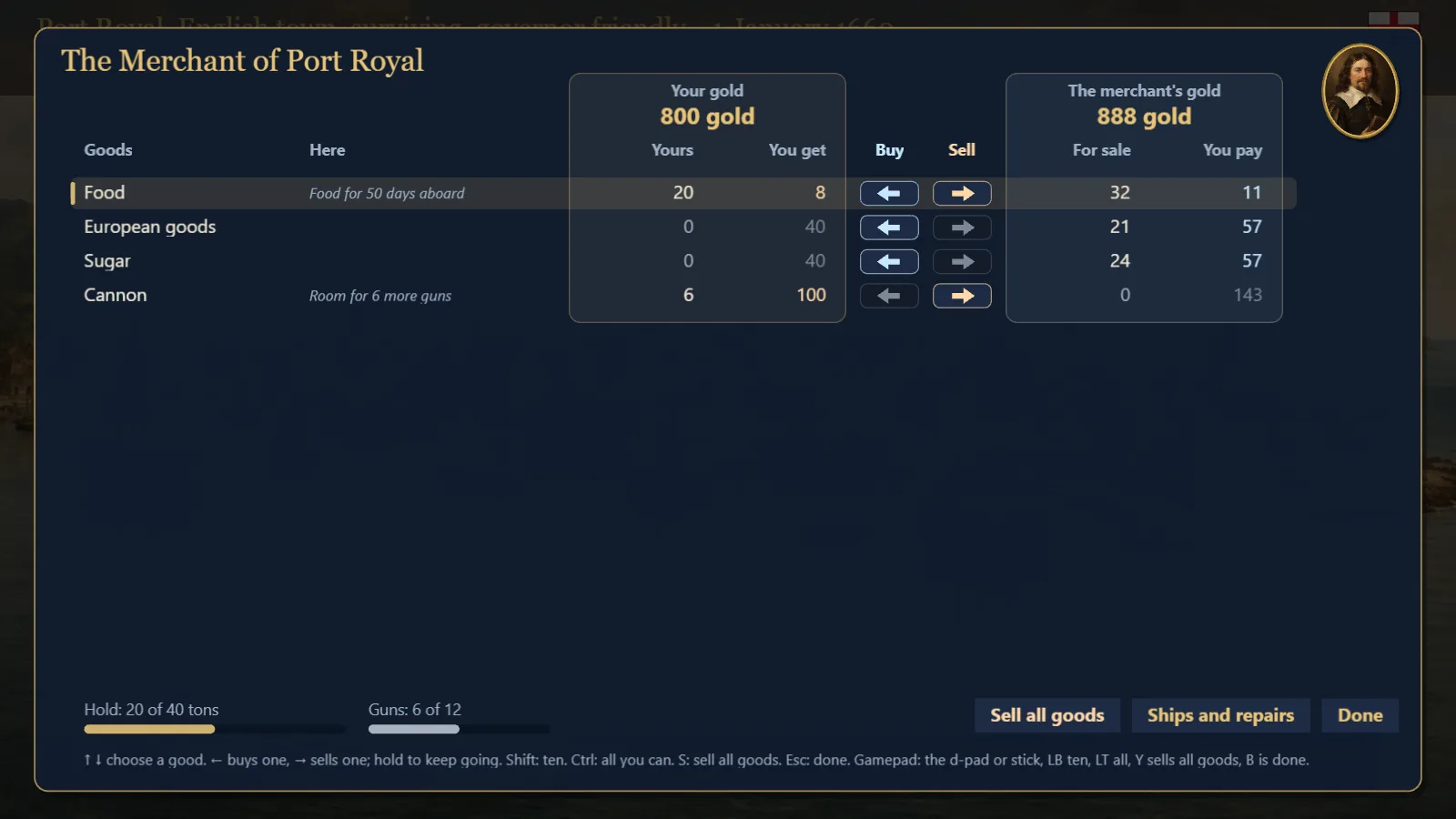
In the Caribbean a merchant trades food, European goods, the era’s export crop (hides in 1560, tobacco in 1600 and 1620, sugar from 1640), and cannon. The wider worlds have the goods of their own regions. The Here column notes goods Made here: cheap, Plentiful here: cheap, Wanted here: sells high and Brought from afar: sells high. Prices and stocks rise with the town’s wealth. Gold weighs nothing; everything else takes room in the hold, a ton at a time, and cannon need room on a gun deck. The bars at the bottom show the hold and the gun ports.
Every merchant has a purse, shown over his column: a few hundred gold in a small town, a few thousand in a great port, less in a native village. He pays for what you sell him from it, and a sale stops when his gold runs out. What you pay him for his goods goes into it. His purse and his goods come back to their usual levels in 30 to 60 days, faster in larger and richer towns. An empty anchorage has no merchant. Sell all goods (X) sells everything in your holds but food and cannon, the dearest first, until his gold runs out, and says what sold and what is left. Make ready and sell the cargo sells the same way.
Spanish law allows only licensed traders, so Spanish merchants are choosy by the town’s wealth: a struggling town trades with anyone but a notorious pirate, a surviving one with captains of decent standing, a prosperous one with captains of high standing, and a wealthy one only with captains who hold a Spanish rank. Merchants of every other nation buy and sell with any captain who gets into their port. In a pirate haven the harbor master asks no questions and buys plunder quietly.
In the expanded worlds a few great naval ports are arsenals, such as Havana, Lisbon, Venice, Amsterdam, Goa and Manila. They always have 10 to 24 cannon for sale, restocked each year, where other towns have a few guns only now and then. An arsenal sells them to you only while you are not at war with its nation and its governor is at least neutral toward you; otherwise the Here column says Arsenal: not sold to you, and the merchant tells you why when you try to buy.
Ships and repairs, at the bottom of the trade screen, is the shipyard: repair all your ships, buy a ship (they are rarely for sale), or sell one of your other ships (the game asks Yes or No first, starting on No). Your fleet can have up to eight ships in the Classic Caribbean and twelve in the wider worlds.
Make ready to sail
One choice (R) readies the fleet: it repairs the ships, signs on the men waiting, and buys food for the days shown, as far as the purse, the merchant and the holds allow. Make ready and sell the cargo sells your cargo first, the dearest goods first, as far as the merchant’s gold goes. A fleet needs at least 8 men a ship to sail, and cannot leave with overloaded holds.
Divide up the plunder
When the voyage has paid, divide the plunder in a friendly town. Your sponsors take a tenth. You take your captain’s share (5% to 20% by difficulty), and hired officers take the rest of the officers’ part. The crew splits what is left equally. Your share goes to your personal fortune.
- Afterward you keep only your flagship, her share of food and her guns. Sell other ships and cargo first.
- Rich shares spread your fame; small ones cost you your name and make the next crew harder to find.
- Then Start a new voyage, with a new difficulty level if you wish, or Retire. A new voyage starts with an empty purse: you may put gold from your own fortune into it to buy food, or sail with an empty purse. Sign on a new crew at the tavern.
Native villages and pirate havens
In the wider worlds you can visit native villages. Their people come down to the shore to meet you, or line it with armed men and wave you away. In a village you can Trade with the Villagers, Talk with the Elders for what traders and hunters have told them, and Ask for Warriors, who join captains at war with their own enemies. A village is never a fight.
Pirate havens, such as Nassau in its lawless years, have no governor and fly no flag but the black one. You can recruit, trade and sell plunder there.
Governors’ families
Daughters, ladies and gentlemen
Many governors have someone of their house to meet. In the Classic Caribbean it is the governor’s daughter. In the wider worlds it is a lady or gentleman of his household, or his sister or brother, as your choice at the start decides. You may meet one on a visit to a governor whose nation is not hostile to you, once you have a little fame or a rank with that nation.
Each has a level, from plain to radiant (for a man, plain to splendid), and asks more of a suitor the higher the level: a rank with the governor’s nation, fame, and a personal fortune. Wit and Charm counts as one of the three. Each visit with all three met warms their interest a stage, through curious, interested and fond to in love. With two met nothing changes; with fewer it cools. Attacks on their nation’s ships cool it too, and sacking one of its towns cools it twice.
As their interest grows they give you the latest news, word of Spanish silver on the move, and at last a piece of a map: to where one of your lost family is held, or, once your family is found, to a treasure. When one is in love with you and you still meet all three, you can Ask for her hand in marriage (or his). You marry once in a career; your spouse adds to your retirement score, more for a higher level. In the Classic Caribbean a daughter who loves a married captain may become his mistress (Ask her to be your mistress); she adds half of what a wife of her level would.
In the wider worlds you may choose at the start that romance is not possible, so those you meet become friends only. A close friend counts half a marriage at retirement. One who likes you may also win you an early release from prison.
The household (wider worlds)
In the wider worlds some governors have, instead of a lady, gentleman, sister or brother, one of five of his staff to meet: a physician, a secretary, a treasurer, a head steward or an aide. Their trust grows a step a visit toward what your rank, service and trade with the town earn, and your wrongs against his nation cool it. They never marry, but they help:
- The physician tells you where fever rages, and later treats your old wounds once a year.
- The secretary shows you the dispatches and may give you a piece of a family map.
- The treasurer lets slip where the silver is moving.
- The head steward gets you cheaper food, then cheaper repairs.
- The aide tells you the strength of his nation’s enemies and sends veterans of the garrison to your crew.
The Information screen
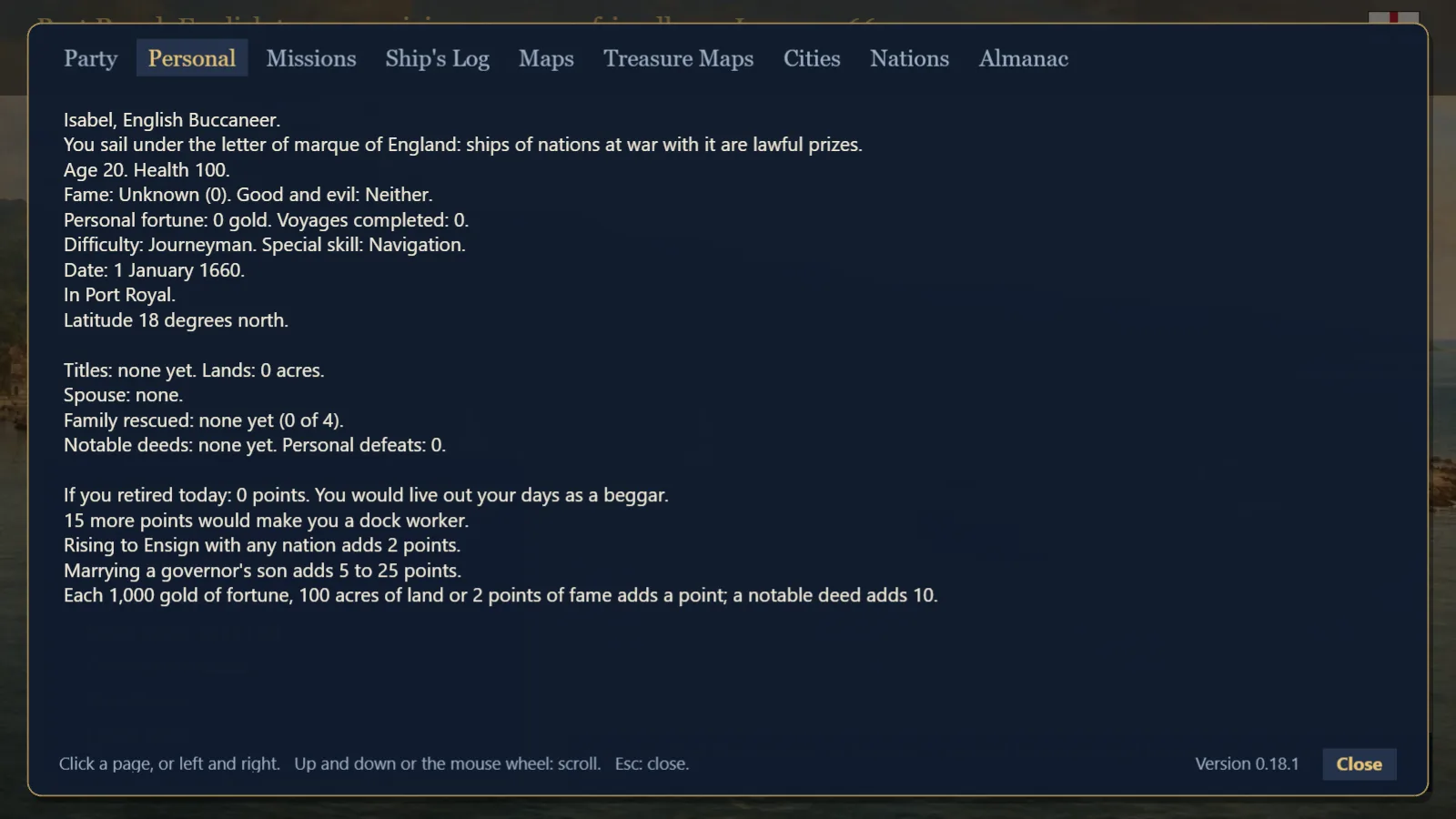
Check Information (in port or in the pause menu) opens these pages:
- Party: each ship with her hull, rigging, guns and tons; the crew and its mood; food; the hold and its cargo; the voyage treasury.
- Fleet: a card for each ship with her painting, hull, rigging and guns, marking the ships whose damage slows the fleet. Each ship but the flagship has a Scuttle button; with the keys, X lists them. The game asks Yes or No first.
- Personal: in the wider worlds, your captain’s portrait; your role and letter of marque, age, health, fame and good and evil, fortune, difficulty, skill, the date and where you are, your latitude (and the sailing master’s guess at longitude, at Apprentice), titles and lands, spouse or close friend, family rescued, notable deeds and defeats. At the bottom: your score if you retired today, the station it would buy, and how to raise it.
- Missions: everything under way: bounties, prisoners and where to turn them in, your lost family and map pieces, convoys you have heard of, an amnesty, your letter of marque, the weekly challenge.
- Ship’s Log: your career day by day.
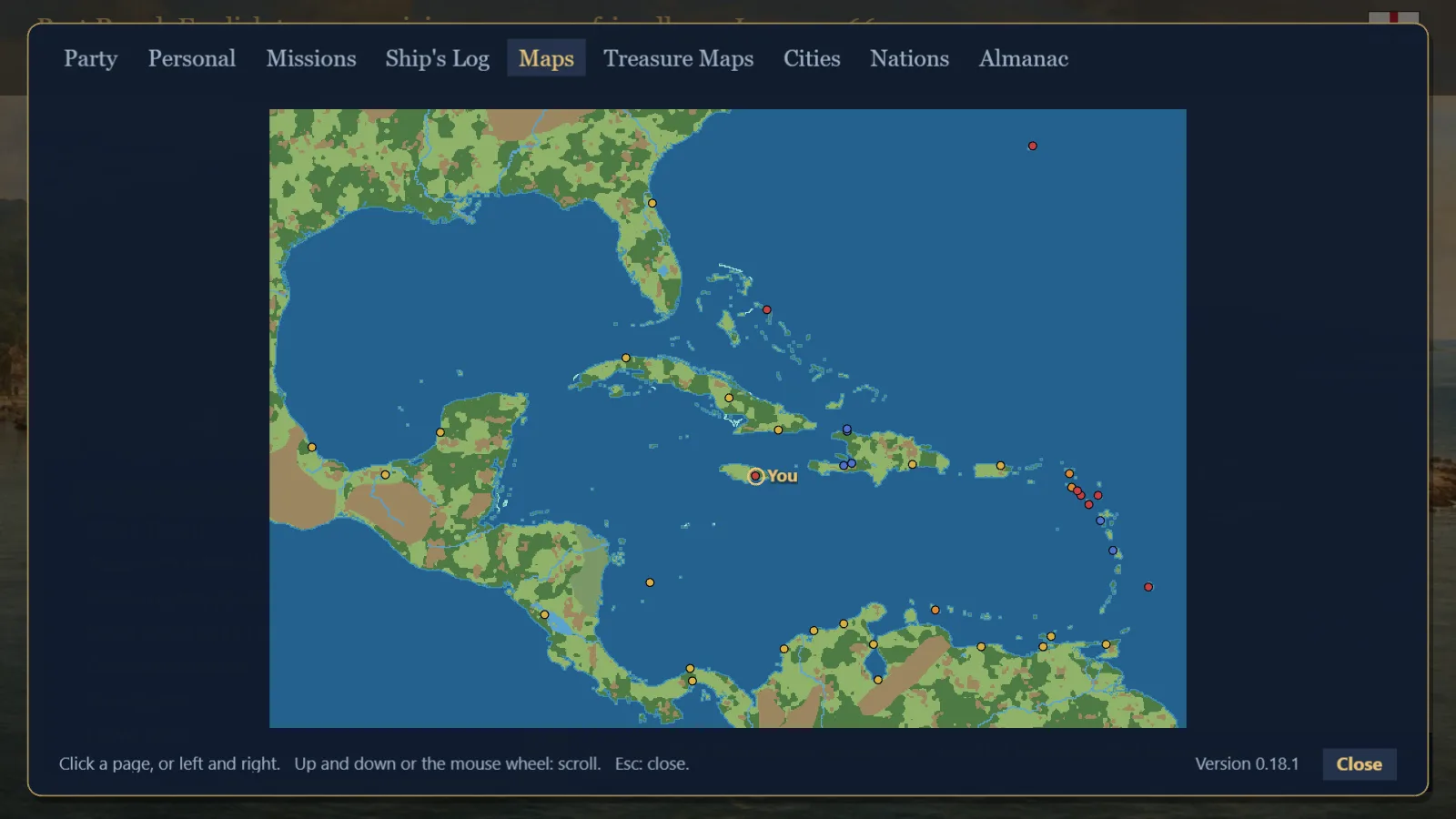
- Maps: the whole map, with the towns in their nations’ colors and you. In the Rivers world a click on it is quick travel.
- Treasure Maps: the map pieces you hold.
- Cities: what you know of each town and when you learned it.
- Nations: the wars and alliances, as last heard.
- Captains: every named captain you have met, the latest first, each with his portrait: his name, kind and fame, his ship, whether he is alive, your prisoner, a famous captain who sails no more (you took his ship, or history lost sight of him), or dead, and how your last meeting ended. A death you did not see is there too, with the day the news came.
- Almanac: the usual dates of the Treasure Fleet and the Silver Train. In an expedition that keeps history’s date, this year’s dates come first.
- Ship Book: every kind of ship in your world, a page each: her painting, guns, crew, hold, speed, turning, rig and years, and a few lines about her. Up and down, the mouse wheel, a click on a page, Page Up, Page Down, Home and End turn the pages.
- Journal (wider worlds): the discoveries you have written down, by kind (winds, currents, plants, animals, foods, landmarks), each with the day and its story, how many of each kind are still to find, and the points the journal brings at retirement (see Discoveries).
Sea battles
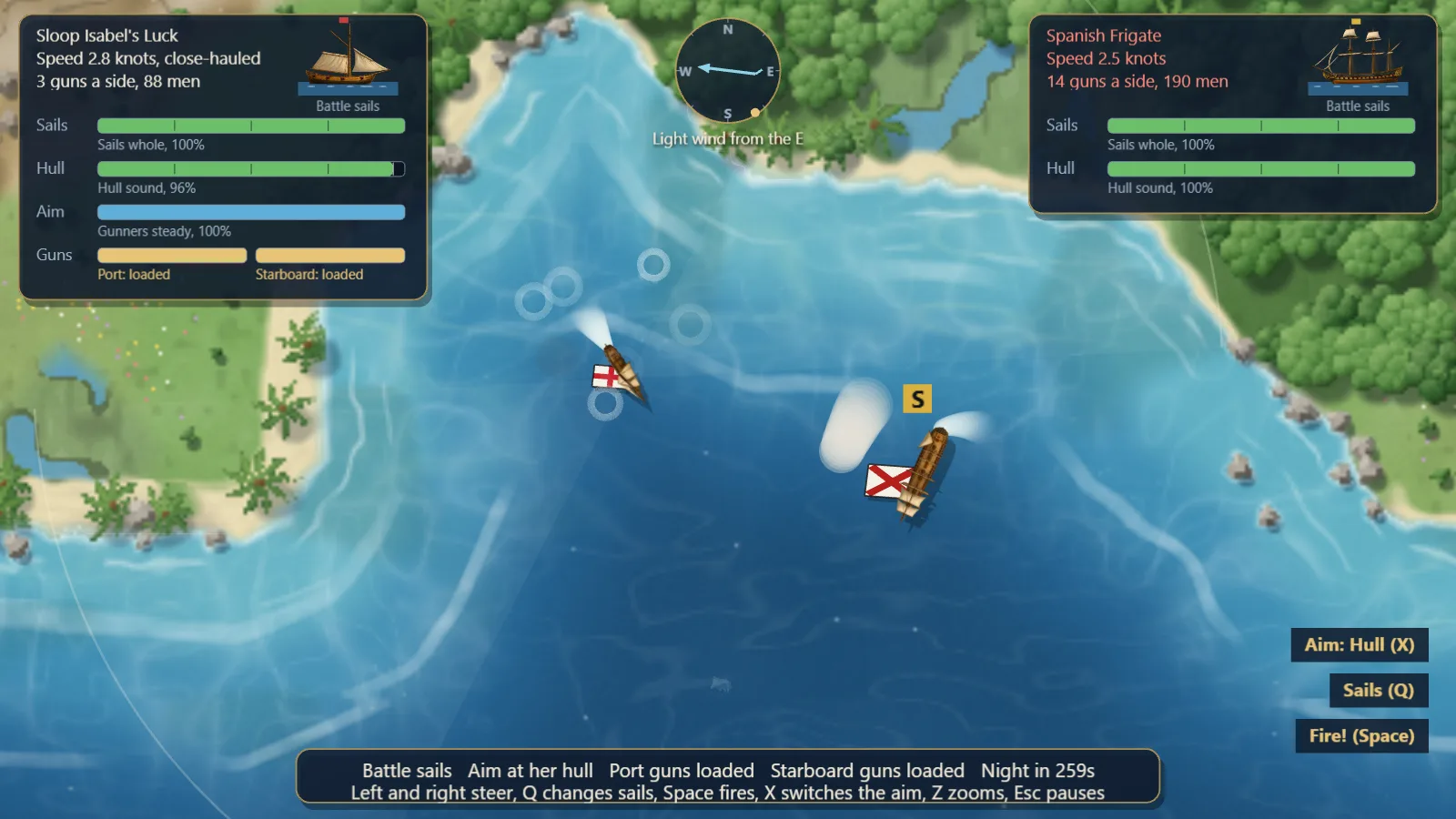
A battle is your flagship against one enemy ship, on the sea where you met, with its coasts and shoals, in the wind of the moment. With several ships you choose the flagship first. The cards at the top show both ships: speed and point of sail, guns a side, men, sails and hull. Yours also shows the Aim meter and the guns on each side.
Sails
Battles begin under battle sails. Full sail is faster but exposes the rigging to her shot. Changing sails stops reloading for a moment. Once the rigging is shot away, the sails jam and can no longer be changed. Big ships turn slowly and carry their way; a ship pointed into the wind makes no headway in a fight. Your ship turns quicker at the easier levels.
Guns
- Each side of the ship carries half her guns, and every gun needs four men, so a short crew fires fewer guns.
- Your gunners fire the broadside on the side facing the enemy, so you aim by turning. The gold arcs light up when your guns bear. Galleys and some other craft carry their guns in the bow instead.
- The Aim meter is how well the gunners have laid their guns. They lay them while you hold your course, once the guns facing the enemy are loaded and she is in reach. Turning spoils their aim, and every broadside empties the meter. Hold your course before you fire. A hit is likelier still when she has held hers.
- Your crew’s spirits speed their reloading.
Where to aim
X changes the aim:
- Her hull: kills more men and dismounts guns. At the last she sinks, and a sinking ship takes everything down with her.
- Her sails: holes, then spars and rigging shot away, a mast lost, and at last she lies dismasted and drifting, with her men and guns mostly spared.
- Her decks: grape and langrage at close range. Many more of her men fall, with only some harm to her hull and rigging, but the guns reach only half as far. Use it to thin a bigger crew before you board. It takes a few broadsides, close under her guns. A ship that fires at your sails can leave you drifting before her crew is thin enough, so rake her from off her bow or stern, clear of her broadsides, or board while you can still close. At the easier levels your shot in her hull kills more men, but your grape does not: it already hits more often there.
Boarding
Touch her ship to grapple and board. A sword fight on deck decides it (see Sword fights). Some ships close in to board you. Then you may fight them on deck, or Strike your colors: you lose that ship and the men aboard her, but they let you go instead of taking you to prison. Striking is worth it when her boarders far outnumber yours.
How a battle ends
- Victory: she strikes her colors, or you take her by boarding.
- She sinks: nothing can be saved from her.
- She gets away, or you break off, when a ship sails off the screen. The view widens as the ships draw apart, and once they are too far apart to show together, the fight is over. Whoever fled pays for it: breaking off costs you fame, and a named pirate or famous captain who runs from you has lost fame when you meet him again. A merchant or a navy patrol that gets away loses nothing. A ship that only turns away to come about is not running. At Apprentice and Journeyman your ship stops near the edge and the game asks first, saying what breaking off would cost; while she waits there, a ship that sails off the screen has got away. At the edge of the map a ship sails on off the map in the same way, and the same rules end the fight.
- Night falls. A fight lasts a few minutes of daylight. The clock in the bottom left corner shows the day: the sun rises at the right, climbs over the top and sets at the left, and the sky turns from dawn to dusk. At Apprentice and Journeyman a fight begins at sunrise; at Adventurer and Swashbuckler it may begin at any hour up to mid-afternoon, and the screen where you choose to fight tells you the time of day and the light left. The game warns you when the sun is low, and at nightfall the ships lose each other.
- Your flagship is lost, or you lose the fight on deck and are captured.
Prizes
A ship you take gives up her gold at once. Some of her crew may want to join you. When you have room for them, berths free in your ships or in hers if you can keep her, you choose: Take them signs on as many as there is room for, those your ships have berths for at once, the rest waiting aboard her to join you if you keep her (with your fleet full, only if she takes the place of one of your ships); Leave them leaves them aboard her. When your crew is too small to sail all your ships, the question says how many ships leaving them would cost, and those ships are abandoned only after you answer. You are asked at every level. With no room for them you are not asked: they wait aboard her, and join you only if she takes the place of one of your ships. Then settle her:
- The ship: man her with a prize crew of 8 (her hold adds to yours), plunder and sink her, or let her go. With no room for her (your fleet full, or too few men to sail one ship more), Keep her in place of one of your ships scuttles a ship you choose and puts the prize in her place; the scuttled ship’s guns and cargo move to your other ships where they fit, and the rest goes down with her; the game says what would be lost before you choose. Choose your flagship, and the prize becomes your flagship.
- Her cargo: take all you can carry, throw some of yours overboard first, or leave it.
- Her guns: into the empty gun ports of your ships, or leave them.
Forts
Attacking a town from the sea pits your flagship against the forts on its shore. X aims at the battlements, which kills her gunners and silences her guns, or at the gates, which breaks them open for the storm. Then sail to the shore close to a fort and the men of your flagship land. The landing must be near a fort: from a distant beach the assault never starts, and you are told to land closer. Some fall to the fort’s fire on the way in. Then the garrison either stays behind its walls, and you storm the ramparts in a sword fight (broken gates take away the walls’ help), or marches out to meet you in a land battle. A small ship cannot outshoot a fort, so land at once; a frigate can batter the walls first and save many men.
Sword fights
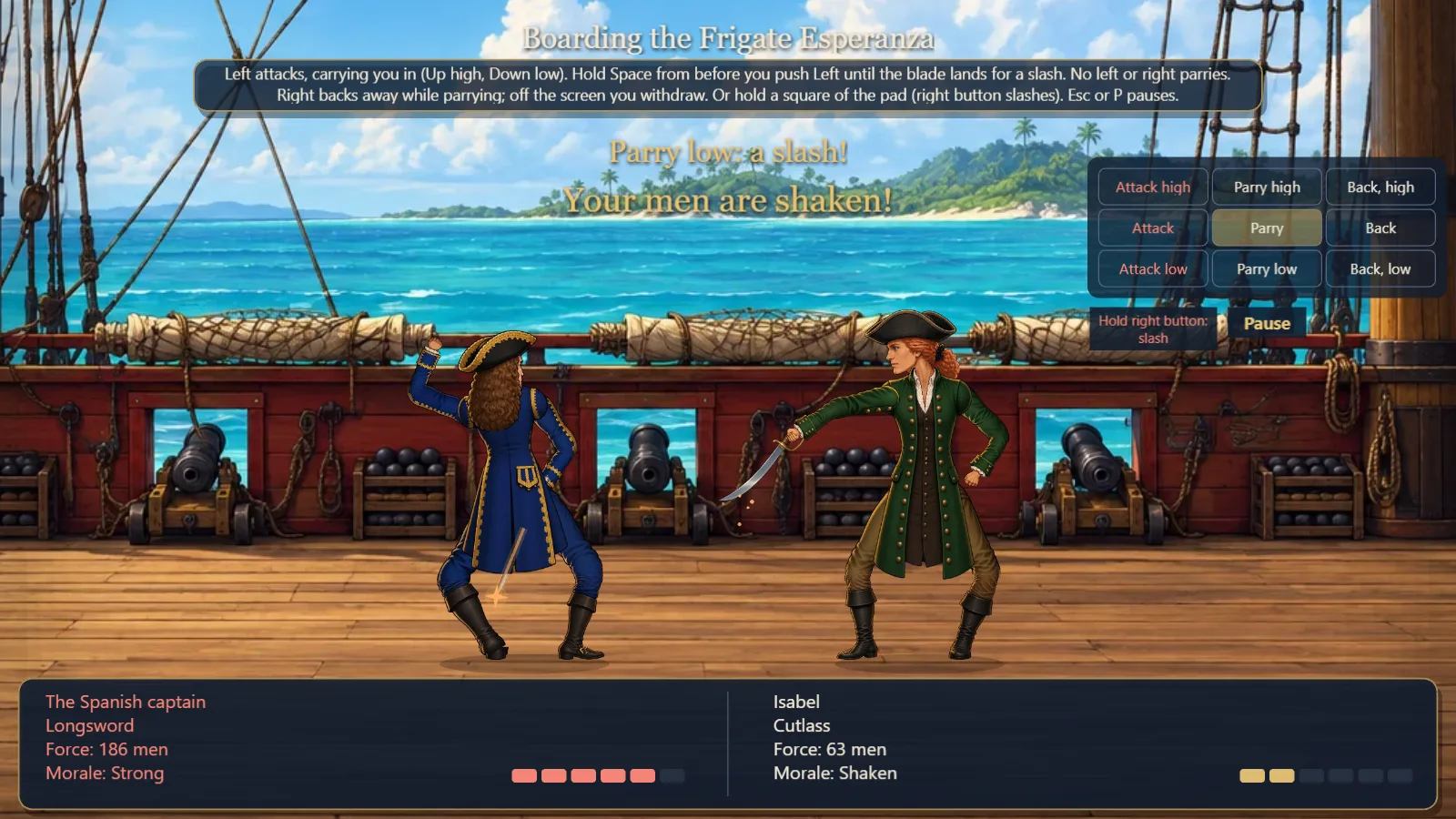
Sword fights decide boardings, the ramparts of a fort, mutinies, escapes from a town, the rescue of your family, and trials by combat. You and the enemy’s leader fight in front of your crews. Your men fight behind you, and the panel at the bottom shows each side’s force and morale.
Your weapon
Before each fight, choose your weapon:
| Weapon | Reach | Speed | Harm |
|---|---|---|---|
| Rapier | Longest | Quickest | Lightest |
| Longsword | Medium | Medium | Medium |
| Cutlass | Shortest | Slowest | Heaviest |
The same order holds for the enemy: a man with a rapier moves quicker than one with a cutlass. A trial by combat is always fought with rapiers.
Heights, attacks and slashes
- Every attack and parry is high, in the middle or low. Low blows are the quickest and reach the least; high blows are the slowest and reach the farthest.
- Every attack carries you forward, so you close in by attacking. From too far off it misses.
- A slash is slower than an attack and reaches farther, but does twice the harm.
- Two blows at the same height at the same moment meet: neither lands.
Parries and the riposte
Before each blow the enemy shows its height: his pose changes and his point glints. The tell lasts longer for a slash, longer at the easier levels, and longer with the Fencing skill. At Apprentice and Journeyman the game names the parry for you. Even his quickest low blows show their tell long enough to parry at Apprentice and Journeyman. Parry at that height as the blow lands and it is turned aside completely. A parried man is off balance for a moment, longer at the easier levels (see the difficulty table): strike at once for a riposte. The enemy parries too, and cannot parry while he shows a tell.
Giving ground
Back away to keep your guard. Back off the edge of the screen and you withdraw from the fight, giving up what you fought for; at Apprentice and Journeyman the game asks first. With men left you get away with them. Alone, you cannot get away: it counts as a defeat, and at those levels the game says so before the last step.
Morale and the end of a fight
Hits on a leader move both sides’ morale, and the crews’ losses follow the numbers and morale on each side. A large crew usually wins, but a small, fired-up crew can beat a big, shaken one. In the Classic Caribbean the two sides’ morale moves as a pair: as one rises, the other falls. In the wider worlds each side keeps its own. A leader hit while his men panic, or hit when his crew is down to one man, throws down his sword. Strike a man who has yielded, and he may fight on.
A crew that breaks. In a boarding, on the ramparts or in a town’s streets, a crew that begins the fight outnumbered more than two to one may break: its men throw down their arms, and its captain fights on alone. Struck with no men left, a captain yields at once, whatever the morale. But a lone captain who beats the other leader without being hit wins the fight. In the Classic Caribbean you beat him by breaking his morale; in the wider worlds, with a number of clean hits set by the level, whatever his crew’s morale (see the difficulty table). When your own men break, or your last men fall in a fight begun that far outnumbered, the screen counts down the seconds you have (see the difficulty table); if time runs out you are overwhelmed and yield. Win alone in a boarding and you gain fame, and her crew respects you: enough of her men offer to join you to sail your ships and the prize. Win alone in a town and the town is yours.
Age and poor health make you slower with the sword.
The fencing lesson and practice
The fencing lesson (offered at the start of a career, and in Options) teaches four steps in two minutes: the parry, the riposte, the slash, and giving ground. Practice sword fighting in Options lets you choose your captain, the level, the kind of fight (a town’s streets and a lone stand, five to one down, among them) and your opponent, then Fight again or Choose another. Nothing in practice touches your career.
Land battles and towns
Attacking a town
- From the sea: choose Attack Town as you arrive. Where forts stand on the shore, it is a fight with the forts (see Sea battles). Where the town has no fort on its shore, or its forts stand inland, the men of your flagship land and meet its garrison in its streets: a sword fight like a boarding, your men against its soldiers, decided by your duel with its commander or the captain of its guard. Win, and the town is yours; lose, and you are taken. In the wider worlds a street fight is a little fairer to a small crew than a fight with a fort’s garrison. It is fought by day or at dusk, as the battle clock stands when you land.
- Overland: go ashore and walk to the town, then March into Town in peace, or Attack Town with your whole party.
Overland, the defenders may march out and fight in the open, hold the town and fight among its houses, or shut themselves in the fort. Every attack sours that nation toward you, and some cities are far too strong to storm.
The land battle
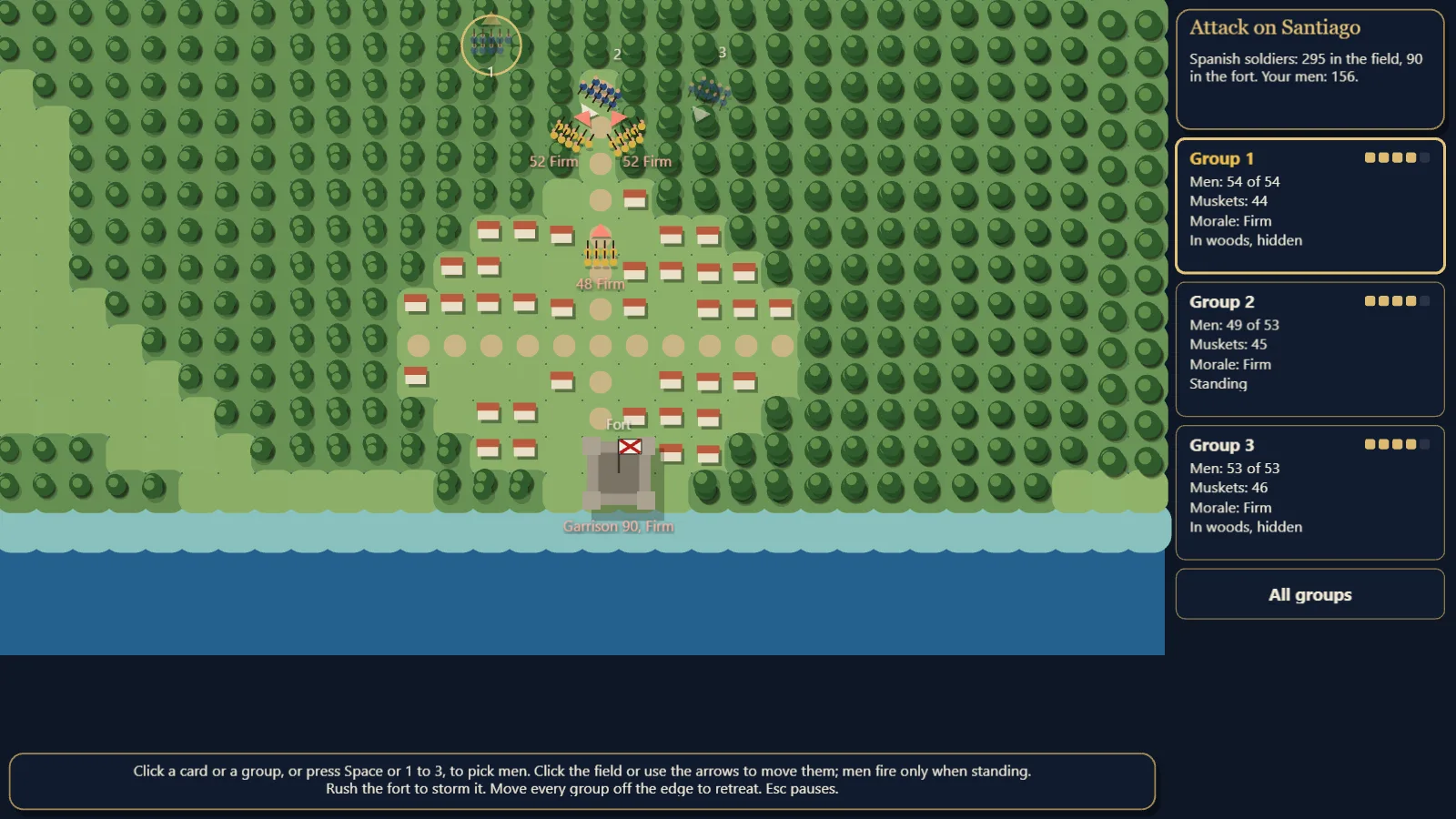
- Your party splits into two groups, or three from 60 men. Each card shows a group’s men, muskets, morale, and whether it stands, marches, or hides in cover.
- Men fire their muskets only while standing still, always at the closest enemy they can see in range. Not every man has a musket; famous captains draw better-armed men.
- Morale runs from strong, through firm, angry and shaken, to panic. Angry men fire a third less often, shaken men two thirds less, and panicking men not at all. A panicking group runs whatever you order. Heavy losses shake a group, and men out of the fight recover their nerve.
- Woods and buildings slow everyone, give cover and hide the men inside. Hidden men are seen only when the enemy touches them or after they fire. Nobody shoots through woods. Marsh slows everyone. Your men can wade shallow water, but cannot fire there and take twice the hits; the enemy has boats.
- Groups that touch fight hand to hand. A blow in the flank costs far more men and nerve, and one from behind more still. Men shot at from two directions at once are in a crossfire.
- Spanish towns of 3,000 people or more send out horsemen. They carry no muskets and woods hold them back badly, but they are fast, and in the open they cut down men hand to hand. In the Rivers world some native peoples fight with bows.
- At Adventurer and Swashbuckler each group carries limited shot, shown on its card. Out of shot, men can still fight hand to hand.
- The garrison in the fort fires at one of your groups at a time. Rush the fort, and it either fights on the ramparts (a sword fight) or surrenders. A shaken garrison may give up the town, more readily to a famous captain.
- To retreat, move every group off the edge of the field. It costs fame.
- A land battle begins in the morning and runs to nightfall, shown by the clock beside the map. At nightfall the attacker falls back with the men left: if you have not taken the town or the Silver Train, your men withdraw, with no fame lost; if you were ambushed, the attackers draw off and you go on.
After a capture
The town is yours to plunder: your men carry off most of its gold, more after a decisive rout. Its people flee and it may take years to recover. A town where the Treasure Fleet or the Silver Train lies holds far more gold. Then Leave the town to its fate, or install a governor of a nation you hold a rank with and that is at war with the town’s owner. The town changes hands, the new nation credits you with great service, and the old owner counts you a sworn enemy.
Before you go, Plunder the town’s stores opens the merchant’s screen with its stores in his column, all free. ← takes a good and → puts back what you took; Shift moves ten, Ctrl all you can, as far as your holds and gun ports allow. Take all you can carry (X) takes the dearest goods first and food last. What you take empties its stores, which fill again over the following weeks.
Ambushes
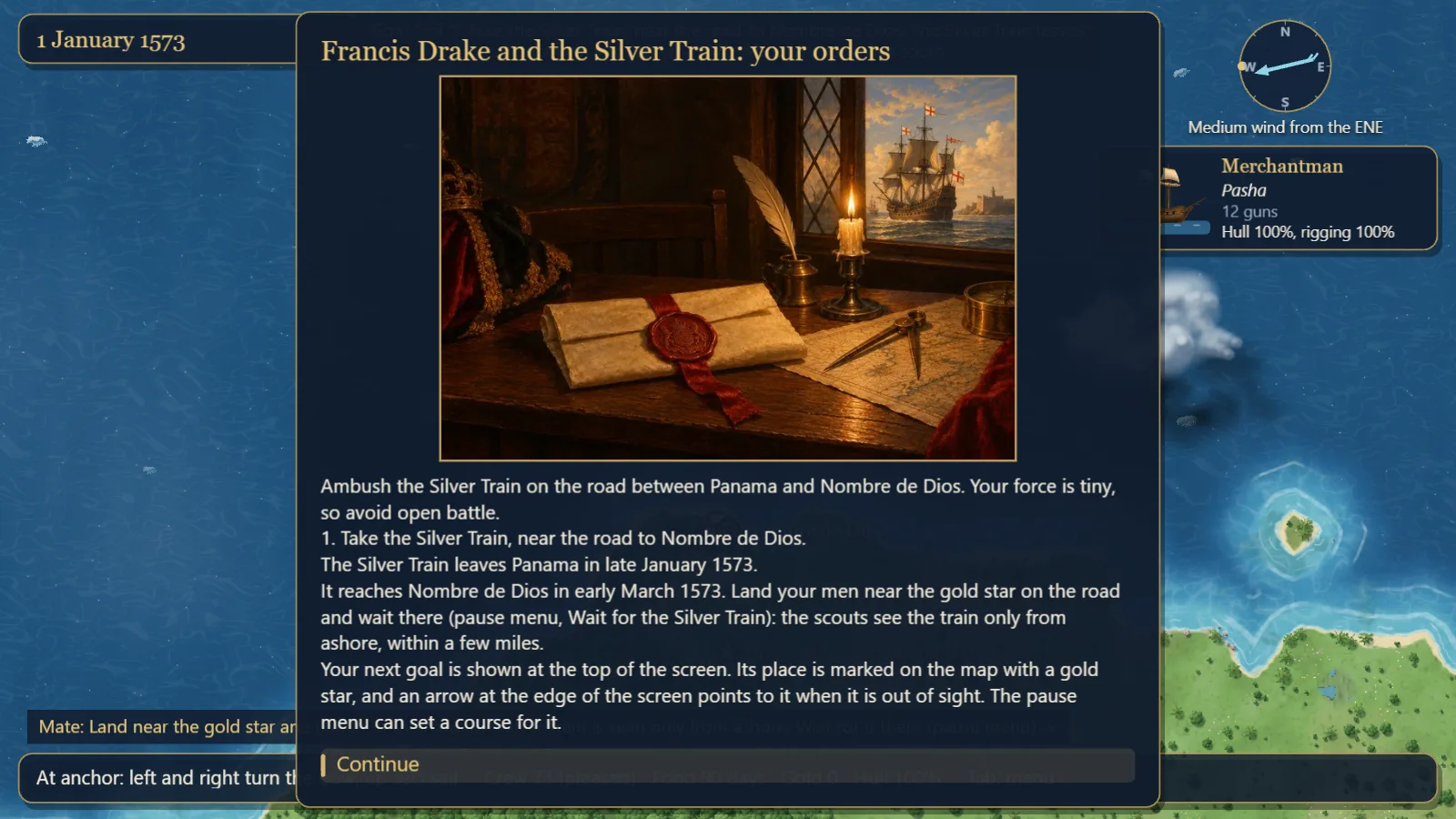
Where the Silver Train is on the road between Panama and the coast, you can meet it on land and Ambush it: a land battle against its escort, for the silver on its mules. Spain will not forget it. On the rivers of the Rivers world, warriors on the bank may ambush your canoes.
Prizes, prisoners and fame
Your letter of marque
You sail under your own nation’s letter of marque. In wartime, an enemy merchant is then a lawful prize: taking or sinking her is no stain on your name. Attacking your own nation forfeits the letter and costs fame; a pardon from your nation gives it back. An outlaw carries no letter at all: he sails as a pirate under the black flag, earns no rank or service with any nation, and may take his own nation’s ships without forfeiting anything. In Northern European Waters, a few captains whose own nation is at peace sail under a foreign letter, which lapses if their nation goes to war, the issuer makes peace, or they attack the issuer.
Fame
Fame is how the world knows you. It rises with victories, rich shares, prizes, sacked towns, promotions, captured pirates, rescues and marriage. It falls with retreats, flight from a ship that challenged you, defeats, prison and failed missions, and it fades slowly when nothing new is heard. Fame draws recruits, opens doors with governors and their households, and makes you easier to recognize when you sneak into a town. There are nine levels, from Pathetic and Cowardly below zero, through Unknown, Somewhat known, Known, Well-known and Notorious, to Famous and Infamous. Every pirate and pirate hunter you meet has a fame level too.
Good and evil
The game also keeps your conduct, in seven words from Villainous through Cruel, Ruthless, Neither, Decent and Honorable to Heroic. Sinking an honest merchant is evil, worse if you never boarded her; making a prisoner walk the plank is evil. Handing pirates over to justice, and sinking pirates, is good. Letting a prize go after you plunder her costs nothing, and so does sinking a prize when your fleet has no room for her. Sinking a prize with men aboard who wanted to join you, left there while your ships had free berths for them, leaves them at sea, a small stain at Swashbuckler only (below it, your other officers share the blame); those you took, waiting for her berths, and those only her berths had room for are no stain; letting her go or keeping her costs nothing, and with no room for them leaving them is no stain. At Apprentice and Journeyman your mate asks whether you are sure before a sinking that would stain your name. Lawful towns send more recruits to a good captain and havens to an evil one, and an honorable captain may be pardoned without an amnesty.
Captured captains
When you win a boarding against a pirate or a pirate hunter, his captain is your prisoner, and taking him adds to your fame by his own. Then choose:
- Let him go: a little fame for your mercy.
- Ask him for news: one answer, where a convoy is bound or how strong a town is, in return for his freedom.
- Keep him prisoner: hand him over in port for more fame. A governor pays a bounty for a pirate and sees justice done, more in your own nation and more again where he preyed on shipping. A pirate hunter is ransomed by his own nation; any other governor who is not hostile pays half of that in a prisoner exchange, and a pirate haven pays a little. You can hold up to four prisoners at Apprentice and Journeyman, three at Adventurer and two at Swashbuckler. A prisoner may break free when you lose a battle or are captured.
- Make him walk the plank: he is gone for good and your fame grows, but it is an evil deed.
In the wider worlds the captain of an enemy privateer you take while she raids a port’s shipping is your prisoner too, with the same choices. A governor of any nation at war with his pays a reward by his fame and owes you a favor, and pays half again as much at the port whose shipping he raided, whose governor thanks you. His own nation’s governors pay his ransom to have him back, as they would for a pirate hunter of theirs.
Above the choices the dialog tells you what you know of him, in short lines. His rank: a captain, or a reis (in the Mediterranean) or a nakhoda (in the Indian Ocean and the Malay seas), where that is what his people call a ship’s captain; a pirate under no flag, a pirate hunter in the service of a nation, or a privateer holding a commission from one. His nationality: his nation, or none for a pirate, with the people he was born among where his name tells it. His fame by name; the more fame a prisoner has, the bigger the bounty, ransom or reward. Who would pay the most for him now, the best nations first, each with its gold and the town it is paid in, and why it pays more: a bounty posted on him, the price on a famous pirate, the waters he was taken in, or your own nation. And where and when you met him before, the latest first, up to three times. The prisoners’ list shows the same fame and the best price now when you pick one, and a hand-over with several prisoners names each one’s fame.
When a governor receives you with prisoners aboard, he first takes any pirate his nation wants off your hands, at once, and pays the bounty: the pirate who haunts his own waters, one you took in his waters or near another of his nation’s towns, a famous pirate with a price on his head, or one who preyed on his nation’s ships. Then he tells you what each of the others would bring there, a bounty, a ransom, a share in an exchange or nothing and why, and you choose whom to hand over. Pirate hunters and privateers are never taken from you this way.
In the Classic Caribbean a pirate handed over simply goes away, and he is never met again. In the wider worlds he stands trial a few weeks later. Most are hanged, and he is never met again. You hear of it once: from that governor, who praises you at your next audience, or, if you come to another port first, in passing in its tavern, with a painting of the gallows. Now and then the court finds one not guilty, or the governor pardons him. That goes into the news and the taverns, and word reaches you that he bears you a grudge: if you meet him again, your lookout knows him, and his ship comes straight for you and will not run, whatever the odds.
The Fleet menu lets you free a prisoner, or walk one off the plank, later. His portrait stands in the dark panel of each of these dialogs, at the left beside the text, and in the governor’s offer when you hand one prisoner over.
Local pirates and bounties
Every world has its local pirates, three in the Classic Caribbean and five in the wider worlds. Each haunts the waters of one town, grows in fame as he takes ships, and is met more often there. That town’s governor warns you of him and names the bounty his nation offers for him alive. Take him and another rises in his place within a few months. In the Caribbean a local pirate may carry a lost piece of your family’s map.
The wider worlds also have famous captains from history, with bounties on the most notorious. Bring the proof of a famous pirate’s end to a governor to claim his bounty.
Captains remember you
Every named captain you meet is remembered: pirates, pirate hunters, the privateers who raid a port’s shipping, local pirates and the famous captains. Meet one again and the lookout, his hail and the opening of the battle remind you where and how you last met: “You last met her off Tortuga in March 1716, when she struck to you and you ransomed her to Spain.” Far from any town, the line names the sea: “in the Gulf of Mexico”. A pirate or pirate hunter you met may turn up again later in the same ship, with the fame he has now. A drawn captain is named for his own people and his time: an English captain of the 1580s and one of the 1690s have different names, a Chinese junk captain is Zheng or Chen or Lin with a given name, a Barbary corsair a reis, a Malay one a nakhoda, and a Japanese pirate roams the China seas only until 1640. The Captains page of the Information screen lists them all.
The dead stay dead. A captain who goes down with his ship, walks the plank or is hanged is never met again, and no stranger takes his name. In the wider worlds a captain may also fall as your men board his ship, and captains die in the living world too, killed by another captain or a warship, lost at sea, taken by fever or hanged elsewhere: the news tells it, and a local pirate who dies is replaced in time. The famous captains end on history’s day: Bellamy is wrecked off Cape Cod in April 1717, Blackbeard is killed at Ocracoke in November 1718, Roberts falls off Cape Lopez in February 1722, unless you have taken or killed him first. L’Olonnais is killed in Darien about 1669, Mansvelt dies in 1666 and Morgan in 1688, and a few are last heard of and sail no more, such as Edward Low in 1724 and Henry Every in 1696. History never ends a captain while a Famous Expedition you are on is about him.
In the wider worlds a pirate you turn in is not always hanged. Now and then the court finds him not guilty or the governor pardons him, more often for a little-known pirate and in a port that buys plunder. You keep the bounty, and he sails again.
The living world
The world goes on while you sail. With the Historical timeline on (the default), wars, alliances, treaties and new colonies come on their dates in history; with it off, they come by chance. Nations at war take each other’s weakly held towns. Colonies grow slowly, helped by traders and held back by pirates taking ships nearby. Native raids, pirate raids and disease strike towns, new gold mines make them rich, and new forts are built.
News
You learn the news from governors (wars and alliances), sailors in the tavern, ships you hail, captured captains, and governors’ families and staff. The Nations page shows the relations as you last heard them, with the date. A war, a peace or an alliance made since then stays unknown to you until someone brings the news.
Treasure convoys
- The Treasure Fleet: Spain’s convoy of galleons and war galleons, which calls at its ports each year and leaves through the Florida Channel. Meet it at sea, or find the town where it lies at anchor, rich with gold.
- The Silver Train: a mule train with a Spanish escort carrying silver to the coast. While it is in a town, that town is far richer. On the road you may ambush it.
- The Manila galleon crosses the Pacific between Acapulco and Manila, and the Mughal pilgrim fleet sails from India to the Red Sea, in the wider worlds.
The Almanac lists the usual dates of the Treasure Fleet and the Silver Train. The ports and their order never change, but each year the whole schedule shifts by up to a month, sometimes two. Tavern talk, captured captains, friendly governors and their families tell you when one stop is due, and the rest follow from the Almanac.
Treasure and your family
Four of your family were taken from you: your sister, your brother, your uncle and your mother. Each is held at a hidden place a few days from some town.
- Map pieces. Each map has four pieces, and shows its spot at the center; more pieces show more of the land around it. Governors’ daughters (in the wider worlds, the people of governors’ households, secretaries among them) give pieces of the maps to your family. Old sailors in taverns sell pieces of treasure maps. A captured local pirate may hand one over. The Treasure Maps page shows what you hold.
- Searching. Go ashore at the spot and choose Search here in the pause menu. Without the right piece, or away from the spot, you find nothing. Searching does not work at sea or in a town.
- Rescue. Guards stand watch over your family. Fight to free them, or leave for now.
- The great treasure. Each relative you rescue carries part of a map to a great treasure: in the Caribbean, the gold of the Inca kings. All four parts lead to it.
Buried treasure brings a chest of gold; each rescue brings fame and adds to your retirement score.
Prison
You go to prison when you are captured: beaten in a fight on deck, forced to yield in an attack on a town, or caught when you sneak into one. The sentence is a few months, longer for a famous captain and longer in a nation that hates you. Prison costs fame, each month costs health, and your men grow restless.
- Serve your sentence, or Pay a ransom, from the voyage treasury and then your fortune.
- A governor’s daughter, or in the wider worlds someone of his household, who likes you may have you released early.
- A notorious pirate may be sentenced to hang. A fond daughter (in the wider worlds, someone of the household) may plead for your life, and the sentence becomes more months in prison. Or the governor, moved by your courage, offers a trial by combat with rapiers against his finest swordsman: win, and you walk free.
- A captain who is hanged ends his career, and the Hall of Fame records it.
If your fleet was taken, a few loyal men wait for you with a small ship when you come out.
Retirement and the Hall of Fame
Health and age
You begin at 20 with full health. The strain of voyages, wounds, lost battles, malaria, shipwreck and prison wear it down, faster as you grow older, slower with the Medicine skill. A sick captain finds fewer men, and age and poor health slow your sword. At Apprentice and Journeyman the ship’s surgeon warns you when your health is failing. When it is broken, you must retire at the next division of the plunder. A career usually lasts about ten years of voyaging, and about fifteen with Medicine.
Retiring
You may retire after any division of the plunder, and come out of retirement while your health allows. Your retirement score sets the life you live out:
| Part | Points |
|---|---|
| Personal fortune | 1 for each 1,000 gold |
| Your highest rank with any nation | Ensign 2, Captain 4, Major 6, Colonel 8, Admiral 10, Baron 15, Count 20, Marquis 25, Duke 30 |
| Lands | 1 for each 100 acres |
| Fame | 1 for each 2 points |
| A spouse | 5 to 25 by level (a close friend, half) |
| Each relative rescued | 5 |
| The great treasure | 15 |
| Each notable deed | 10 |
| Discoveries in your journal (wider worlds) | 0.5, 1 or 1.5 each by rarity; 5 more with every kind |
| Each personal defeat | minus 1 |
Notable deeds include taking a galleon of the Treasure Fleet, taking the Silver Train, and installing a governor. The stations run from a beggar (below 15 points) through dock worker, tavern keeper, shopkeeper, merchant, ship owner, harbor master, mayor and colonial governor, to the King’s Advisor at 200 points. The Personal page shows where you stand at any time.
The Hall of Fame
Every retired captain goes into the Hall of Fame, best first, with name, nation, era, the station reached, the score, the year and age of retirement, and the difficulty; in the wider worlds also the discoveries in the journal and the points they brought. Captains who were hanged are remembered there too.
Famous expeditions
Command a Famous Expedition plays a short game from history, with its own year, wars, ships, men and goals. The list has tabs by period (the 1500s, 1600 to 1649, 1650 to 1699, the 1700s). Each expedition shows who you are, your forces and the objective; choose Take command, then a difficulty. Expeditions from the wider worlds are played in their own world.
The Classic Caribbean’s seven are John Hawkins at San Juan de Ulúa (1569), Francis Drake and the Silver Train (1573), Piet Heyn and the Treasure Fleet (1628), L’Olonnais and the sack of Maracaibo (1666), Henry Morgan (1671), Baron de Pointis (1697), and Wager’s Action (1708). The wider worlds add more than forty, from Magellan’s voyage round the world and the relief of Malta to Blackbeard, Black Bart and Woodes Rogers.
- Your orders come at the start, numbered. The next goal shows at the top of the screen, its place is marked on the map with a gold star, and an arrow at the edge of the screen points to it when it is out of sight. The pause menu can set a course for it.
- Goals include taking a town, a treasure convoy, a number of ships or a famous captain’s ship, reaching a place, bringing home gold, and coming home. A plunder goal says how much gold to take and counts plunder taken anywhere on the voyage, and the goal line shows how far along you are. A deadline is the end of the month it names.
- You never attack your own nation in an expedition: as Drake, no English ship or town is offered as a target. The outlaws (Blackbeard, Bellamy and Black Bart Roberts) preyed on their own nation in history, and still may.
- Drake’s voyage round the world sails in the Golden Hind, a fast galleon. On the coast of Chile and Peru, history’s prizes wait for him in their months, the treasure ship Cacafuego among them, and he can water and careen where he did, at Isla Mocha, Bahia Salada and Isla del Cano.
- A goal that waits on a convoy (the Manila galleon, the Treasure Fleet, the Silver Train, the Mughal pilgrim fleet) says in the orders and the goal line when she is next due, and where; while she lies in port there, when she sails and when she comes again. A deadline gives its month. Reach the goal’s place before she comes and you are offered to wait for her there: the days pass at anchor and the men eat, and the wait ends when she comes in sight, when a ship comes for you (a hunter, or an enemy or pirate passing within sight who sees you), or when food runs short. Or sail on, and come back; the pause menu offers the wait again while you are there.
- The Silver Train is met only on land. In Drake’s expedition the gold star sits on the road south of Nombre de Dios: land your men near it, march to the star and wait there (pause menu, Wait for the Silver Train). If the train gets past you, the expedition ends.
- The plunder is reckoned when the expedition ends: when every goal is met, when it can no longer succeed, or when you end it from the pause menu. The reckoning gives the plunder, ships taken and goals met, and history’s verdict: a triumph, a partial success, or a failure.
Achievements and the weekly challenge
Achievements
Achievements are kept across all your careers. The main menu’s Achievements lists them, with the date and captain for each one earned. The harder ones are marked as challenges.
- First Prize: take your first ship.
- Scourge of the Seas: take 25 ships in one career.
- Sacker of Towns: sack a town.
- The Silver Train: take the Silver Train.
- Treasure Galleon: take a galleon of the Treasure Fleet.
- The Florida Channel: take a treasure galleon in the Florida Channel as the fleet passes (challenge).
- The Manila Galleon: take it, in Pacific and Asia or the Whole World.
- Hunter of Captains: take or sink the ship of a famous captain.
- Commissioned: earn a rank with any nation.
- Titled: rise to Baron with any nation (challenge).
- Married Well: marry into a governor’s household.
- Family Reunited: find a lost relative.
- The Great Treasure: find the treasure your family’s map leads to (challenge).
- Master Swordsman: win a sword fight at Swashbuckler (challenge).
- A Fortune: hold a fortune of 50,000 gold.
- Respectable: retire above beggar.
- Never Caught: retire after at least three years without a day in prison (challenge).
- The King’s Advisor: retire as the King’s Advisor (challenge).
The weekly challenge
Each week brings one start in the Classic Caribbean, the same for every captain: an era, a role, a level and a skill, from a seed shared by everyone that week. The goal changes by week: the best retirement score, the most ships taken, or the largest fortune (with the ship’s purse), after three to five years. When the time is up, the career ends and goes to the Hall of Fame, and the game tells you your result and your best that week.
The worlds
Every world keeps the same rules of sailing, trade, battle and career. The wider worlds add nations, peoples, goods, ship types and roles of their own, and their towns are painted for their builders, their climate and their era.
| World | Where and when |
|---|---|
| Classic Caribbean | The Caribbean, the Gulf of Mexico, Florida, the Bahamas and Bermuda, with Spain, England, France and the Dutch. Seven eras, 1560 to 1700. The place to start. |
| Expanded: The Americas | Both coasts of the Americas, from Newfoundland to Cape Horn: New France, New England, Brazil, the River Plate and the Spanish Pacific, with native nations to visit and the buccaneers. Adds the 1715 era of the pirates’ golden age. |
| Expanded: Pacific and Asia | The Indian Ocean, the East Indies and the China Seas, from Mocha and Mozambique to Nagasaki, Manila and Acapulco: the European companies, the Mughals, the Marathas, Oman, the sultanates, China, Japan and Korea. Monsoon winds. |
| Expanded: The Whole World | The world from 60 degrees south to 72 north, sailing round east and west: all of the above, with Atlantic Europe, the Mediterranean, the Barbary Coast and Africa. |
| Expanded: Northern European Waters | From the Bay of Biscay to Shetland: the Channel, Ireland and the North Sea, with the Sea Beggars, the sea dogs, the pirates of Munster and the Dunkirk privateers. Four eras, 1560 to 1640. |
| Expanded: The Mediterranean | From Madeira and the Canaries to the Levant: the corsairs of Algiers, Tunis, Tripoli and Salé, the Knights of Malta and St. Stephen, the Uskoks of Senj, Venice and the Turks. Galleys, captives to free, and villages to raid. |
| Expanded: The Americas, Rivers (experimental) | The Americas with the great rivers open to canoes (see Rivers and canoes). |
The eras
In the Caribbean you may start in 1560, 1600, 1620, 1640, 1660 (the usual start), 1680 or 1700. Each era sets the towns and their owners, their strength, the wars, the ships at sea and the export crop.
- 1560: Spain holds every town, and the others come as raiders. There is no Dutch role.
- 1600 and 1620: the smugglers’ years. Every town is Spanish, but for English Bermuda in 1620.
- 1640 and 1660: English, French and Dutch colonies on the small islands, sugar, war, and the buccaneers at their height.
- 1680: the last years of the buccaneers.
- 1700: a new era for this game. The Spanish throne passes to a French prince, and war follows in 1702. Kingston replaces Port Royal; Pensacola and Biloxi appear.
- 1715 (the Americas): the golden age of piracy, with outlaw roles, the King’s Pardon, pirate havens, fences and famous rivals with bounties on their heads.
In Northern European Waters the 1560 start opens in May 1568 and the 1620 start in April 1621, on the first day a privateer of those waters could sail lawfully.
Roles
| Caribbean role | Starts | Ship | Men | Gold |
|---|---|---|---|---|
| English Buccaneer | At sea (1560, 1600), Bermuda, Barbados, Port Royal, Kingston | Pinnace, a sloop from 1640 | 40 | 800 |
| French Buccaneer | At sea (to 1620), Tortuga, Petit Goave | Pinnace, a sloop from 1640 | 50 | 500 |
| Dutch Adventurer | At sea (1600, 1620), Curaçao | Barque | 30 | 1,500 |
| Spanish Renegade | A small Spanish town: Margarita, Trinidad or Rio de la Hacha | Barque | 40 | 600 |
In 1700 the English sail as English Privateers and the French as French Corsairs. The wider worlds add roles of their own, from the Portuguese Corsair and the Pirate Hunter to the Algerine Corsair, the Ottoman Reis, the Red Seal Captain and the Sea Beggar. A few are outlaws, shown as pirates: born to a nation but serving none, under the black flag. Every power’s governors eye them with suspicion, take no prisoners from them and post no bounties for them, every power’s warships and pirate hunters treat them as enemies, their own nation’s included, no power’s ships answer their hail, Spain’s licensed ports will not trade with them, and no crown names them to a rank. Their own nation’s pardon, such as the King’s Pardon of 1717, makes them its captains again. Blackbeard, Bellamy and Roberts sail their Famous Expeditions as outlaws too.
Ships of the Caribbean
| Ship | Most guns | Most men | Hold (tons) | Notes |
|---|---|---|---|---|
| Pinnace | 8 | 64 | 20 | Fore-and-aft, shallow draft, rows |
| Sloop | 12 | 96 | 40 | Fore-and-aft, shallow draft, rows |
| Barque | 16 | 128 | 60 | Fore-and-aft, rows |
| Cargo Fluyt | 20 | 160 | 80 | Square-rigged, shallow draft |
| Merchantman | 24 | 198 | 100 | Square-rigged |
| Frigate | 28 | 224 | 120 | Square-rigged, good close-hauled |
| Fast Galleon | 28 | 224 | 120 | Square-rigged, the fastest big ship |
| Spanish War Galleon | 32 | 256 | 140 | Square-rigged, closes in to board |
| Spanish Galleon | 36 | 288 | 160 | Square-rigged, slow, poor close-hauled |
The wider worlds sail their own craft as well: caravels and carracks, galleys and galliots, xebecs, dhows, junks and war junks, kora-koras, East Indiamen, ships of the line and the great Manila galleon, among others. Galleys row and carry their guns in the bow. In the Mediterranean the great war galleys, with two or three hundred men at the oars and on deck, are rare. They are met only near their navies’ bases (Venice and its Gulf, Ragusa, Malta, Genoa, Livorno, Marseille, Naples and Sicily, Constantinople, the Aegean islands, Rhodes, Algiers, Tunis and Tripoli) and with the war fleets when their powers are at war, as Venice and the Turks were over Crete, or under a famous corsair. Elsewhere the corsairs and coast guards sail smaller craft: galliots of a hundred or so men, brigantines, xebecs and feluccas.
The wider worlds’ ways
- In Muslim lands the tavern is a coffee house, in China, Japan, Korea and the Ryukyus a tea house, and in some other ports an inn. Governors take their local titles: Pasha, Dey, Bey, Raja, Datuk, Bugyo and others.
- Governors’ households, native villages and pirate havens appear (see Ports and Governors’ families).
- Some great cities are far too strong to storm, and some nations close their ports to all but a few.
- In the Mediterranean, taking a corsair’s galley or storming a town frees its Christian or Muslim captives, a deed that brings fame and service at home.
Rivers and canoes
In Expanded: The Americas, Rivers (experimental), sea-going ships go no farther than a river’s mouth, and the men go on by canoe: up the St. Lawrence to Montreal and Lake Ontario, the Hudson to Fort Orange, the Mississippi to the Illinois country, the Magdalena, the Orinoco, the Rio Negro, the Paraguay to Asunción, Lake Nicaragua, and the rivers of the Colorado and Columbia peoples. Eight towns can be reached only by canoe.
- Taking to the canoes. At a river’s mouth choose Take to the canoes. Take food and cargo, or food only; what the canoes cannot carry waits in the ships, which wait at anchor. A course for a town up a river ends at its mouth. While the men are in the canoes, the flagship panel says where the ships lie (anchored at the mouth of the river), and a panel under it shows the canoes, their men and what they are doing: waiting, or rowing up or down the river by its name. Ships waiting at a river’s mouth may be attacked by shipworm while the men are away (see Ship’s worm).
- Rowing. Up (or W) rows up the river and down (or S) rows down it, faster with the stream. The canoes follow the river by themselves. Enter or A stops them. A click on a settlement rows there. Tab goes ashore or lands at a settlement.
- Where they stop. At forks (choose a branch), lakes (choose where across), settlements, falls and rapids, the head of the river, and the sea.
- Falls and rapids. Going up, the canoes always stop and the men can carry them round. Going down, at Apprentice and Journeyman they stop with a warning: go round, or go through rapids (never over falls). At the harder levels they do not stop going down, so watch for the white marks on the map and stop in time. Canoes in rapids or over falls may overturn, drowning men and losing supplies; Navigation and fame make it safer. You never drown yourself.
- Ambushes. Warriors on the bank may open fire on the canoes: land and fight, or paddle hard past them and lose a few men.
- Quick travel. In this world a click on the Information screen’s map takes you there at once: ships to open sea, a party on foot to land, canoes to rivers and lakes.
- Goods brought from afar fetch more up river, and the towns’ own goods are cheaper.
In the other worlds, ships are towed up the rivers they can reach.
Languages
Every menu, message and name in the game is in your language. Choose it at the first start, or at any time with the first row of Options; the screen draws itself again in the new language.
- English (US)
- English (UK)
- English (Australia)
- 简体中文
- Русский
- Español
- Português (Brasil)
- Deutsch
- 日本語
- Français
- 한국어
- Polski
- Türkçe
- Italiano
- 繁體中文
That is American, British and Australian English, Simplified Chinese, Russian, Spanish, Brazilian Portuguese, German, Japanese, French, Korean, Polish, Turkish, Italian and Traditional Chinese. Your captain’s name can be typed in any script, with your system’s input method.
Options
New careers use these settings.
| Row | What it does | At first |
|---|---|---|
| Language | The language of every menu and message. | Your system’s |
| Opening question | Your backers ask when a treasure convoy reaches a town before the first voyage. | Off |
| Save in towns only | The classic rule, for the Classic Caribbean. Turn it off to save anywhere and autosave every week at sea. The other worlds always allow it. | On |
| Longitude only at Apprentice | Only the Apprentice’s sailing master estimates your longitude. | On |
| Nine-character names | Captains’ names are limited to nine letters. | On |
| Historical timeline | Wars, treaties and new colonies follow history. | On |
| First-voyage guide | Your mate suggests the next step in port and at sea. | On |
| Sword fight controls | Classic or Modern (see Controls). | Classic |
| Sound effects | Cannon, muskets, swords, the crowd and the ship’s bell: off, low, medium or high. | Medium |
| Music | Original tunes for the sea, the ports and battle: off, low, medium or high. | Off |
| Text size | Normal, Large or Larger. | Normal |
| Screen | How the game looks on your computer: see Screen below. | |
| Keys | Your own keys for each action. | |
| Fencing lesson | Two minutes with a fencing master. | |
| Practice sword fighting | A practice bout of your choosing. | |
| View the world map | Any world’s map with every town, era by era. |
The pause menu also turns the music on and off during play.
Screen
The Screen row opens a page of settings for how the game looks and runs on your computer. Each one works at once. They belong to your computer, not to a career, so they stay as you set them for every career. The same page is in the pause menu at sea, so you can change a setting in the middle of a voyage.
| Setting | What it does | At first |
|---|---|---|
| Display | Fill the whole screen or play in a window. In the Windows app F11 switches it too. In a browser, Esc leaves full screen. While the game is full screen, a press of Esc stays with the game, so hold it to leave. | Windowed |
| Window size | The size of the game inside its window, or Maximized to fill the screen above the taskbar. Only the Windows app has this row. The window keeps its size for next time. | As you left it |
| Graphics quality | High has moving water, whitecaps, cloud shadows and the finest painting of the map. Medium and Low draw less, for a slower computer. | High |
| Sharpness | Standard or Sharp. Sharp draws with all of your screen’s pixels: crisper, but more work for the computer. | Follows your screen |
| Frame rate limit | The screen’s own rate, 60 or 30 frames a second. A limit saves power and keeps a laptop cooler; the screen’s own rate is the smoothest. | The screen’s rate |
| Reduce motion | Calmer hit flashes, no screen shake, and slower water and whitecaps. | Your system’s choice |
| Brightness | Lighter or darker, from 80 to 120 percent, for your screen and your room. | 100 percent |
| Show frame rate | A small count of the frames drawn each second, in the top right corner. | Off |
Developer mode
Developer mode is a tool for testers and for people who make the game, and you will not need it to play. Press Ctrl+Shift+D anywhere in the game to switch it on or off; the game remembers the choice. While it is on, a mark shows on the main menu and a notice lists what it adds:
- T on the map or the main menu, or a row of the pause menu, starts a test fight in any world, with no career. Nothing in a test fight is saved.
- Ctrl and a click on the sailing map or the Information map takes your party there at once.
- Ctrl+G on foot brings your ships to the nearest sea you can walk down to.
Its words are in English in every language.
Saves
- Save Game (in port, or in the pause menu where saving at sea is allowed) offers five slots and Export to a file.
- The autosave is made on entering a town, and every week at sea where saving at sea is allowed.
- Continue a Saved Game lists the autosave and the slots with each captain’s name, date and place, and can Import a save file.
- In the Classic Caribbean, with Save in towns only on, you can save only in a town, as in the classic rules.
- Saves and settings stay on your computer, in the game’s own folder, and survive updates. A save made by a newer version needs that version to load.
Questions, ideas and problem reports are welcome at info@xn3tech.com. Please include the version number from the main menu.
Tips for a first career
- Start in the Classic Caribbean at Apprentice or Journeyman, with the first-voyage guide on. Take the fencing lesson.
- Visit the governor first in every friendly port. His news tells you whose ships are lawful prizes, and he may whisper where the treasure is.
- Look every sail over before you fight. Merchants are rich and weak. A ship that looks stronger and faster is best left alone.
- Board with more men than she has. Thin a big crew with grape on her decks first, and keep your own crew large.
- In a sword fight, watch his tell and parry at its height, then strike at once. Do not attack blindly.
- Sell plunder for gold soon. Gold keeps the crew happy; cargo does not.
- Divide the plunder before the crew turns angry. A year at sea is a long time.
- Serve one nation in its wars, and visit its governors often: rank brings land, a better welcome, and the one you hope to marry.
- Read the Almanac and listen for convoy news. The Treasure Fleet and the Silver Train are the richest prizes, and the best guarded.
- Hand captured pirates to a governor for bounties, fame and a good name.
- Watch your health on the Personal page, and retire while your score is high.
Glossary
- Almanac
- The Information page with the usual dates of the Treasure Fleet and the Silver Train.
- Amnesty
- A nation’s offer to pardon pirates for a time. Its governors can then pardon you.
- Anchorage
- An island or a stretch of coast where no one lives: take on food and water, or careen a ship.
- Battle sails
- Reduced sail for a fight: slower than full sail, but the rigging is safer.
- Careen
- To haul a ship down on a beach, scrape and patch her: repairs at an anchorage that cost only days, as far as the timber there allows.
- Close-hauled
- Sailing as close to the wind as the ship can point.
- Conduct
- Your good and evil, from Villainous to Heroic.
- Divide the plunder
- Ending a voyage: shares for the sponsors, officers, you and the crew.
- Fame
- How the world knows you, in nine levels from Pathetic to Infamous.
- Fence
- A port that quietly buys plunder.
- Flagship
- The ship you command in battle and that carries your men to a landing.
- Fortune
- Your own gold, from your shares of the plunder. It is yours to keep when you retire.
- Grape
- Small shot fired at an enemy’s decks at close range.
- Haven
- A pirate town with no governor and no flag.
- Lawful prize
- A ship of a nation at war with the nation whose letter of marque you carry.
- Letter of marque
- A nation’s license to take the ships of its enemies.
- Local pirate
- A pirate who haunts one town’s waters, with a bounty on him.
- Morale
- The spirits of your crew on the map (happy to angry), and of each side in a fight.
- Outlaw
- A pirate with no nation’s letter of marque, an enemy to every power until his own nation pardons him.
- Parry
- Turning aside a blow by guarding at its height.
- Prize crew
- The 8 men who sail a captured ship into your fleet.
- Riposte
- A blow struck at once after a parry, while the enemy is off balance.
- Service
- What a nation credits you for blows against its enemies. It earns ranks.
- Slash
- A slow sword blow with twice the harm of an attack.
- Sneak
- To slip into a town by night with a few men.
- Station
- The life your retirement score buys, from beggar to the King’s Advisor.
- Tell
- The sign an enemy swordsman gives of his coming blow’s height.
- Voyage treasury
- The gold aboard your ships, the ship’s purse, divided at the end of a voyage.
This manual describes Letters of Marque 0.18.90. Letters of Marque is a game by XN3 Technologies.