Contents
- Getting started
- The screen
- The keys
- Outfitting and the port
- Sailing and the wind
- Food and scurvy
- Landing and marching
- Seasons and the cold
- The peoples
- The Wayfinding and embassies
- Settlements and the capital
- Commodities
- The Crown
- Discoveries
- Events and tales
- Coming home
- Your fortune and investing
- The career and retiring
- The hall of fame and legacy
- Difficulty and captains
- Settings
- Saves and export
- The desktop app
- Tips
- Glossary
Getting started
Terra Incognita is an exploration and strategy game for Windows. You are a young captain of the Crown in Puerto Celeste, the capital of a kingdom on the eastern edge of the map. West of it lies an ocean no chart has crossed, and beyond it a new world with its own peoples, eight natural wonders and seven cities of gold. Each voyage you outfit a fleet with the Crown’s money, sail west, explore, and come home to report. Your career runs from the age of 25 until you retire, the Crown retires you, or you die.
Installing
- Download the installer,
Terra-Incognita-Setup-0.53.0.exe, and run it. - The beta is not code-signed yet. If Windows shows “Windows protected your PC”, choose More info, then Run anyway.
- The installer installs the game for you alone; no administrator is needed. You can choose the folder. It adds Start menu and desktop shortcuts.
- Open Terra Incognita from the Start menu.
System requirements
- Windows 10 or Windows 11, 64-bit.
- About 400 MB of free disk space (500 MB while installing).
- A mouse or touchpad, and a keyboard.
- No internet connection, account or sign-in. The game plays offline and sends nothing.
The title screen
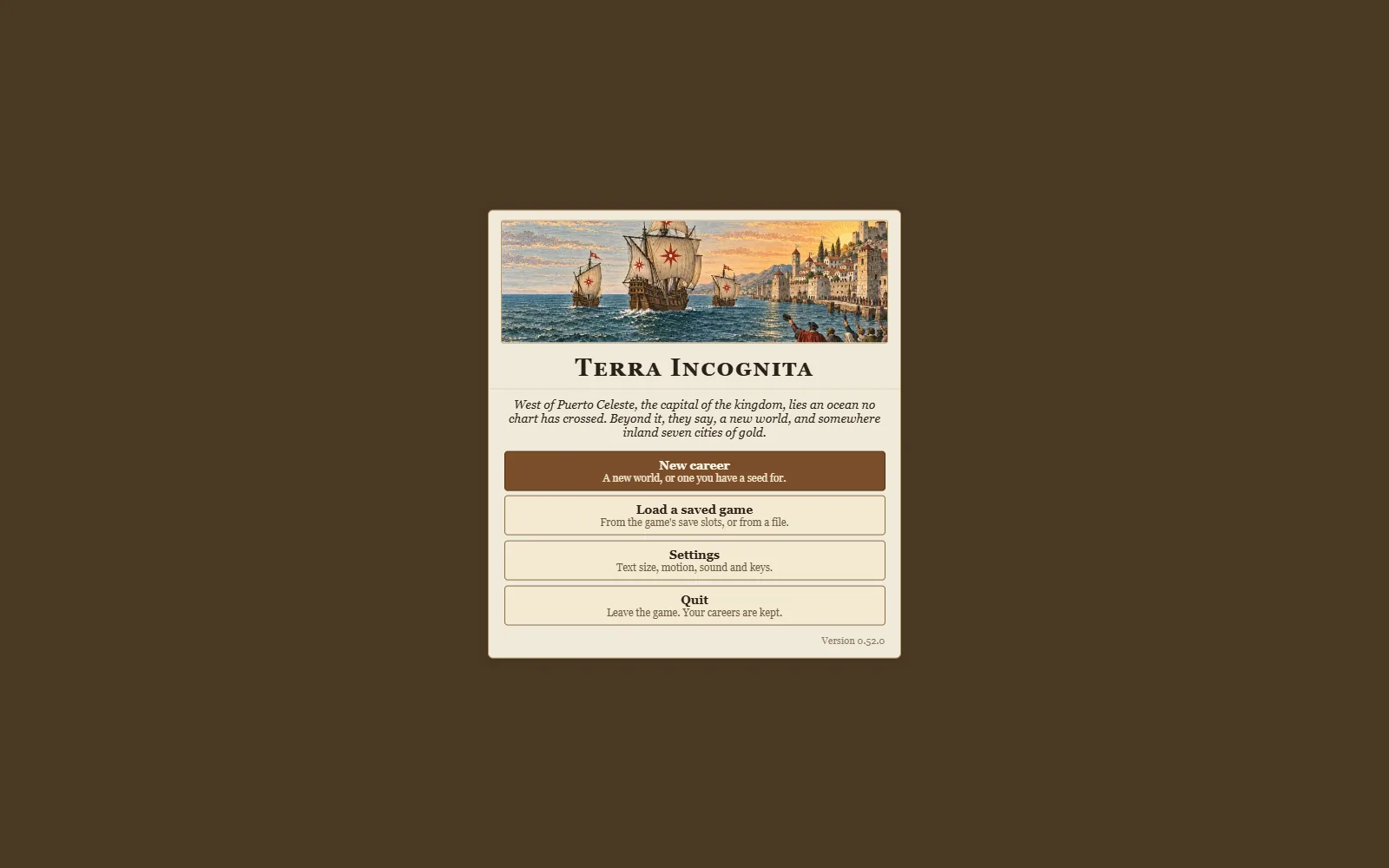
- Continue opens your latest unfinished career.
- New career starts a new one on a new world, or on one you have a seed for.
- Load a saved game opens the save slots, or a file you exported.
- Hall of fame lists your finished careers. It appears once you have finished one.
- Settings sets the text size, motion, sound and keys.
- Quit closes the game. Your careers are kept.
A new career
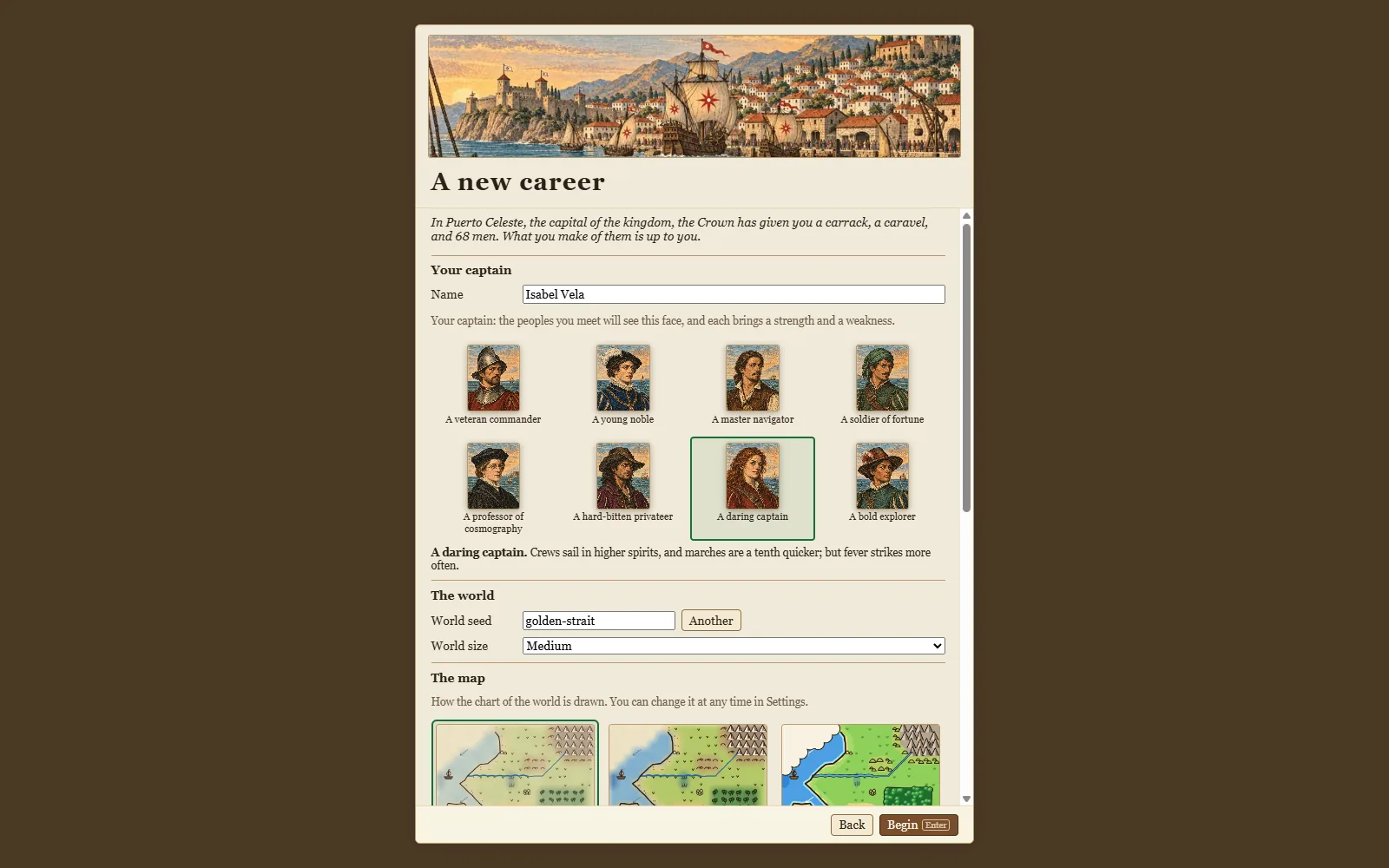
- Your captain. Type a name and choose one of eight portraits. Each captain brings a strength and a weakness (see Difficulty and captains). The peoples you meet see this face.
- The world. The seed names the world; Another picks a new one. Choose a small, medium or large world. The same seed and size always make the same world.
- The map. How the chart is drawn: six styles, each shown in a small picture. You can change it at any time in Settings.
- The Crown. The difficulty (Easy, Normal or Hard) and how much the Crown weighs your conduct (Low, Moderate or High).
- Your ambitions. Up to two goals for the career, if you want them (see The career and retiring).
Choose Begin, or press Enter. The first time the game runs, Easy is chosen for you.
The walk-through
Every Easy career asks, as it begins, whether you would like a walk-through. The game then stops at each new thing: the port, setting sail, the first shore and landing, the first settlement and visit, rivers and other firsts, and the homecoming. It dims the screen around the control or the place on the map and says what it does. Enter or Next goes on, Back goes back, and Esc skips that part. It ends by itself once you have seen the basics. You can turn it on or off for the career in play in Settings, on any difficulty.
Your first voyage in brief
- In the port, take the suggested outfit or a load-out, and choose Set sail.
- Run south to the easterly trade winds.
- Cross west with the wind behind you.
- When the ships lie beside the shore, go ashore with a party (L).
- Meet a people: click one of their settlements to visit it.
- March back to the ships (B), go aboard, and sail home (B again).
On a first voyage this plan sits in the tasks card beside the compass and ticks itself off as you go.
On Easy and Normal your first two voyages forgive: what would have killed your captain becomes a narrow escape, and on the first voyage no ship goes down.
The screen
The map fills the window. Land and sea you have not seen are blank. What your ships and parties see is charted as they go.
The top bar
- Your company as pictures and figures: soldiers, settlers, horses, bearers, trade goods and gold.
- Bars for food, morale and the ships’ hulls. The food bar is marked where the way home falls: at sea, the voyage home; ashore, the march back to the ships. Food short of the mark will not get you there.
- The date and the season where you are, and warnings such as scurvy, the cold or a summons home.
- The commands, each with its key: for example Go ashore, Carry on, Rest and Found a settlement. A command you cannot use now is drawn dashed; rest the pointer on it for the reason.
Rest the pointer on any figure, bar or button for what it means. With the keyboard, Tab moves through the buttons, and a focused control shows its tooltip.
The compass, the tasks card and the news
- The compass in the top-left corner has a blue vane that shows which way the wind blows where your company is.
- The tasks card beside the compass lists what is asked of you, in tabs: The Crown (its orders and how far along each is, a summons home, a rank the Crown has warned you about), Peoples (favors you agreed to do, with the days left) and Other (settlements short of food, and your ambitions). Folded, it is one line of counts. Press T or click it to open it, and click a task to see its place on the map.
- News shows in up to three notes under the top bar, newest on top. Click one to put it away. Routine news also goes to the log at the foot of the screen. A city of gold or a natural wonder gets a banner.
- The minimap shows the whole world. Click it to jump there.
Pointing and clicking
- Point at any square to see the route there and its cost in days and food. “≈” means the route crosses unexplored country.
- Rest the pointer on known land for a second and a half to see its people, forage, marching pace, rivers and season. Rest it on a settlement for what you know of it.
- The pointer turns to a hand over anything a click acts on. Click to sail or march there.
- If the map moved under the pointer since the route was drawn, the first click only shows the new route, and the next click goes.
Moving the view
Drag to pan, and scroll to zoom. The arrow keys or W A S D pan, and + and − zoom. While your company moves, the view follows it. Move the view yourself and it holds until the next move, or until you press Space.
What stops you
Danger always stops your ships or party: events, food warnings, the cold and storms. Sightings stop you as Settings say: by default only the important ones (cities, cities of gold, wonders, and the first coast after a crossing). A stop leaves your course drawn faintly; Carry on (C) goes on along it.
Map views and the journal
- 1 shows the map, 2 the reputation overlay (how each region feels about you), and 3 the rumor overlay (circles where rumors place a city of gold, a wonder or a town; blue pennants for the favors you agreed to do).
- J opens the journal, with tabs for discoveries, encounters, rumors, news, events, requests, settlements and voyages.
Six ways to draw the map
- Classic chart, the default: ink and light washes on parchment.
- Classic chart, sharpened: deeper colors, a bolder coast and crisper symbols.
- Bold storybook: bright color inside thick outlines, with cartoon clouds over the unknown.
- Engraved chart: black lines, hatched mountains and ripples along the coast.
- Painted relief: hills and peaks that cast shadows, a deep sea with bright shallows.
- Watercolor atlas: painted washes and symbols on cream paper.
The keys
| Key | What it does |
|---|---|
| W A S D or the arrows | Pan the map |
| + − | Zoom in and out |
| Space | Center on your company |
| Esc | Stop moving, or close the open panel |
| C | Carry on after a stop |
| R | Rest a day |
| F | Foraging on or off |
| L | Go ashore |
| B | Back to the ships, aboard from beside them, or sail home (just after boarding it asks first: press B again) |
| E | Go in: the village beside you, your settlement, or the market of the trading port beside the ships |
| G | Found a settlement |
| 1 2 3 | Map, reputation overlay, rumor overlay |
| J | Journal |
| T | Tasks: open or fold |
| M | Game menu: save, load, export, settings |
| F11 | Full screen on or off |
- Every key except Esc and F11 can be changed in Settings. Reset keys brings back the defaults.
- Holding a key acts once, except panning and zooming.
- In a dialog, Enter presses its main button, Esc closes it, and Tab moves between its controls. Each button shows its key.
Outfitting and the port
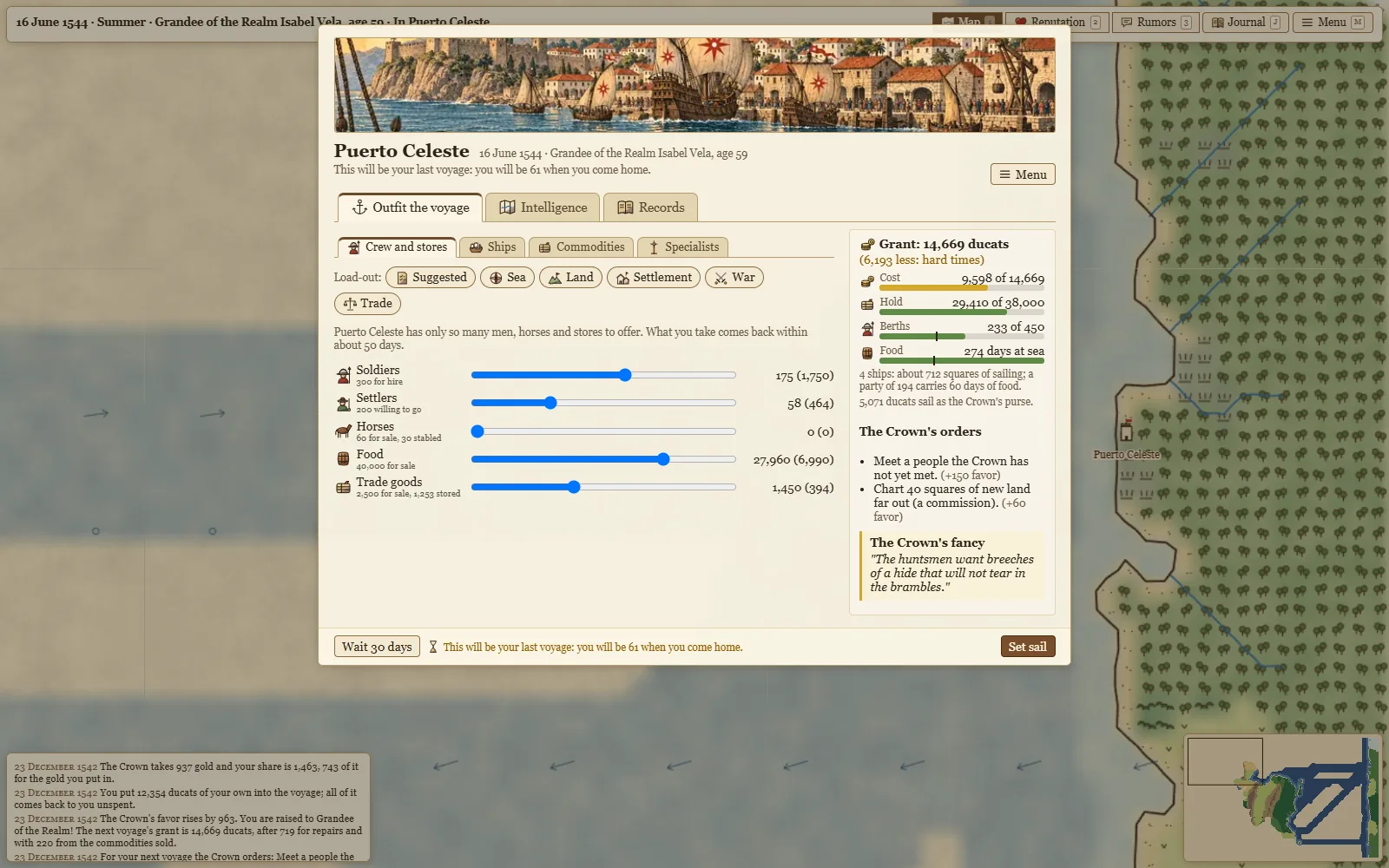
Between voyages you are in Puerto Celeste. The port has three tabs: Outfit the voyage, Intelligence and Records. The Menu button (or M) opens the game menu.
The Crown’s grant
You outfit each voyage with the Crown’s grant. On Normal the first grant is about 6,000 ducats. It grows with your rank, by up to half again after a voyage that won the Crown’s favor, and a little with good conduct; harsh conduct shrinks it. Easy grants a quarter more, Hard a tenth less.
Whatever you leave unspent sails with you as the Crown’s purse. It is spent first at the trading ports and in your capital, it never counts as gold found, and what is left goes back to the Crown.
Load-outs
A load-out fills the ships for the voyage’s purpose. Start from one, then adjust.
| Load-out | What it takes |
|---|---|
| Suggested | A balanced outfit within the grant. |
| Sea | Food above all and a small crew: the longest time at sea, for charting coasts. |
| Land | A moderate party, mostly settlers who eat less, and all the food the hold takes. |
| Settlement | Many settlers to found settlements, food for the crossing with some to spare, and some trade goods. |
| War | Mostly soldiers and plenty of food; no trade goods. |
| Trade | Settlers and some soldiers, enough food, and a hold full of trade goods. |
Crew and stores
| What | Price in Puerto Celeste | Notes |
|---|---|---|
| Soldiers | 10 ducats each | Crew the ships, fight, and eat a full ration. |
| Settlers | 8 ducats each | Eat half a ration and fight at half strength. They work the settlements you found. |
| Food | ¼ ducat a ration | One ration feeds one soldier for a day ashore. |
| Trade goods | 2 ducats a bale | For trade, gifts, guides, bearers and warriors. |
| Horses | 100 ducats each | Each takes two berths. See Landing and marching. |
Puerto Celeste has only so many men, horses and stores to offer, and the outfitter shows how many. On Normal it holds about 40,000 rations, 2,500 bales, 300 soldiers, 200 settlers and 60 horses; Easy has more, Hard less. What you take comes back within about 50 days.
Ships
| Ship | Price | Hold | Berths | Sailors needed | Character |
|---|---|---|---|---|---|
| Caravel | 800 | 3,000 | 40 | 15 | The fastest; light and least sturdy. |
| Carrack | 1,800 | 7,000 | 90 | 30 | The all-rounder. |
| Galleon | 3,600 | 14,000 | 160 | 55 | The slowest, biggest and sturdiest. |
- The suggested outfit buys up to four ships; you may buy more if you can pay for them and man them.
- The hold carries food, trade goods and commodities, one unit each (some commodities take more room). Gold weighs nothing.
- The slowest ship sets the fleet’s pace. A ship with less than half her hull sails slower, and a fleet without enough sailors sails at half speed.
- A ship sold fetches half her price. Repairs at home cost up to half a ship’s price, from wreck to whole.
Specialists
| Specialist | Price | At most | What for |
|---|---|---|---|
| Emissary | 400 | 2 | Opens an embassy of the Wayfinding. |
| Governor | 2,000 | 1 | Raises a fort or an embassy to a capital. |
| Trader | 500 | 2 | Founds a trading post. |
“At most” is how many a fleet or a party carries. Specialists you don’t use wait in port for the next voyage. When you reach the rank of Governor, the Crown sends you a governor free.
Food for the crossing
The food bar in the outfitter has a mark: food for a crossing and back on this world, 60 days on a small world, 90 on a medium one and 120 on a large one. The load-outs keep at least that much.
Orders, the commission and the fancy
The outfitter lists the Crown’s orders for the voyage, the commission from the rank of Captain-General, and the riddle of the Crown’s fancy. See The Crown and Commodities.
Setting sail, or waiting
Set sail starts the voyage. Wait 30 days passes a month in port, to sail in a better season. The outfitter warns you before your last voyage.
Intelligence
The Intelligence tab shows your charts, with rumors or reputation, the Crown’s orders, the favors you agreed to do, the rumors still to run down and your settlements. Each has a way to see it on the map. View the map sets the outfitter aside so you can look over your charts; Esc or Back to port brings it back.
Records
- Report: each voyage’s report, with its profit and loss: what it brought in, what it cost, and what was lost. Earlier and Later page through the voyages.
- Accounts: the whole career: where the money came from, what it went on, who paid, and each voyage’s profit or loss.
- The Crown: your rank, favor, conduct, wealth and ambitions, and, from 45, Retire.
- Discoveries: your finds, the Crown’s chart, and your islands, continents and rivers.
- Personal: your portrait, purse, the Crown’s gifts, your fortune and estate, and investing in the next voyage.
Sailing and the wind
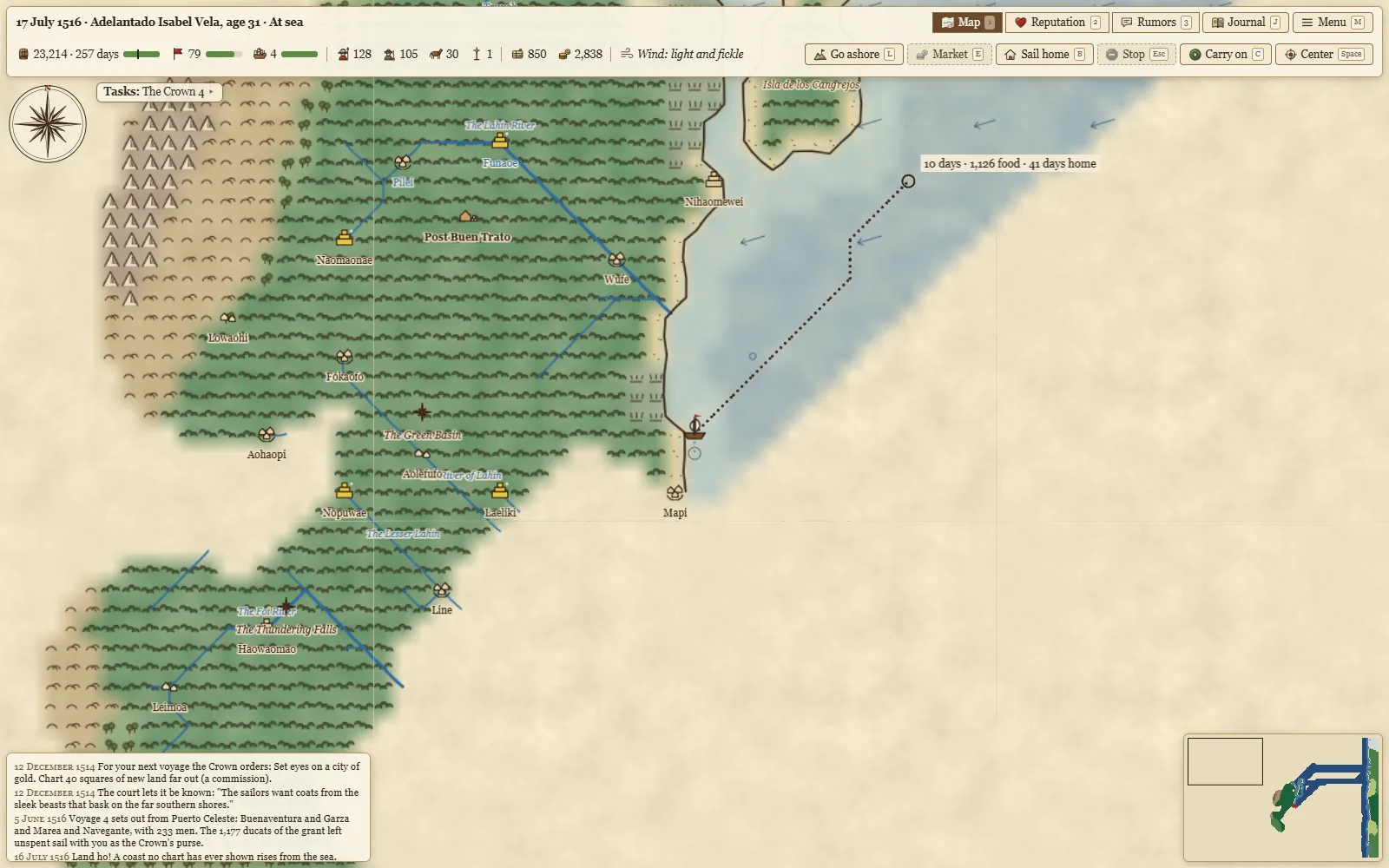
Point at a place to see the days there, the food it costs and the days home from there. Click to sail. Routes keep to charted water where they can, because uncharted water near coasts is riskier.
The winds
The wind blows by latitude, the same on every world. The compass vane shows it where you are.
| Latitude | Wind |
|---|---|
| 60° to the north pole | Polar easterlies: from the east, fairly light. |
| 35° to 60° north | Westerlies: strong, from the west. The road home. |
| 25° to 35° north and south | The horse latitudes: light and fickle. |
| 5° to 25° north | The northeast trade winds: strong and steady, toward the west. The road out. |
| 5° north to 5° south | The doldrums: nearly calm. |
| 5° to 25° south | The southeast trade winds: strong and steady, toward the west. |
| Beyond 35° south | The southern westerlies: strong, from the west. |
With the wind behind you, ships sail 1.4 times their normal pace; with the wind on the beam, at their normal pace; against it, at little more than half; in a calm, at 0.6. So heed the old pilot’s advice: run south to the trade winds to cross west, and come home on the westerlies farther north.
Storms
Storms can come at any time, more often in their seasons:
- Hurricanes from August to October between 8° and 30° north.
- Winter gales from November to February north of 40° north.
- Winter gales from June to August south of 40° south.
When a storm comes, you choose:
- Ride it out: the ships take a heavier beating, and the storm drags you about.
- Run before the wind: less damage, but the storm drives you far downwind.
- When land lies within a few leagues, make for its lee. Reach it and the land breaks most of the storm’s force; miss it and you take the storm full on.
Near land storms come less often than out at sea, but they hit harder and blow onto the shore. Claw off the shore and you take a heavier beating but may keep off the rocks; Run before the wind and the storm drives you onto them. A fleet thrown on the shore takes far more damage and loses men in the surf.
Damage and repairs
Ships below half their hull sail slower, and a ship at nothing founders. Repairs are made at home, at the trading ports, and at a capital’s shipyard in the New World.
A restless crew
After a month at sea with low spirits, the crew may grow restless. You can turn back for home (the voyage may then sail only for home), promise them a share of the treasure (a tenth of the gold, paid at home), or refuse and press on. Very low spirits can end in mutiny.
The trading ports
Two cities of the kingdom stand on the home coast south of Puerto Celeste: Bahía Alvar, toward the middle of the map, and Cabo Sereno, far to the south. On Easy both are open; on Normal only Bahía Alvar; on Hard neither. Sail in by clicking the port; E or Market opens its market.
- Buy food (0.4 ducats a ration), trade goods (3 a bale), soldiers (20), settlers (15) and horses (150), and repair your ships.
- The merchants take bills on your own funds in Puerto Celeste first, then the gold aboard. The Crown’s purse is spent first of all.
- They hold a tenth of what Puerto Celeste has and restock more slowly.
- Once a voyage in each port you can buy the sailors a round (100 gold) for their tales: an unseen city of gold or natural wonder, marked on your chart within 8 leagues.
- Putting in gives the crew fresh food and lifts their spirits.
Nothing on the home coast follows the seasons, and its coasts hold nothing to discover.
The Crown’s summons
After two years away, the Crown may summon you home. It expects you within 180 days, and every day beyond costs 3 favor.
Sailing home
Click Puerto Celeste, or press B at sea. A route that only crosses the water by Puerto Celeste sails on by; only an order for home ends a voyage.
Food and scurvy
Rations
- Ashore a soldier eats one ration a day and a settler half a ration. A horse eats one and a half.
- At sea, and aboard ships at anchor, everyone eats half that: biscuit and salt fish keep.
- Easy needs a little less food and Hard a little more. The bold explorer’s food goes a tenth further.
- Ships at anchor fish while they wait, so the men aboard may live on fish.
Food warnings
As the stores fall toward what the way home will take, the game stops you and warns you: two early warnings and a last one on Easy, one and a last on Normal, and only the last on Hard. Hover a route for the food it costs, and keep an eye on the mark on the food bar.
Running out
A starving company loses men every day, and its spirits sink. At sea, the crew may ask to eat the horses (a hundred rations each). Forbid it and the crew starves until a seventh of it is dead, then means to eat them anyway. Forbid it again and, when a tenth more have died, they put you in chains, eat the horses and sail for home on their own.
Fresh food
The peoples sell food for trade goods: a bale fetches 8 rations on Easy, 6 on Normal and 4 on Hard from a neutral people, more from friends. Friendly peoples also feed a visiting expedition once a season. Foraging ashore makes the food go further (see Landing and marching).
Scurvy
After about five months without fresh food, from a landing or a port, scurvy may break out aboard, likelier every day. Then men die every day until the fleet lands or puts into a port. What cures it depends on the land: pine-needle tea in the snow, dates or cactus fruit in the desert, limes and guavas in the jungle, rose hips and spruce tips in the forest, wild onions on the plains. On Normal a snowy shore yields a cure only one time in three, and on Hard less often. Then the first step onto land without snow cures it.
Landing and marching
Going ashore
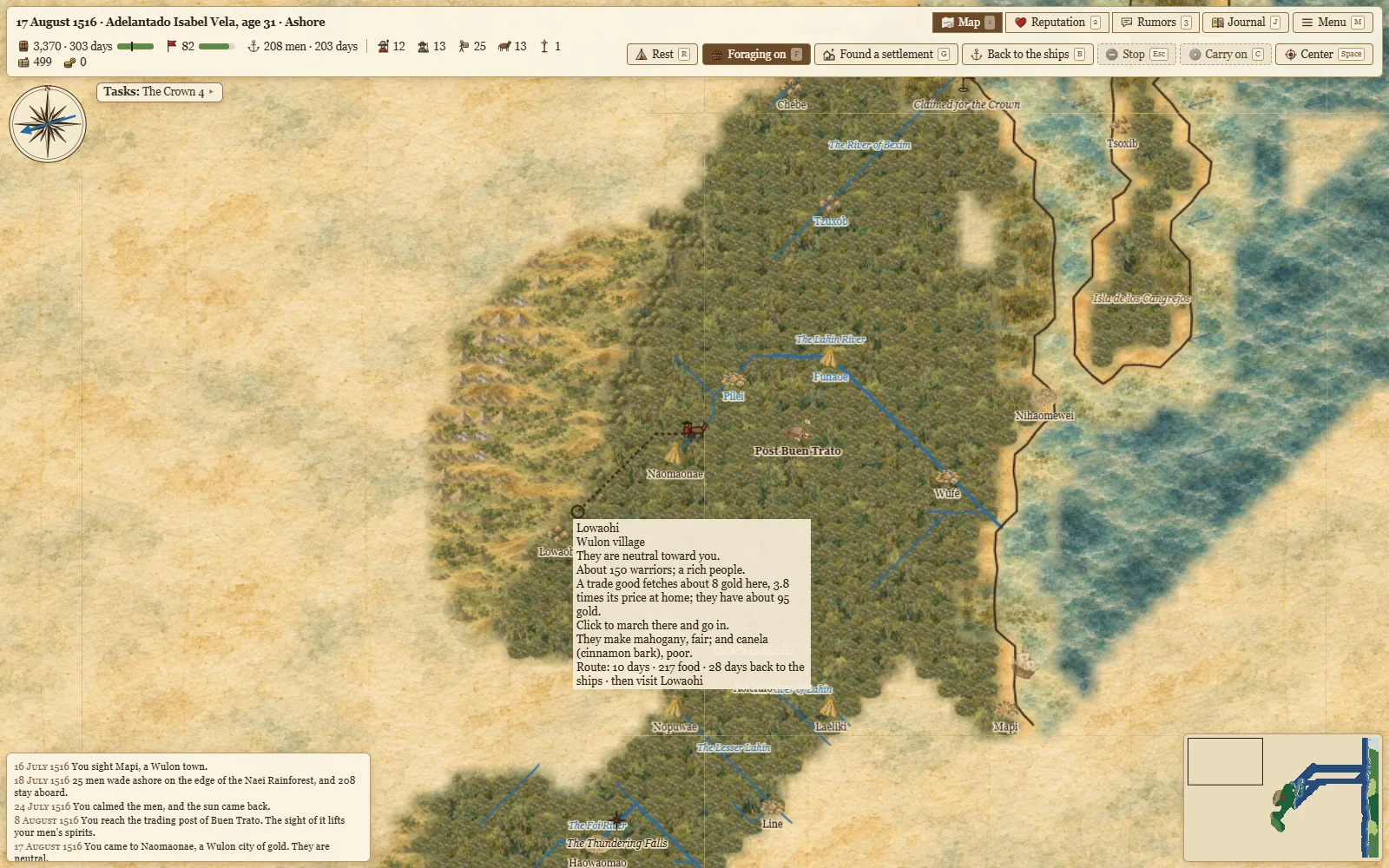
Going ashore is never automatic. When the ships lie beside a shore, click it (“Click to go ashore”), press L, or use Go ashore. Click a coastal village from the ships and they sail beside it and open the landing there.
The landing dialog sets the soldiers, settlers, horses, food and trade goods that go ashore. A quarter of the sailors the ships need must stay aboard. The dialog says how long the ships can wait on what is left aboard.
Your first landing in the New World plants the royal standard and claims it for the Crown.
Carrying
- Each man carries 60 units of food and goods. Gold weighs nothing.
- A horse carries four men’s loads, and a bearer one man’s load.
- The party carries its own food; the ships cannot feed it.
Marching
Click to march. The days for each league depend on the land:
| Land | Days a league | Land | Days a league |
|---|---|---|---|
| Coast, grassland | 0.75 | Hills | 1.5 |
| Forest, desert, tundra | 1.1 | Jungle | 1.8 |
| Along a river | 0.5 | Swamp | 2.2 |
| Crossing a river | +1 (+2 a great river) | Mountains | 3 |
A step to the side costs a little more than a step straight. A guide makes marches a fifth quicker. Snow slows a march (see Seasons and the cold).
Seeing
A party sees 3 leagues around it, 4 from hills, 5 from mountains, and 2 in forest. Ships see 3 leagues. The professor of cosmography sees a league farther ashore, and so does a party with bearers who know the land.
Foraging
Foraging is on unless you switch it off (F). Each step takes a quarter longer, but the men eat less: half as much on plains and in forest, less saved in hills and swamp, little in the desert or the mountains. Switch it off to move faster when food is plentiful.
Horses
- With a horse for every two people, the party marches half again as fast; with one for everyone, twice as fast.
- A horse for every soldier makes them cavalry, a quarter stronger in a fight. Otherwise horses add nothing to a fight, and they die in battles lost like the men.
- Horses that come home are stabled free for the next voyage.
Resting and camping
Rest (R) passes a day in camp, and the men’s spirits rise. Camped beside a friendly settlement they rise faster. Inside one of your forts a camp is safe from ambush; in hostile country the button warns you of the risk.
Morale
The men’s spirits start at 70 out of 100.
- They rise when you go ashore, sight land, rest, find gold, meet a friendly welcome, and reach one of your settlements (more at an embassy or a capital, once a month each).
- They fall with long days at sea, hard marches and mountains, hunger, the cold, losses, storms and every battle lost.
- Each rank you hold takes 6% off every loss of spirits, up to 45%.
- Below 40, the men may refuse a hostile act. Below 35, men begin to desert. Very low spirits bring mutiny: ashore, they will march only back to the ships unless you hang the ringleaders.
Fever
Fever strikes in jungle and swamp, less often on Easy. Rest until it passes and fewer men die, and you are safe; press on and more die, and it may take you too. Carrying 10 or more units of cinchona bark halves the chance of fever.
Back to the ships
Click your ships, or press B, to march back; click them again, or press B, beside them to go aboard. The way back keeps to country you know unless an unexplored shortcut saves a long way round. You are warned when the party’s food is down to the march back plus whatever the ships will lack for the voyage home.
If the ships cannot take everything the party has, you choose what to leave ashore. Men, horses and stores you leave go to your nearest settlement within 12 leagues; with none near, they are lost.
Seasons and the cold
The game starts on 1 March 1510. The north is coldest around 13 January and the south half a year later. Within 23.5° of the equator there is no autumn or winter; the tropics have a dry season and the rains. The top bar shows the season where you are.
- Autumn: forests turn orange, red and brown.
- Winter: snow lies where it is cold enough, first on the mountains and in the far north, and the map whitens.
The cold
- In deep snow a march takes up to 80% longer, the men eat up to half again as much, and foraging finds little.
- The deeper the cold, the likelier it takes men to frostbite and exposure, most on the march. Camping halves the risk; camping in forest or jungle, beside a friendly settlement or in one of yours quarters it.
- Route hovers, the landing dialog and the top bar warn you of the cold, and a cold spell stops you.
The peoples’ stores
Native stores follow the seasons: little to trade, give or plunder in winter, more in spring and summer, and plenty after the autumn harvest. They refill fastest in autumn and slowest in winter. Bigger places store food, so the seasons swing a town’s stores less than a camp’s, and a city’s less still.
Commodities
Each commodity comes in its own season: outside the tropics by the hemisphere’s seasons; inside them, in the dry season or the rains. A village’s card says whether what they make is in season.
Choosing when to sail
Storms have their seasons too (see Sailing and the wind). Wait 30 days in the outfitter lets you sail in a better one.
The peoples
The New World has its own peoples, each with its own lands, temperament and kind of country. They live in camps, villages, towns and cities, and a few of the richest peoples guard the seven cities of gold. Your captain’s face is the one they see.
Attitudes
Each place has an attitude toward you from −100 to 100, shown as a bar when you visit:
| Attitude | Range | What it means |
|---|---|---|
| Hostile | below −50 | They may attack you, ambush your party and come after you. |
| Wary | −50 to −15 | They pay a fifth less and hire out no bearers. |
| Neutral | −15 to 15 | They trade and hire out bearers. |
| Friendly | 15 to 50 | They pay more, guide you, feed you, ask favors and send warriors. |
| Devoted | 50 and above | Guides for nothing, gold with their hospitality, and they may invite you to stay. |
Peaceful peoples start warmer, warlike ones cooler. News of what you do spreads from region to region, the bad faster than the good, and slowly fades. The reputation overlay (2) shows how each region feels.
Visiting
Click a settlement and your party marches to its doorstep and goes in. Beside one, a click or E goes in. An event, an ambush, the cold, hunger or another order on the way calls the visit off.
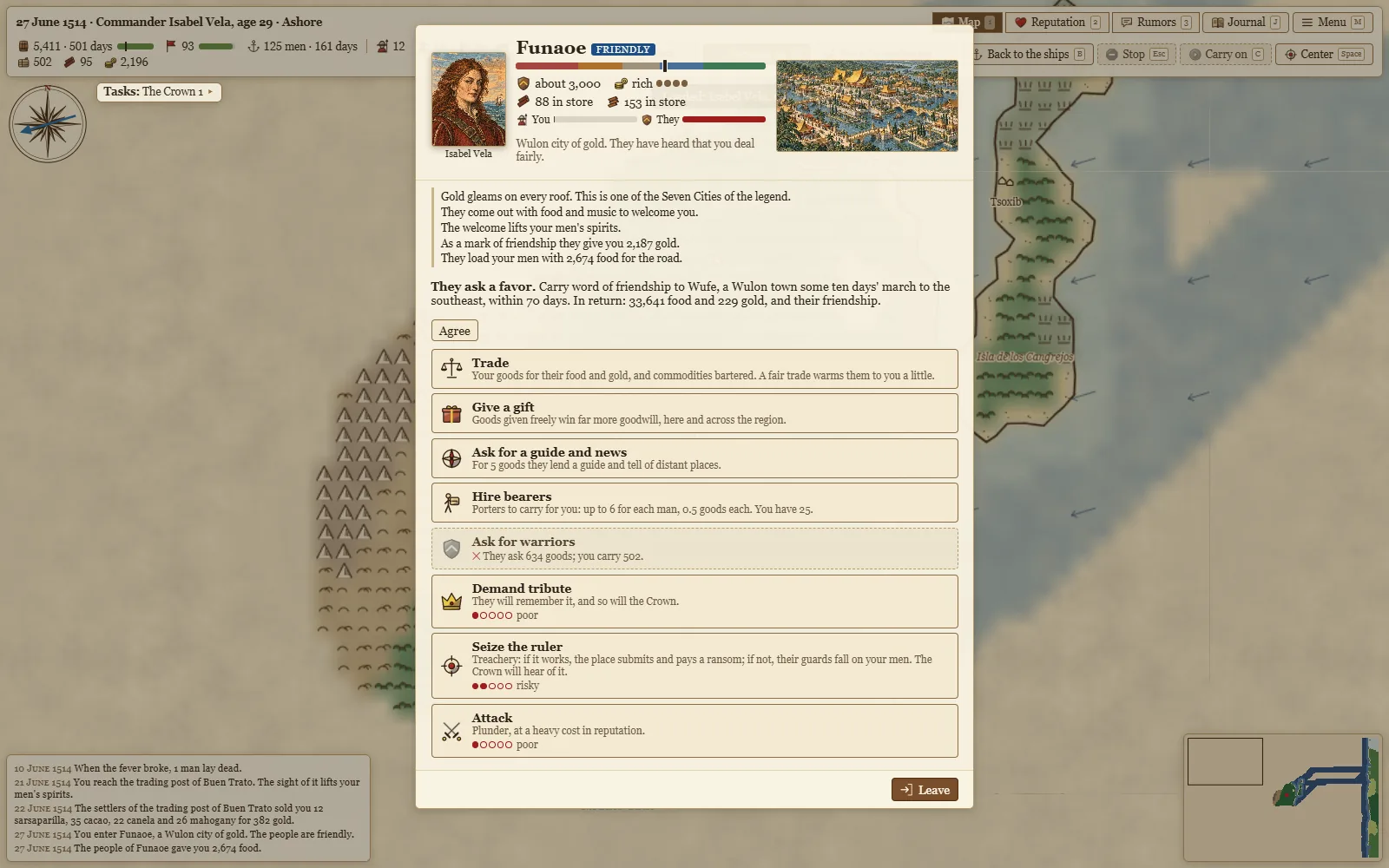
Your portrait faces a picture of the place. The panel shows where they stand toward you, their warriors and wealth, what they make, and your strength against theirs. Tribute and an attack show their odds on five pips.
Trade
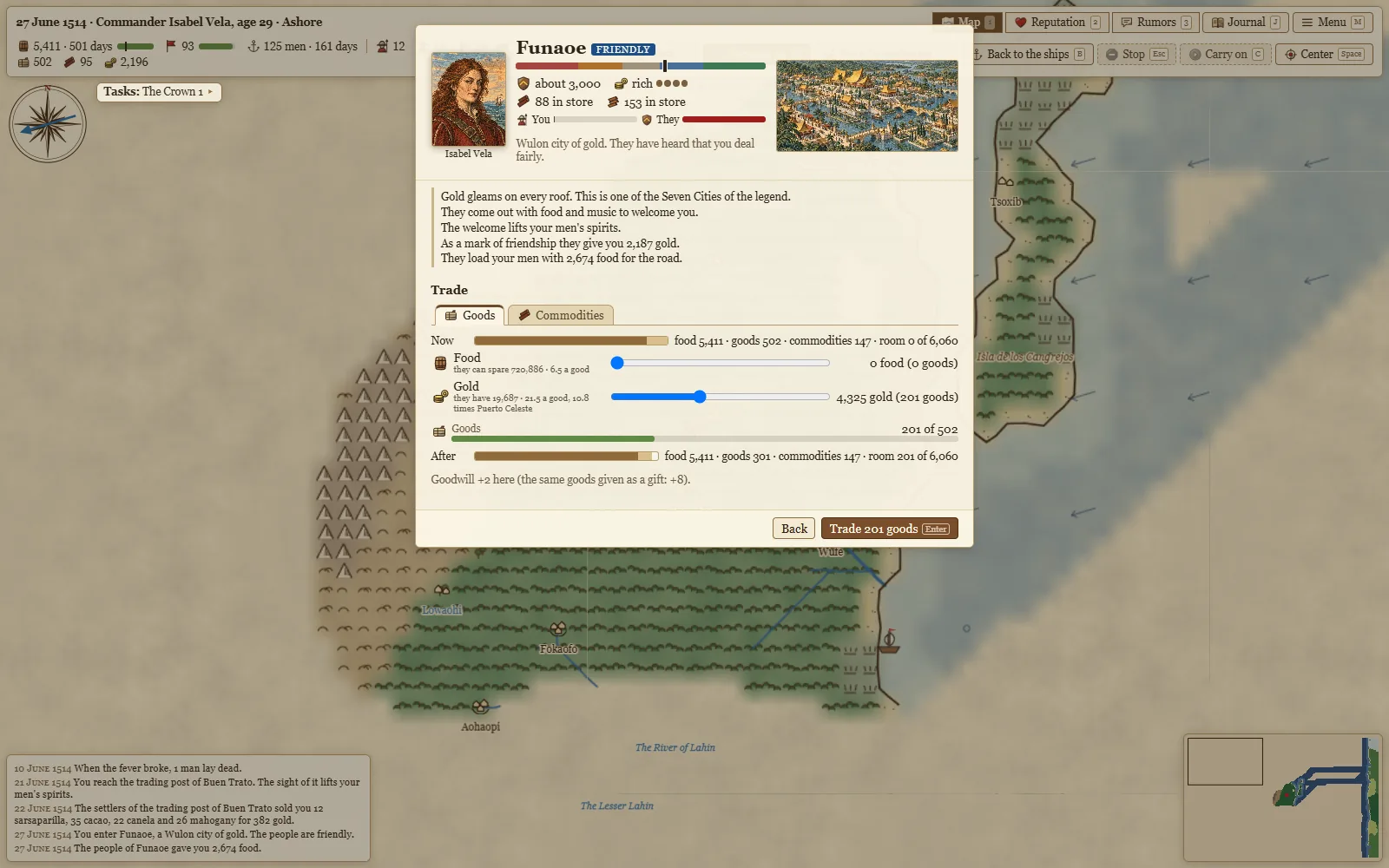
Trade has two tabs, Goods and Commodities.
- Goods: trade goods for food and gold, in one deal. A bale bought for 2 ducats at home fetches about twice that in gold in a poor village, more among richer peoples and in bigger places, about five times in a rich city, and ten times in a city of gold. Friends pay up to 40% more, the wary a fifth less.
- A place pays only with the gold and food it has. Gold traded away comes back slowly: a village or a town fills again between voyages, but a city of gold you empty has under a third of its gold by your next voyage. The best trade is with places you have not sold to yet.
- A fair trade earns a quarter of the goodwill the same goods would earn as a gift.
Barter
- On the Commodities tab you buy their wares with goods or commodities. They ask a share of the home price, 40% for staples, 25% for prizes and 10% for treasures, and less as they like you.
- They buy your commodities with food, gold or wares. They pay little for what they make themselves, and more in bigger, richer places.
- Wanted commodities. Many places seek a commodity they don’t make and pay three times as much for it. The tab always shows what they seek, and the visit, the hover card and the map tell you when you carry it.
- The peoples take no gold from you. Food, guides, bearers, warriors and wares are paid in goods or commodities.
Gifts
Give a gift of trade goods wins far more goodwill than trade, here and across the region, and improves your record of conduct a little.
Guides and news
Ask for a guide and news. Only friends will guide you; friendly peoples ask a few goods, devoted ones nothing. Their elders sketch the country around for you, and a guide travels with you for 10 days, making your marches a fifth quicker. They also tell you rumors.
Bearers
- Most peoples who are not wary of you hire out bearers: 1 to 6 for each soldier and settler, as many as the place can spare, for goods by the head, cheaper the better they like you.
- Each bearer carries a man’s load and eats nothing.
- Hiring new bearers sends the old ones home, and all go home when the party goes aboard.
- They are as loyal as their village was friendly: after a fight, some may run off with what they carry.
- Bearers from a friendly or devoted village know the land: foraging slows the march only half as much, and the party sees a league farther.
Warriors
A friendly or devoted place will send some of its warriors to march with you for 60 days, for a few goods each, and more for the side you took in a feud. Ask for warriors. They fight beside you in every battle except against their own town, and against their own people less keenly. After a defeat they may go home. With warriors from a city of gold’s neighbors, a strong force has a fair chance of storming it.
Hospitality and requests
- Friendly peoples feed a visiting expedition once a season, and devoted ones add gold.
- Friendly places ask favors: carry word to another settlement, bring them trade goods, or scout a place and come back to tell them. Agree in the visit.
- Open requests are in the journal (Requests), on the tasks card under Peoples, and marked with blue pennants on the rumor overlay (3). Each has a deadline, and its reward is food, gold and goodwill.
- Requests still open when you sail home lapse without blame; the way home warns you first.
Rumors
Friends tell rumors of towns, wonders and cities of gold. Rumors of the same place grow sharper as you collect them: the rumor overlay (3) shows the tightest circle for each.
Tribute, seizing and attacks
- Demand tribute: if they give way, they hand over half their gold and much of their food, and remember it. If they refuse, they may fight. Tribute brings out no war parties.
- Seize the ruler of a town or city that has received you. The stronger you are against them, warriors included, the likelier it works. If it does, the place submits and pays a ransom of most of its gold; if not, its guards fall on your men.
- Attack to plunder most of what they have, at a heavy cost in reputation. Every attack brings war parties out in that country for months, even among friends.
- Each costs conduct and the region’s trust, and the Crown notices. A hostile place may come after you when you leave.
- A town you take can be garrisoned as a fort or become an embassy (see Settlements).
Fighting
A soldier with steel and powder is worth about two and a half warriors; a settler half a soldier; cavalry a quarter more. Towns and cities are harder to take than villages, and a city of gold hardest of all. Winners lose some men, losers many; the captain may fall in a lost battle (on the first two voyages on Easy and Normal, your men carry you from the field instead). When you are ambushed, stand and fight, or fall back and drop baggage to lose fewer men.
Refusals
Men in low spirits may refuse to attack, seize or demand tribute. See The Wayfinding.
The Wayfinding and embassies
The Wayfinding is the kingdom’s philosophy: peaceful coexistence with all beings. Its sign, the navigator’s star, is also the Crown’s emblem, on every sail and banner.
Hostile acts weigh on the men
- Attacks, seizures and demands for tribute wear on the men. The first leaves them unmoved, but each further one within a month costs morale, more for each one before it.
- An officer, the men or an emissary reminds you of the Wayfinding’s tenets, at most once a month, and the Crown reminds a cruel captain.
- Below 40 morale, the men may refuse a hostile act. The deeper their spirits, the likelier, and more so on Hard and under a Crown that cares about conduct. The button shows “The men may refuse” and the odds first. A refusal holds at that place for some days while their spirits stay low.
Conduct
The Crown keeps a record of how you treat the peoples: Merciful, Fair, Stern or Brutal. Gifts and fair dealing raise it; tribute, seizures and attacks lower it, attacks on friends most. Conduct counts in the Crown’s favor (how much depends on the career’s setting) and in the size of your grants.
Embassies
- An embassy opens only in a people’s town: one you have taken, or one whose people are devoted to you and invite you.
- It needs an emissary with the party, hired in Puerto Celeste. In a town you have taken, at least 15 of your men stay to hold it.
- An embassy warms the region around it and lifts the men’s spirits when they visit.
- Lodge a governor there and it can become your capital.
A devoted village that invites you may also offer to join you as a fort: some of its people become your settlers, led by five of your soldiers.
Settlements and the capital
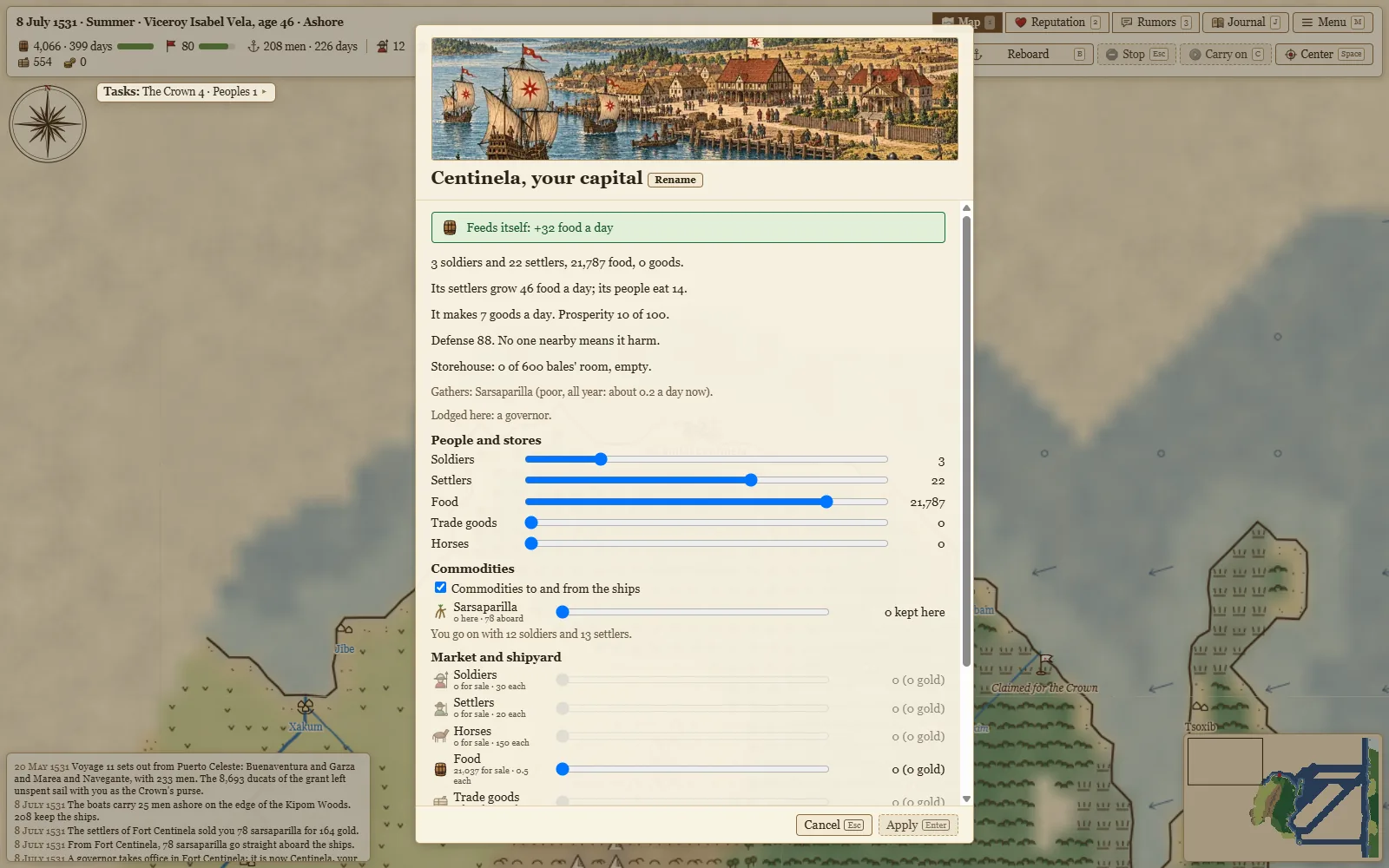
Settlements leave people behind for good. Ashore, use Found a settlement (G). Not on a mountainside, not inside a native settlement, and not within 2 leagues of another of yours. Name it as you found it; the name box offers one from home.
| Kind | Needs | What it does |
|---|---|---|
| Fort | At least 12 men stay | Holds men, food and goods. Camping inside is safe from ambush. Storehouse room 100. |
| Trading post | A trader and at least 5 men; open ground 3 leagues from any settlement | Trades with the peoples around it: gold reaches the Crown with each voyage, and a fifth of its takings comes to you every month. Its fair dealing slowly warms the region, and brigands leave friendly country alone. Storehouse room 150. |
| Embassy | An emissary, in a town you have taken (at least 15 men stay) or one that invites you | Warms the region and lifts the men’s spirits. Storehouse room 200. |
| Capital | A governor lodged in a fort or an embassy where 25 or more people live, 10 of them settlers | A home in the New World, one in each people’s lands: a market, quays and a shipyard. Storehouse room 600. |
Fields and food
At every kind of settlement the settlers farm, the same all year. Each settler grows their own food and part of a soldier’s, by the land within two leagues. Soldiers, horses and specialists only eat.
| Land around | Settlers to feed 10 soldiers |
|---|---|
| Grassland | 4 |
| Coast | 5 |
| Forest | 6 |
| Jungle | 8 |
| Hills | 10 |
| Swamp | 13 |
| Mountains | 20 |
| Tundra | 25 |
| Desert | 40 |
A river through the settlement or beside it halves the settlers needed. Each settlement shows whether it feeds itself (“Feeds itself: +6 food a day”) or how long its food lasts and how many more settlers would feed it. Under 60 days its name on the map carries a warning mark, the tasks card lists it, and the journal warns you, again under 30 days. The founding dialog forecasts the same as you choose the people and food to leave.
The settlement’s screen
Stand in a settlement and click its name on the top bar, press E, or click it. Click one of yours elsewhere and the party marches there and opens it on arrival. The screen shows what it grows, eats and earns and its defenses. Here you move men, settlers, horses, food, goods and commodities in and out, lodge specialists, and rename it.
The capital
- Its settlers make trade goods, and as it prospers people come to its market, where you buy soldiers (30), settlers (20), food (0.5 a ration), goods (4 a bale), horses (150), and traders (750) once it prospers. Emissaries and governors still come from Puerto Celeste.
- Its quays put what you buy straight aboard ships anchored within 4 leagues, and its shipyard repairs them for gold.
- You pay with the party’s gold, then, when the ships lie near, with the gold aboard, the Crown’s purse first.
Storehouses
Your settlements gather what their land yields, in season: more at a capital, less at a fort. A trading post gathers nothing itself but takes a share of what the villages within its reach harvest. Storehouses fill while you are home. Collect them on the settlement’s screen; when your ships lie at anchor within 4 leagues, they can go straight aboard. What the settlers gathered they sell to you for gold; what your expeditions left there comes back free. Nothing is shipped home by itself.
Attacks
Any settlement near hostile peoples or brigands may be attacked; the nearer they live, the likelier. One that is overwhelmed is lost with everyone in it. You hear of each attack, and a settlement lost is reported at the homecoming of the voyage it fell on. Keep enough soldiers in settlements near trouble.
Towns taken and joined
A town you take by force can be garrisoned as a fort, or, with an emissary, opened as an embassy. A devoted village may offer to join you. A town taken or joined keeps its own name.
Commodities
Beside gold, the New World yields 33 commodities in three tiers, priced by what a unit fetches in Puerto Celeste.
| Tier | Price at home | Commodities |
|---|---|---|
| Staples | under 10 ducats | salt cod, maple sugar, deerskins, agave fiber, chili peppers, cotton, sarsaparilla, sassafras, yerba mate, tobacco, allspice |
| Prizes | 10 to 34 ducats | indigo, seal pelts, bison robes, brazilwood, cacao, canela (cinnamon bark), beaver pelts, balsam, fine furs, mahogany, mast pines |
| Treasures | 35 ducats and up | tortoiseshell, turquoise, cinchona bark, featherwork plumes, vicuña wool, amethysts, cochineal, vanilla, pearls, emeralds, unicorn horn |
Where they come from
- Each comes from its own land and latitude, in its own season: cacao from jungle near the equator, beaver from northern forest beside a river, seal pelts from the far southern coasts.
- Each place yields at most two, rated poor, fair or rich, and the scarce ones are rare.
- A people you have met says on its card what it makes, and known land says what it is good ground for.
- Villages keep a store of what they make, filling in season and slowly used up out of season, more in bigger and richer places.
Room in the hold
A unit takes a bale’s room. Bison robes take 2, brazilwood and mahogany 3, and mast pines 5. Gold weighs nothing.
Getting them
- Barter with the peoples (see The peoples).
- Your settlements gather what their land yields, and trading posts take a share of the villages’ harvest (see Settlements).
- Tribute and plunder take commodities in the same share as gold.
- Gold buys commodities only in your own settlements, from what the settlers gathered, and in the kingdom’s cities.
Selling them at home
The Crown’s factors in Puerto Celeste buy every commodity when you come home. A market takes only so much at full price: 225 units of a staple, 110 of a prize and 30 of a treasure. Beyond that each unit fetches less.
- The Crown takes half of the sale. Of the rest you keep 40% on Easy, 60% on Normal and 80% on Hard, and the remainder goes into the next voyage’s grant.
- Every 20 ducats of the sale earn one favor, weighed as gold. Commodities pay mostly in money; exploring stays the way to the Crown’s favor.
- On Easy, sailing home with commodities aboard asks first, with what they would fetch.
- The homecoming’s step The cargo sold lists each commodity’s price and how the sale splits.
The Crown’s fancy
Before each voyage the court lets it be known, in a riddle, what it longs for: “His Majesty finds his morning drink thin and bitter.” Bring it home and its sale earns six times the favor, on what the market takes at full price. It is always something a people of this world makes. On Easy a courtier names it; on Normal and Hard you must work out the riddle. Staples and prizes come early in a career, treasures likelier from Captain-General. The riddle appears at the audience, in Intelligence, the outfitter, the journal, and under The Crown in your tasks.
Carrying 10 or more units of cinchona bark halves the chance of fever.
The Crown
Favor
The Crown weighs your favor voyage by voyage, when you come home. Your total favor sets your rank.
| What earns favor | Favor |
|---|---|
| Gold brought home | 1 for every 10 gold |
| Commodities sold | 1 for every 20 ducats |
| Each new square of land charted | 2 |
| Each new square of coast charted | 3 |
| First contact with a camp, village, town or city | 10, 20, 50, 120 |
| A city of gold, first seen | 1,000 |
| Claiming the New World (your first landing) | 300 |
| A natural wonder | 300 |
| A river, its mouth, its source | 40, 60, 150 |
| An island, a continent | 60, 200 |
| A fort, a trading post, an embassy, a capital | 100, 120, 150, 400 |
| Each order carried out | 150 to 600 |
| Good conduct | by the career’s setting |
Favor is lost for every ship lost (150) and man lost (2), for half the worth of each order ignored, for cruelty, for coming home late after a summons (3 a day), and for any shortfall below what the Crown expects of your rank. A voyage can lose favor overall.
How the Crown judges you
Each career chooses how much the Crown weighs your conduct against gold:
- Low: the Crown cares mostly for gold. Gold counts half again, and your treatment of the peoples a quarter. A raider prospers best here.
- Moderate: both count as they are.
- High: the Crown judges how you treat the peoples you meet: three times the weight, and gold counts three quarters.
Ranks
| Rank | Favor in all | Grant |
|---|---|---|
| Captain | 0 | ×1 |
| Commander | 2,500 | ×1.2 |
| Captain-General | 5,500 | ×1.45 |
| Adelantado | 9,000 | ×1.7 |
| Governor | 13,000 | ×1.95 |
| Marquis | 18,000 | ×2.15 |
| Viceroy | 25,000 | ×2.3 |
| Grandee of the Realm | 35,000 | ×2.45 |
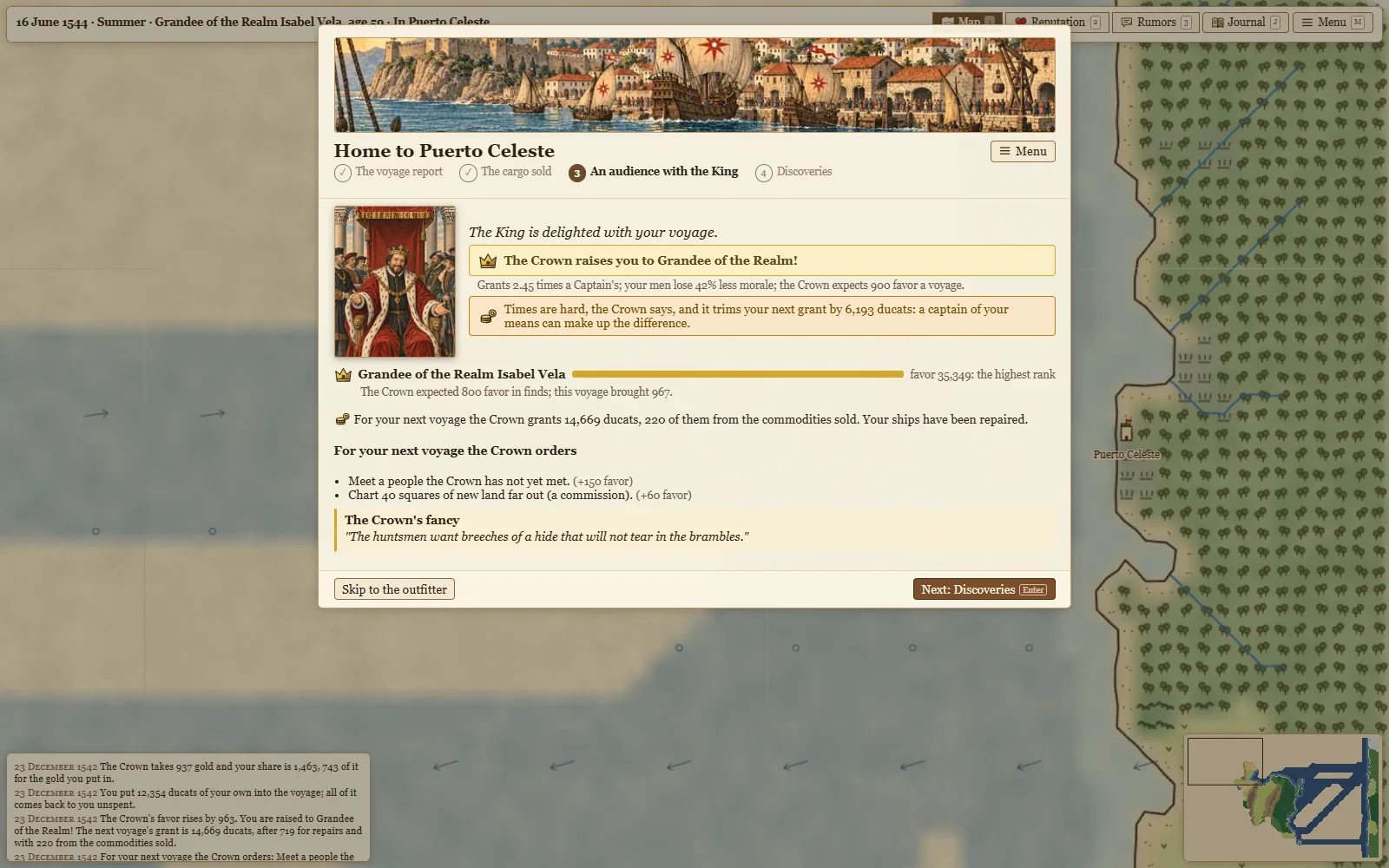
A promotion or demotion says what it changes: the grant, how much losses weigh on the men, and the favor the Crown expects of a voyage. Rank follows favor both ways. If your favor falls below your rank, the Crown first warns you that its patience wears thin; if the next voyage leaves it there too, it strips you of the title.
What the Crown expects
From Captain-General up, the Crown expects favor in finds every voyage: 400 at Captain-General, and 100 more for each rank above, up to 900 for a Grandee. Hard expects half again, and the young noble a little more. The tasks card shows the expectation with what you have so far, and the audience shows what the voyage brought against it. Below Captain-General no shortfall is counted.
Orders
The Crown may give a voyage up to two orders, only ones that can still be done. Each one carried out earns favor; each one ignored costs half its worth.
| Order | Favor |
|---|---|
| Find the lands that lie across the western ocean | 200 |
| Find 3 new rivers | 150 |
| Meet a people the Crown has not yet met | 150 |
| Chart 40 squares of new coastline | 150 |
| Build a fort in the New World | 150 |
| Found a trading post | 200 |
| Bring home gold (about what your last voyages brought) | 200 |
| Open an embassy of the Wayfinding in a native town | 250 |
| Find one of the wonders the natives speak of | 250 |
| Trace a river to its source | 250 |
| Set eyes on a city of gold | 400 |
| Raise a capital from one of your forts or embassies | 500 |
The gold order comes only once a voyage has brought home 600 gold or more.
The commission
From Captain-General up, every voyage also carries the Crown’s commission: chart 40 squares of new land far out, 30 or more squares past the New World’s nearest shore. It is worth 600 favor (much less from Marquis up), and nothing is lost if you don’t. It keeps the later voyages worth sailing once the near coast is charted.
The audience
Every homecoming brings an audience with the King or the Queen, heralded by trumpets. The monarch’s face shows how the voyage measured up, in seven moods from angry to elated. You hear the Crown’s verdict, your rank and grant, and the next orders.
The Crown’s gifts
At each audience the Crown rewards the voyage’s discoveries (charting, first contacts, cities of gold, wonders and rivers, claiming the New World) with a gift worth half a ducat for each point of favor they won:
- a purse of gold;
- a gold chain (from 250 ducats);
- a jeweled sword (600);
- a house at court (1,000);
- an estate (1,800);
- lands in the New World (3,000);
- a lordship with a coat of arms (4,500).
Gifts count toward your fortune, but they are not money to spend.
Hard times
After a voyage that made you at least 500 ducats of your own, if you hold 2,000 or more, the Crown pleads an empty treasury and trims your next grant by a quarter of your wealth, at most 30% of the grant. Your own money can make up the difference in the outfitter.
Discoveries
Whatever your ships and parties see is charted. New land and new coast earn favor, and the Crown’s chart grows with every voyage.
Claiming the New World
Your first landing plants the royal standard and claims the New World for the Crown, which rewards it.
Natural wonders
Eight natural wonders lie somewhere in the New World: the Sea of Grass, the Whispering Forest, the Green Basin, the Glass Sands, the White Silence, the Smoking Mountain, the Great Chasm and the Thundering Falls. Peoples speak of them, and some will ask you to go and see one. A wonder gets a banner and an engraving when first seen, and its mark on the map.
Rivers
- Each river you find is named for its lands, and its name appears on the map.
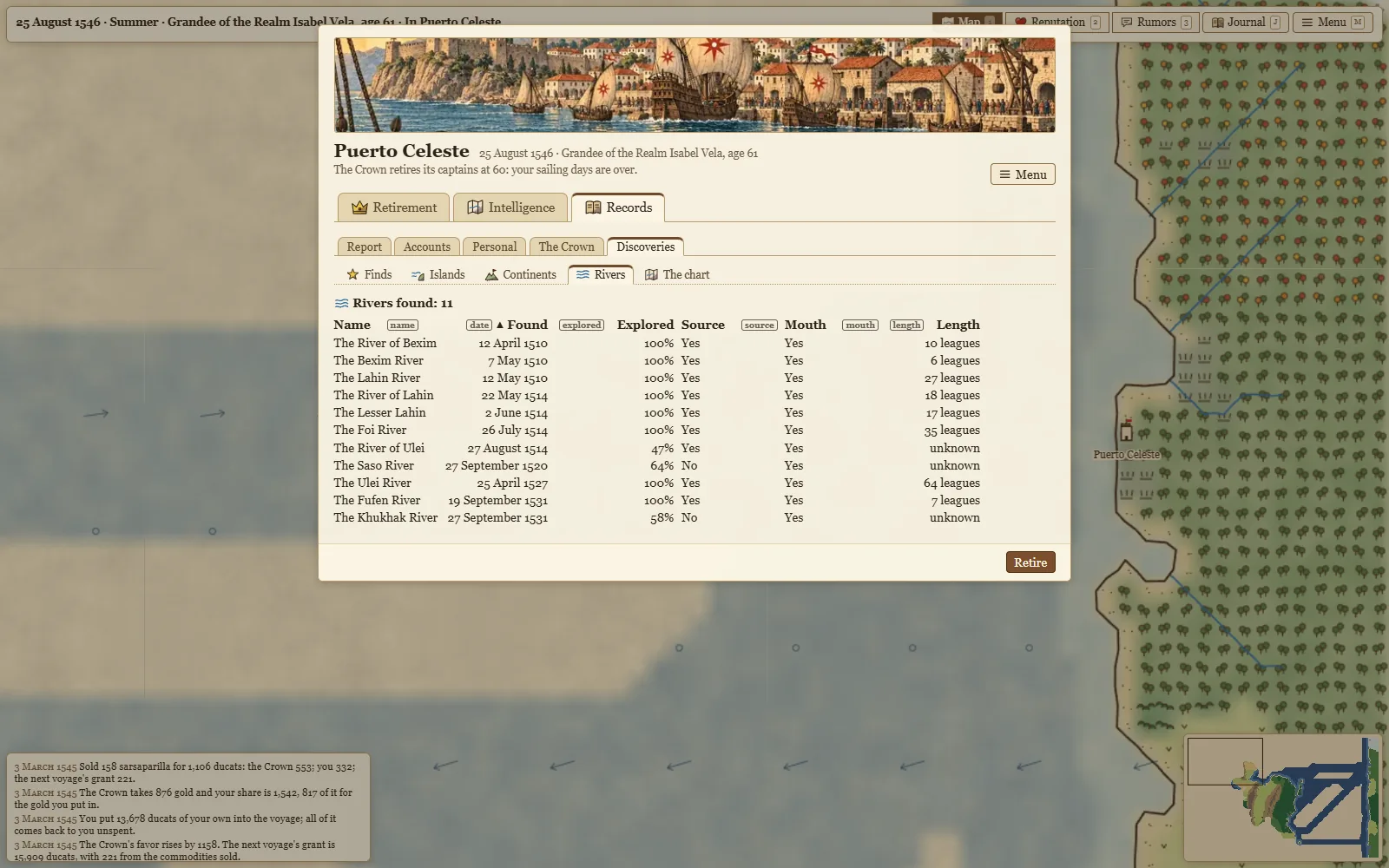
- Finding its mouth and tracing it to its source (any headwater well upstream) both count.
- Anything in sight counts, even a river first seen from the ships or charted on an earlier voyage.
- Point at a river for what is left to find.
Cities of gold
Seven cities of gold stand in the lands of the richest peoples, always far inland, many days’ march from the nearest beach. Rumors point the way. A city of gold is worth 1,000 favor when first seen, pays ten times the usual price for trade goods, and is the hardest place of all to take by force.
Islands and continents
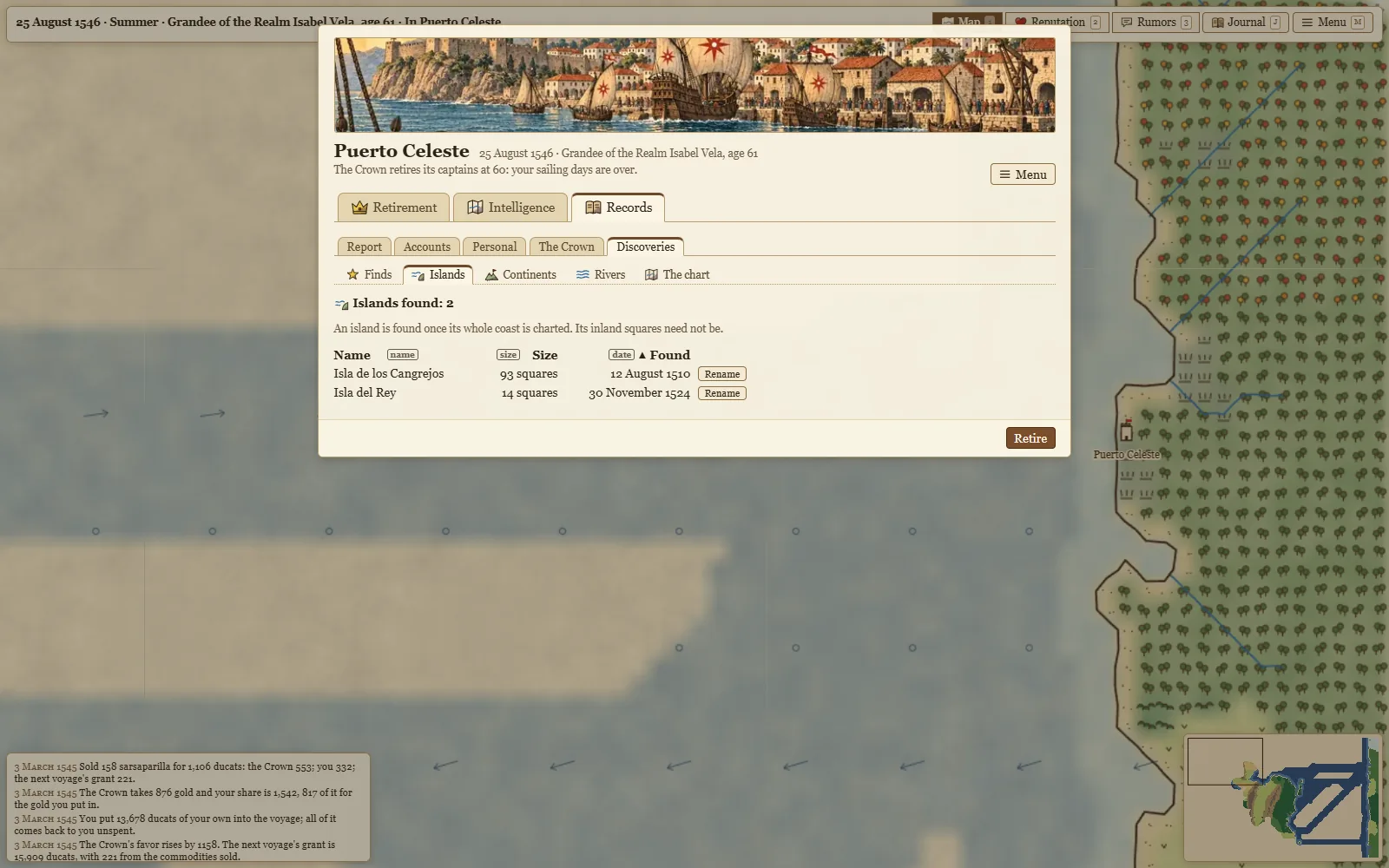
- An island is found when its whole coast has been charted.
- Land whose coast runs on longer than any island’s is a continent. Larger worlds may hold two, besides the New World itself.
- Each is worth favor, and you are asked to name it: take the name chosen for you, type your own, or never be asked again (Settings turns asking back on). Rename them in Records.
The continent prize
Chart a continent’s whole coast, the New World’s included, and at the next homecoming the Crown rewards you with ducats for your own purse, a gift and favor. The longer the coast, the bigger the prize: 1,500 ducats, a gift worth 1,000 and 600 favor, plus more for every square of coast.
Your discoveries on record
In port, Records, Discoveries has these tabs:
- Finds: what your career has found, voyage by voyage: land and coast charted, rivers, mouths and sources, wonders, peoples, settlements and cities of gold. A table splits the settlements by kind, from camps to cities of gold, with those not yet visited.
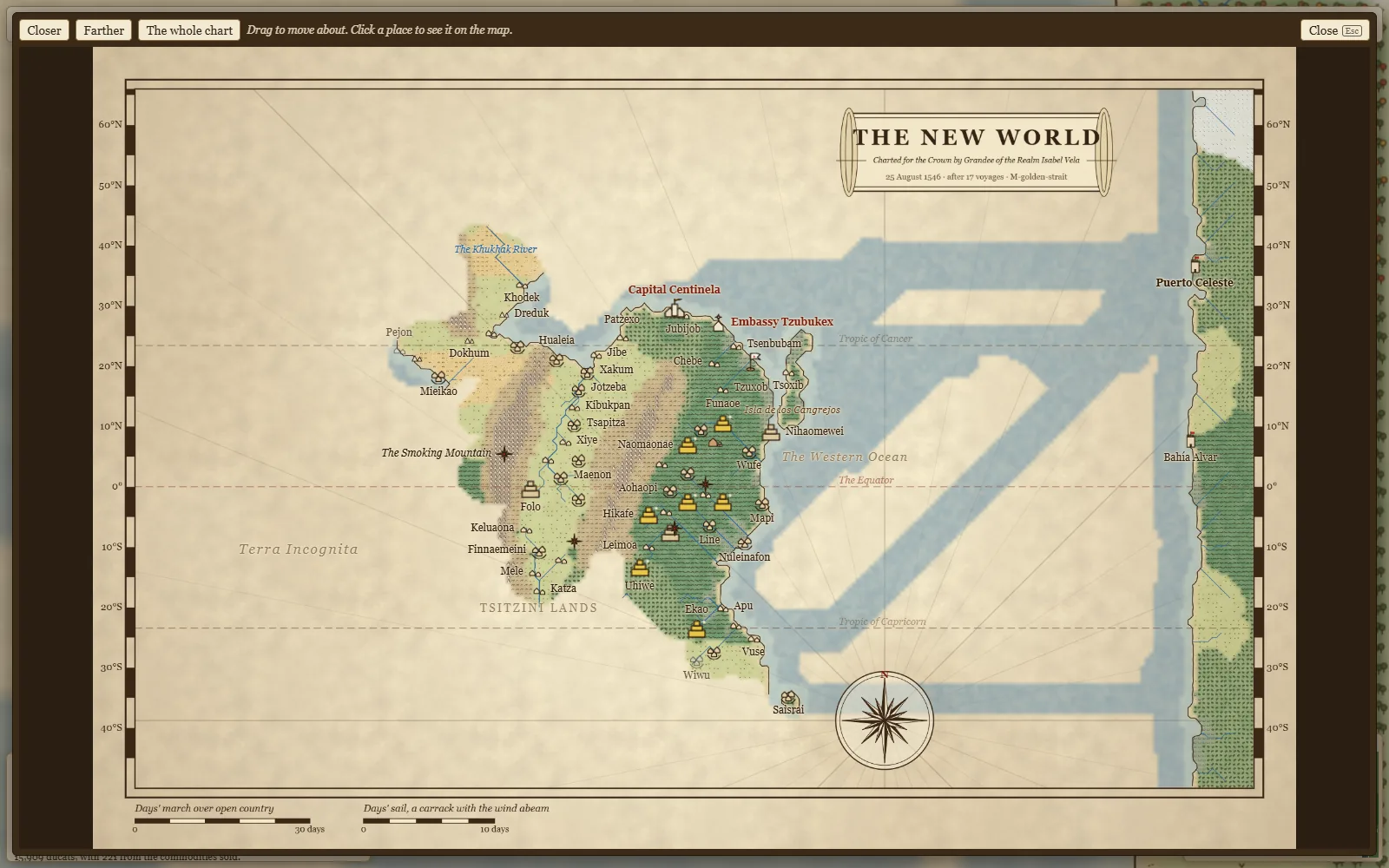
- The chart: the Crown’s parchment chart of what your voyages have drawn, with the names you know and a legend. Enlarge the chart shows it across the whole window: zoom with the wheel, a double click, or + and −; drag to move about; Esc closes it. Click a place to see it on the map.
- Islands, Continents and Rivers: each in a table you can sort by any column. Continents show the coast left to chart; rivers show when they were found, how much is explored, source and mouth, and length once fully explored.
Events and tales
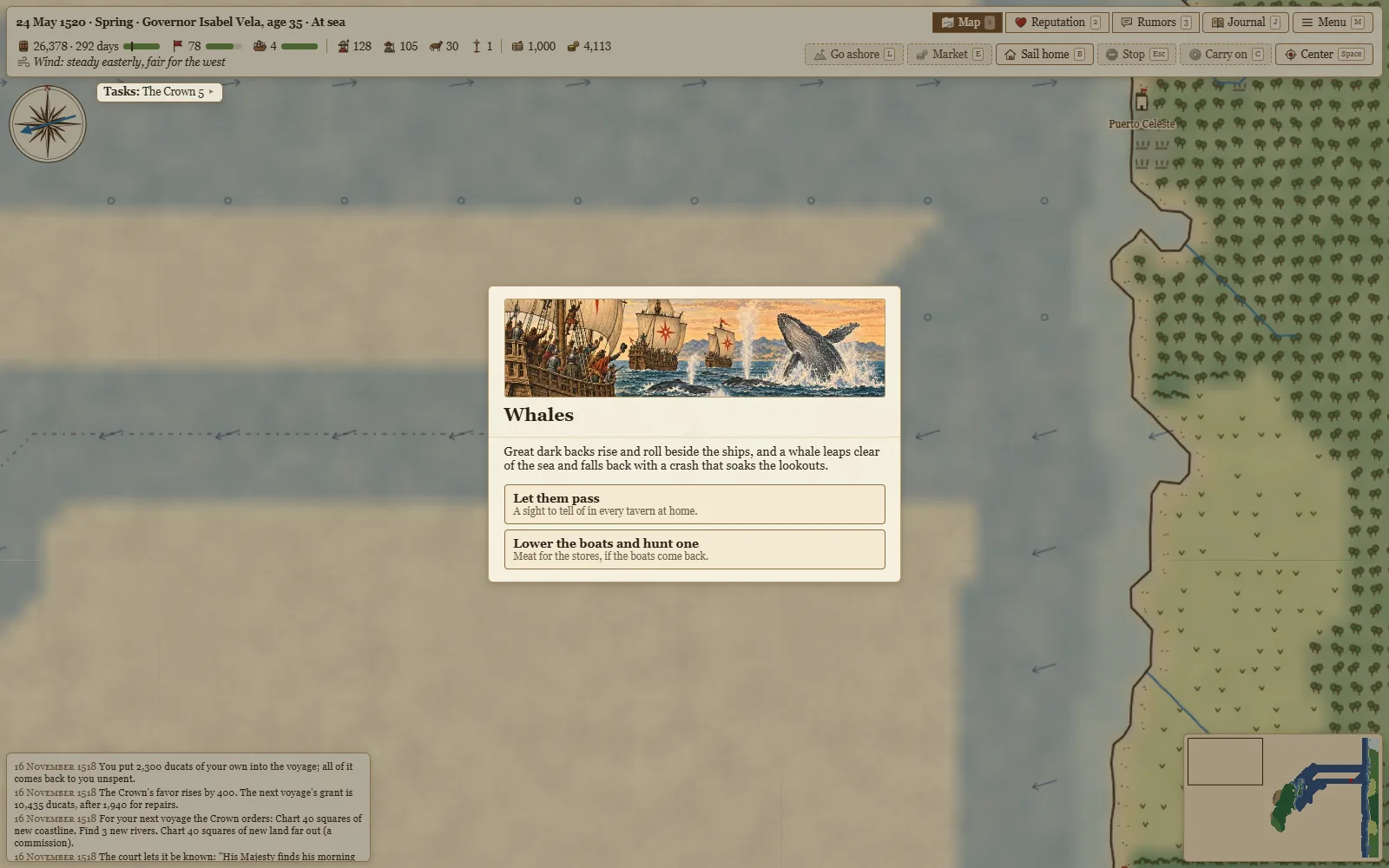
Every event and tale has its own engraving. When you answer one, what came of it shows on the same card. Routine news shows briefly at the foot of the screen and goes into the journal.
Dangers
- At sea: storms, storms on a lee shore, a restless crew, mutiny, and starving with horses aboard.
- Ashore: river crossings (build rafts, slow but safe, or ford it now), fever, ambushes, mutiny, and the cold.
Tales at sea
Becalmed in the doldrums, whales, a derelict, a man in the water, signs of land, the navigator’s fire, a waterspout, and a shoal of fish.
Tales ashore
- Ruins, an abandoned cache and high ground need no answer: they show on a banner over the map and the company walks on.
- The sun darkens, an earthquake, a festival, snakebite, wild fruit and an idol each bring a choice or news.
Stories over voyages
Some tales go on in a later voyage: a deserter who comes back as a guide, a lost expedition’s camp and its last survivor, a sick town that remembers who stayed, an envoy who sails home with you, and a feud you take a side in.
What a career has met grows rarer, and the common events are told in several ways, so the same words seldom come twice. No tales come while you are camped in one of your own settlements.
Coming home
Click Puerto Celeste or press B at sea to sail home. On arrival the voyage’s charts join the Crown’s, requests still open lapse without blame, and the homecoming runs in order:
- The voyage report, with its profit and loss.
- The cargo sold, when the ships bring commodities.
- An audience with the King or the Queen: the Crown’s verdict, your rank, grant and gift, and the next orders.
- Discoveries: what the voyage found.
The first homecoming of a career runs in full. From the second on it is brief unless you choose full (in Settings, or on the first screen of a homecoming): one screen, after the audience only when the Crown has news for you. The last homecoming always runs in full. You can skip to the outfitter at any step.
Each homecoming says how old you are now. A voyage is followed by about 18 months ashore. The port says how many voyages are left before the Crown retires you, and the outfitter warns you before the last one.
Your fortune and investing
Your share
- You keep 30% of the gold you bring home. The rest is the Crown’s.
- A trading post pays you a fifth of its takings every month.
- Of commodities sold at home you keep your cut (see Commodities).
- The Crown’s gifts add to your fortune, but they are not money to spend.
Your wealth is the money you can spend. Your fortune is your wealth plus the gifts. Grants grow with rank but level off near the cost of a full four-ship outfit, so beyond that your own money pays for more. Records, Personal shows your purse, gifts, fortune and the estate it would buy.
Investing in a voyage
You may put your own gold into the next voyage, up to the size of its grant, in Records, Personal, or in the outfitter.
- On the voyage, the Crown’s purse is spent first, then the gold the voyage finds, then your stake. What is left of it comes back to you.
- Your stake is your share of the voyage: what you put in, divided by the grant plus what you put in, at most a half. You receive that share of the Crown’s part of the gold brought home, besides your own 30%.
- For example, 3,000 ducats against a 6,000 grant is a third of the voyage, so you also take a third of the Crown’s part of the gold.
- If the voyage is lost, so is your stake.
Promises and costs
A promise to a restless crew costs a tenth of the gold. What you spend of your own money in the outfitter, the trading ports or your capital comes off your wealth.
Your estate
When the career ends, your fortune buys the finest estate it can pay for:
| Fortune | Estate |
|---|---|
| under 500 | a narrow house by the harbor |
| 500 | a farm in the hills, with an orchard and a mill |
| 1,500 | a manor with vineyards and olive groves |
| 4,000 | an estate with a village of its own |
| 10,000 | lands across three provinces, and a palace at court |
The career and retiring
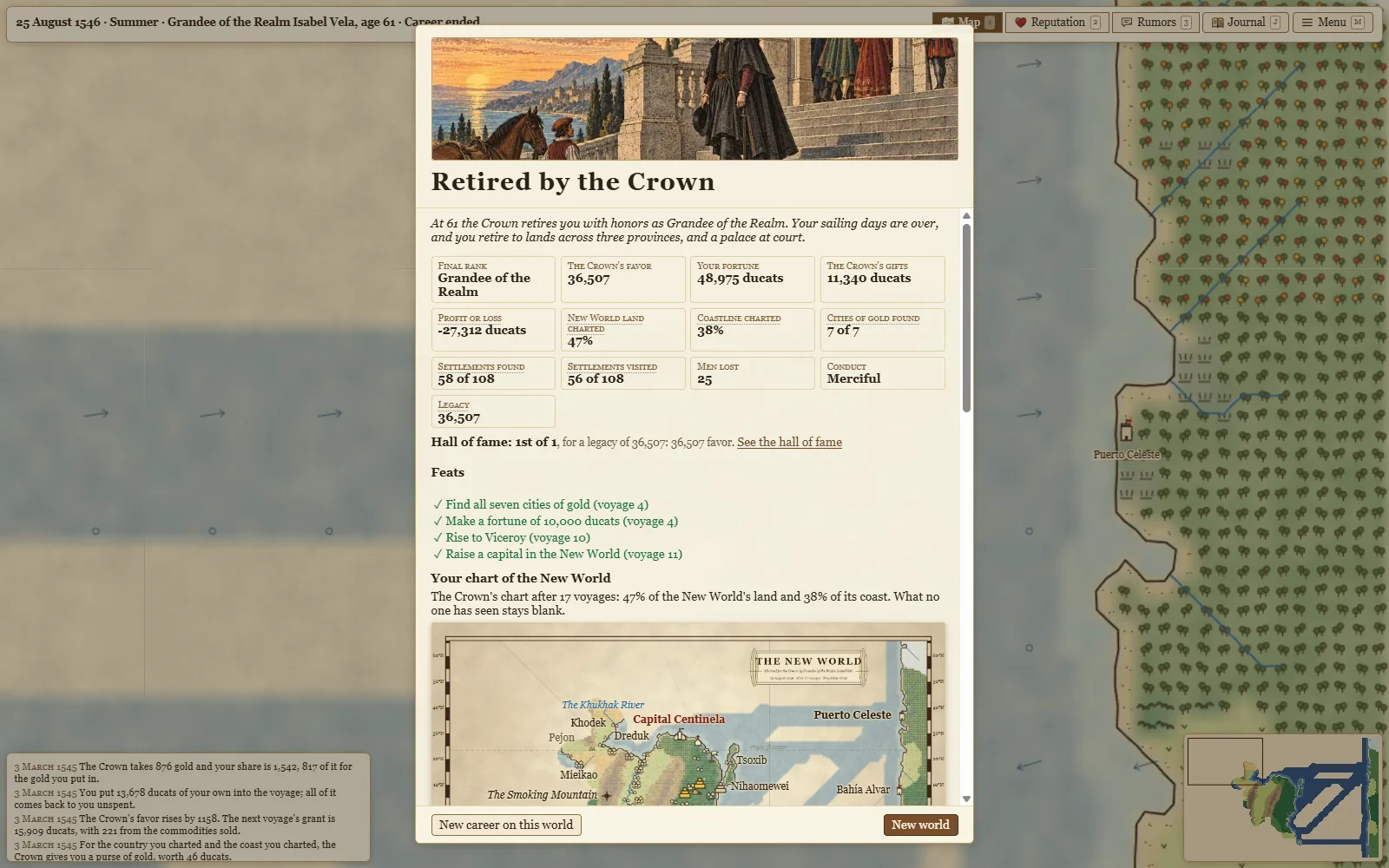
Every captain starts at 25, in the spring of 1510. Each voyage is followed by about 18 months ashore, so a long career runs to seventeen voyages or more.
How a career ends
- You retire. From the age of 45, choose Retire in Records, The Crown.
- The Crown retires you at 60. The last homecoming plays out, then you retire.
- You retire in glory. Fulfill every ambition you chose and you may retire in glory at any age, or sail on.
- You die: of fever, in battle, with a party wiped out, or with the fleet lost at sea.
The first voyages forgive. On Easy and Normal, during your first two voyages, what would have killed you becomes a narrow escape. A fever costs two weeks and morale. Struck down in battle, your men carry you from the field and will only march back to the ships. If the whole party is lost, you alone make it back. If the fleet is lost, a passing ship brings you home without your ships or cargo, but with the voyage’s charts and journal. On the first voyage no ship goes down. On Hard, death can come from the first voyage.
Ambitions
A new career may set out with up to two ambitions. Each says how to fulfill it and how hard it is, and each is also a feat the chronicle records whenever you achieve it.
| Ambition | How hard | How |
|---|---|---|
| Find all seven cities of gold | Hard | Follow the rumors of gold inland. A city counts once you have seen it and come home. |
| Rise to Viceroy | Hard | Earn 25,000 favor in all. |
| Raise a capital in the New World | Hard | Found a fort, then lodge a governor there once 25 people, 10 of them settlers, live in it. |
| Chart 50% of the New World’s land | Very hard | March inland on every voyage, for the ships chart little beyond the shore. |
| Make a fortune of 10,000 ducats | Fair | Your share of the gold and of trade adds up, and so do the Crown’s gifts. |
| Find 5 natural wonders | Very hard | Most lie far inland, and rumors point the way. |
The end screen
The end screen sums up the career voyage by voyage, with your ambitions, feats and estate, the chart of what you found, and your place in the hall of fame. A career that has ended is over: every save of it shows the ending, Continue moves on to your latest unfinished career, and an older copy of the ended career will not load. Start a new career to sail again.
The hall of fame and legacy
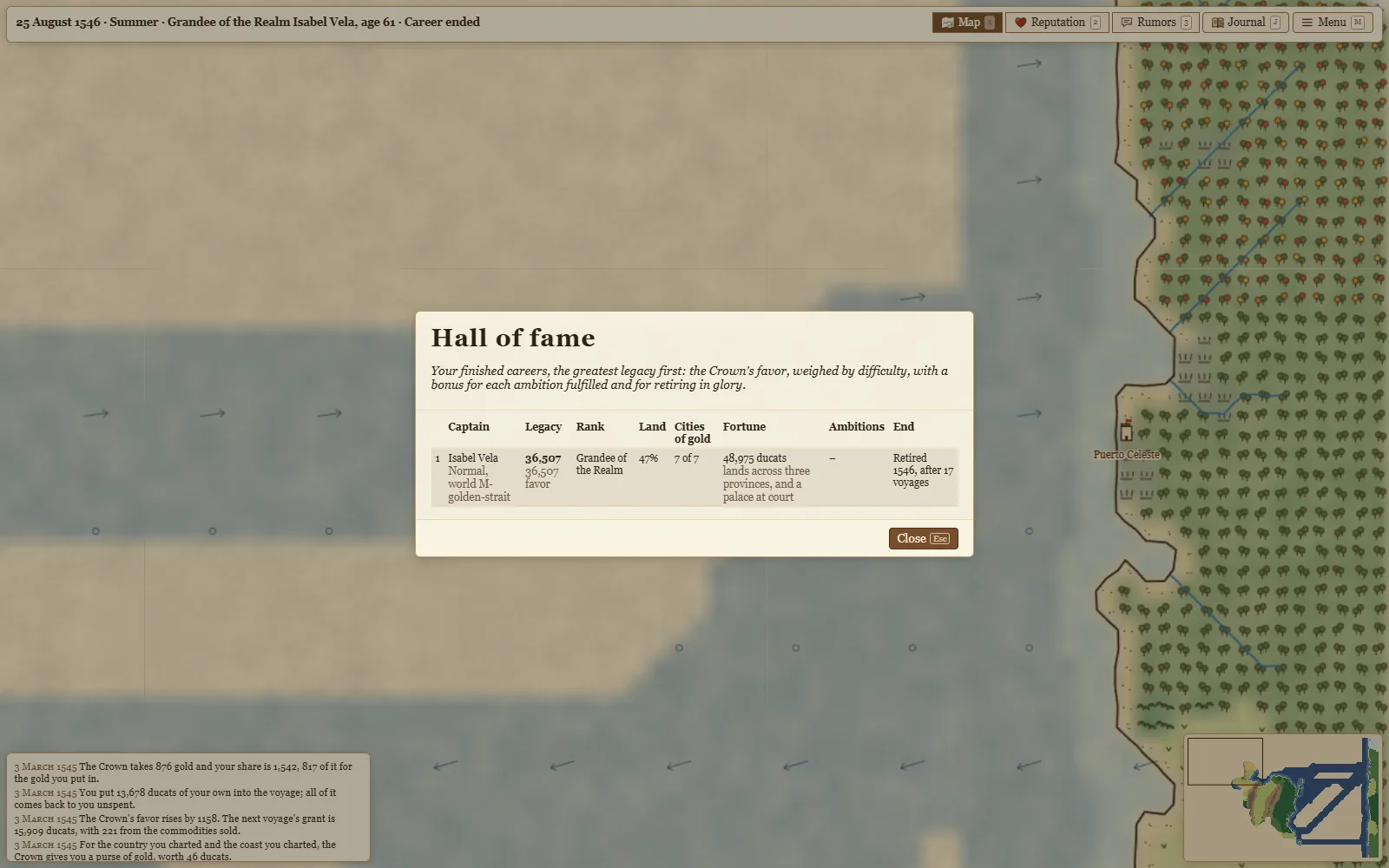
The hall of fame keeps your finished careers, the greatest legacy first. Open it from the title screen or from a career’s end screen.
A career’s legacy is its favor (never below zero), weighed by difficulty (Easy 0.8, Normal 1, Hard 1.25), plus 2,500 for each ambition fulfilled and 6,000 for retiring in glory.
Difficulty and captains
Difficulty
| Easy | Normal | Hard | |
|---|---|---|---|
| The Crown’s grants | a quarter more | as they are | a tenth less |
| Food eaten | 15% less | as it is | 15% more |
| Storms | much rarer | as they are | a little more often |
| Fever | much rarer | as it is | as on Normal |
| The peoples start | warmer | as they are | a little cooler |
| Food a bale fetches from a neutral people | 8 | 6 | 4 |
| Trading ports | Bahía Alvar and Cabo Sereno | Bahía Alvar | none |
| Puerto Celeste’s stock | more | as it is | less |
| Food warnings | two early and a last | one early and a last | the last only |
| The first voyages forgive | yes | yes | no |
| A snowy shore cures scurvy | always | one time in three | rarely |
| Your cut of commodity sales, after the Crown’s half | 40% | 60% | 80% |
| Men refuse hostile acts | half as often | as they do | half again as often |
| The Crown expects of a voyage | as on Normal | as it is | half again as much |
| The Crown’s fancy | a courtier names it | a riddle | a riddle |
| Walk-through offered at the start | yes | no (turn it on in Settings) | no (turn it on in Settings) |
| Legacy weight | 0.8 | 1 | 1.25 |
Captains
All eight captains start at 25. Each brings a strength and a weakness, shown as you choose and on the Crown’s record.
| Captain | Strength | Weakness |
|---|---|---|
| A veteran commander | Parties fight a quarter better | Peoples start a little warier of you |
| A young noble | The Crown’s grants are a fifth larger | The Crown expects a little more of each voyage |
| A master navigator | Ships sail a tenth faster, and storms do a quarter less damage | Marches ashore are a tenth slower |
| A soldier of fortune | Trade goods fetch half again as much gold | Cruelty costs half again as much favor |
| A professor of cosmography | Sees a league farther ashore | Parties fight a fifth worse |
| A hard-bitten privateer | Peoples pay tribute more readily, and plunder brings half again as much | Peoples start warier of you |
| A daring captain | Crews sail in higher spirits, and marches are a tenth quicker | Fever strikes more often |
| A bold explorer | Food goes a tenth further | The Crown’s grants are a tenth smaller |
See the portraits on the Terra Incognita page.
Settings
Open Settings from the title screen or the game menu (M). Every setting takes effect at once and is kept by the game itself, apart from any save.
- Display: the size of text and panels, from 75% to 150%; and Reduce motion, which makes your ships and party jump from place to place instead of gliding, the map jump after them, and nothing pulse. It is on at first when Windows asks for reduced motion.
- The map: one of the six map styles.
- Voyages: what stops you (every sighting, important sightings, or danger only); how coming home runs (full the first time then brief, always full, or always brief); Ask me to name islands and continents; Guide me through a first voyage (the plan in the tasks card); and, in a game, Walk-through for this career.
- Sound: volume, ambient sound and mute. Every sound is made by the game as it plays: a ship’s bell coming home, surf, storms, war drums, coins, a chime when you sight land and a grander one for a city of gold, a fanfare when you found or raise a settlement, a warning horn when danger stops you, and trumpets, a herald’s call or a slow drum at court, as the Crown’s verdict goes. Ambient sound is the quiet sound under play, as a share of the volume: the sea and the wind aboard, birds, insects, frogs or wind ashore by the land, a campfire when the party stands still, and the harbor at home. At 0% it is off.
- Keys: click an action and press a new key. Reset keys restores the defaults.
Saves and export
- The game autosaves when you set sail, land, go back aboard and come home, every 10 days of play, and when you switch away from it or close it. The game menu says when it last saved.
- The game menu (M) has three more save slots. Saving over a used slot asks first.
- Export to a file saves a game as a file, to keep it safe or to play it on another computer. Import a file loads one.
- Save and quit saves to the autosave slot and goes back to the title screen.
- If something goes wrong in the game, it stops your company, says so, and stops autosaving, so the last autosave stays safe.
The world code
The game menu shows the world code, for example M-golden-strait: the size and the seed. Anyone who starts a new career with that seed and size plays the same world.
The desktop app
- Terra Incognita installs for the current Windows user, with no administrator needed, in the folder you choose, with Start menu and desktop shortcuts.
- F11 switches full screen on and off. The window remembers its size.
- Quit on the title screen closes the game.
- The game needs no internet connection and sends nothing. Your careers, saves and settings stay on your computer, in the game’s own storage for your Windows account.
- To keep a career safe, or to move it to another computer, export it from the game menu and import it there.
- The beta does not update itself. To update, download the newer installer from the Terra Incognita page and run it. Export your careers first if you want to be safe.
- To remove the game, open Windows Settings, Apps, and uninstall Terra Incognita.
Help
Questions, ideas and problem reports are welcome at info@xn3tech.com. Please include the version from the title screen.
Tips
- On a first voyage, take the suggested outfit, make for the trade winds, land early, meet a people, and come home with food to spare.
- Watch the mark on the food bar. Food short of it will not get you home.
- Out on the trade winds, home on the westerlies. A course against the wind can take twice as long.
- Avoid the storm seasons, and land where the season is warm. A month’s wait in port can save a voyage.
- Give a few bales as gifts before you trade. Friends pay more, guide you, feed you and tell you rumors.
- Sell goods where you have not sold before. A place you emptied takes a long time to fill again.
- Collect rumors: each one of the same place tightens its circle on the rumor overlay.
- Rest through a fever. Pressing on kills more men, and may kill you.
- Horses make marches twice as fast with one for everyone; bearers carry for you and eat nothing.
- Found settlements on grassland or coast, beside a river, so that a few settlers feed many soldiers.
- Keep soldiers in settlements near hostile peoples.
- Carry a commodity a place seeks: it pays three times as much.
- Solve the Crown’s riddle: its fancy earns six times the favor.
- From Captain-General on, every voyage must earn favor. Plan each one with the orders and the commission in mind.
- Keep the men’s spirits above 40 if you mean to use force.
- Choose ambitions you can plan for, and retire in glory when they are done.
Glossary
- Adelantado
- The fourth rank, after Captain-General.
- Ambition
- A goal you may choose for a career. Fulfill every one you chose to retire in glory.
- Attitude
- How a place feels about you, from −100 (hostile) to 100 (devoted).
- Bale
- A unit of trade goods, and the room a unit of most commodities takes.
- Bearers
- Porters hired from the peoples. Each carries a man’s load and eats nothing.
- Berth
- A place for one man aboard. A horse takes two.
- Capital
- A fort or embassy raised by a governor: your home in the New World, with a market, quays and a shipyard.
- City of gold
- One of the seven rich cities deep inland.
- Commission
- From Captain-General, the Crown’s standing request to chart new land far out.
- Commodity
- One of the New World’s 33 goods, sold at home: staples, prizes and treasures.
- Conduct
- The Crown’s record of how you treat the peoples: Merciful, Fair, Stern or Brutal.
- Continent
- A landmass whose coast runs on longer than any island’s.
- The Crown’s fancy
- The commodity the court longs for this voyage, told in a riddle. It earns six times the favor.
- The Crown’s purse
- The part of the grant you did not spend in port. It sails with you and is spent first.
- Ducat
- The kingdom’s money.
- Embassy
- A settlement of the Wayfinding in a people’s town, opened by an emissary.
- Emissary
- A specialist who opens an embassy.
- Favor
- The Crown’s regard, won voyage by voyage. Your total sets your rank.
- Feat
- An ambition achieved, recorded in the chronicle whether or not you chose it.
- Foraging
- Living partly off the land as you march: slower, but the food goes further.
- Fortune
- Your wealth plus the Crown’s gifts. It buys your estate when the career ends.
- Grant
- The Crown’s money for outfitting a voyage.
- League
- One square of the map, as a distance.
- Legacy
- What the hall of fame ranks careers by.
- Load-out
- A ready outfit for a voyage’s purpose: sea, land, settlement, war or trade.
- Morale
- The men’s spirits, from 0 to 100.
- The navigator’s star
- The red eight-pointed star, sign of the Wayfinding and emblem of the Crown.
- Orders
- Up to two tasks the Crown sets a voyage, each worth favor.
- Puerto Celeste
- The kingdom’s capital and your home port.
- Ration
- A day’s food for one soldier ashore.
- Rumor
- News of a place you have not seen, shown as a circle on the rumor overlay.
- Settlers
- Men who eat half a ration, fight at half strength, and farm the settlements you found.
- Square
- One cell of the map, for charting land and coast.
- Stake
- Your own gold invested in a voyage, and the share of the gold it earns you.
- Summons
- The Crown’s call home after two years away.
- Trading port
- A city of the kingdom on the home coast where you can buy supplies and repair ships.
- Trading post
- Your settlement that trades with the peoples around it.
- The Wayfinding
- The kingdom’s philosophy: peaceful coexistence with all beings.
- World code
- A world’s size and seed, such as M-golden-strait. The same code makes the same world.
This manual describes Terra Incognita 0.53.0 beta. Terra Incognita is a game by XN3 Technologies.